 Known to be toxic - Toxic to cats and dogs if ingested.
Plant Names

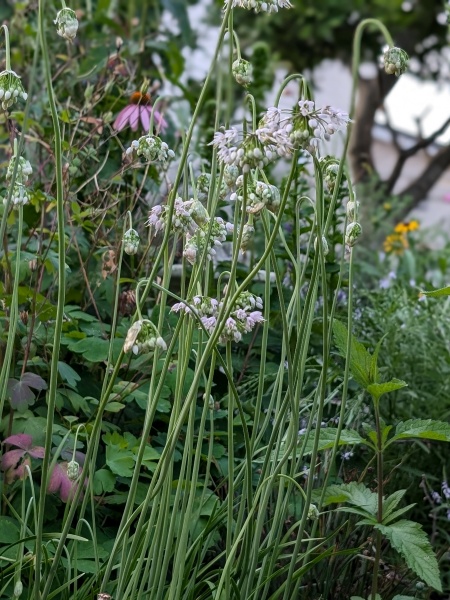
Allium cernuum
Nodding Onion
Ail penché
Synonyms
nodding wild onion
Plant Characteristics
Bloom Colour: Purple
Bloom Period: Jun - Aug
Max Height: 1.5 feet
Max Width: 0.6 feet
Light Condition:
 More than 6 hours of direct sun a day
 More than 2 or 3 hours but less than 6 hours of direct sun a day
Soil conditions:
More than 2 or 3 hours but less than 6 hours of direct sun a day
Soil conditions:
 Tolerates dry soil condition
 Tolerates medium soil condition
More than 6 hours of direct sun a day
More than 2 or 3 hours but less than 6 hours of direct sun a day
Tolerates dry soil condition
Tolerates medium soil condition
Lifespan:
Perennial
plants that will come back year after year
Gardener Experience:
 Suitable for beginner gardeners
 Does not spread uncontrollably
 Easy to germinate
 Self-seeding
Suitable for beginner gardeners
Does not spread uncontrollably
Easy to germinate
Self-seeding
Landscape Uses:
 Suitable for Right of Way gardens
 Suitable for rain gardens
 Suitable for container garden
 Suitable for school gardens
 Tolerates boulevard garden conditions
Suitable for Right of Way gardens
Suitable for rain gardens
Suitable for container garden
Suitable for school gardens
Tolerates boulevard garden conditions
Ecological Benefits:
 Supports hummingbirds
 Butterfly host
Supports hummingbirds
Butterfly host
Tolerates:
 Tolerates drought conditions
 Tolerates salt conditions
 Deer resistant
 Rabbit resistant
 Tolerates limestone conditions
 Tolerates juglone conditions
 Tolerates transplantation
Tolerates drought conditions
Tolerates salt conditions
Deer resistant
Rabbit resistant
Tolerates limestone conditions
Tolerates juglone conditions
Tolerates transplantation
Special Features and Considerations:
 This plant is endangered
This plant is endangered
Seed and plant distribution status
No seeds available for this plant.
We currently accept seeds for this plant
Fun Facts
Nodding Onion is a lovely plant that does well at the front of the garden in larger groupings. The grass-like leaves come up first in the spring followed by the flowers in early summer, which are loosely nodding, bell-shaped flowers. The flowers are popular with the bees. The plant produces a strong, onion-like odour when the leaves are crushed or mowed.
Plant Location
Distribution according to VASCAN
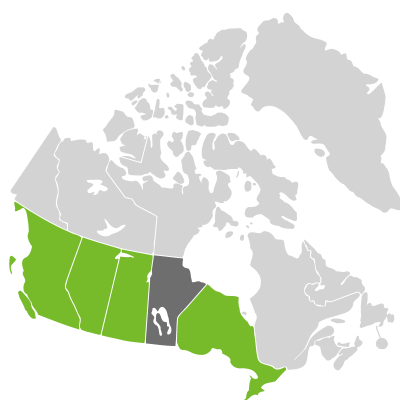
Ephemeral
Native
Introduced
Excluded
Extirpated
Doubtful
Absent
 Canadensis

Thrives in Ecozones
- Montane Cordillera
- Pacific Maritime
- Mixed Wood Plains
Ecological Benefits
Butterflies Supported by Allium cernuum
-
Euxoa messoria
Reaper dart -
Euxoa tessellata
Tessellate dart -
Melanchra picta
Zebra caterpillar
Specialized Bees Supported by Allium cernuum
No bee data available for this plant.
Complementary Plants
- Coreopsis lanceolata
Lance-leaved Coreopsis
Coréopsis lancéolé - Erigeron strigosus
Rough Fleabane
Vergerette rude - Linum lewisii
Lewis' Wild Blue Flax
Lin de Lewis - Monarda didyma
Scarlet Beebalm
Monarde écarlate - Verbena stricta
Hoary Vervain
Verveine veloutée
Substitute For Non-Native Plants
- Alliums (Non-Native Alliums)
Sowing Information
Download Seed Envelope Labels (PDF)
- Sowing depth: Sow just below surface
- Sow by February
- Stratification duration: 60 days
- Self-seeding
Harvesting and Seed Sharing
- Harvest start month: September
- Harvesting indicator:
- Pods are slightly open and seeds inside are dark
- Harvesting:
- Use hand to detach from main stem
- Seed viability test:
- No test needed before donating
- Packaging measure: 1 rounded 1/32 teaspoon
- Seed storage:
- Air dry in paper bag or open container, for a few days until crisp
- Shake seeds to move them once in a while to prevent molding
- Cultivar: Yes, do not donate unless you know source, and there are no known cultivars in your garden or at proximity
- Harvesting video: Watch here
Toxicity Notes
Toxic to cats and dogs if ingested.