 Known to be toxic - Toxic to mammals if ingested.
Plant Names

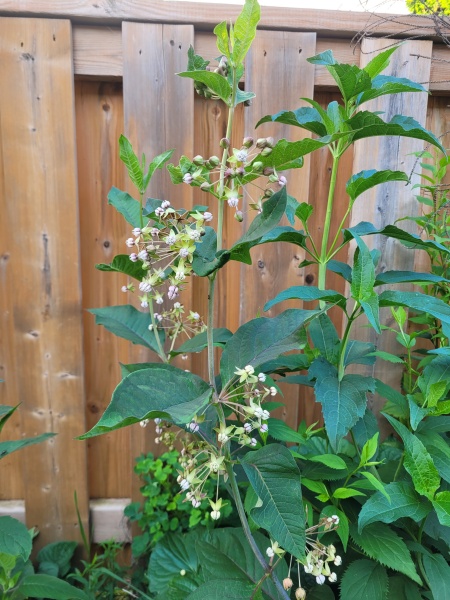
Asclepias exaltata
Poke Milkweed
Asclépiade très grande
Synonyms
tall milkweed
grande asclépiade
Plant Characteristics
Bloom Colour: White
Bloom Period: Jun - Jul
Max Height: 5.0 feet
Max Width: 3.0 feet (spreads by rhizome)
Light Condition:
 Less than 2 or 3 hours of direct sun a day
Soil conditions:
Less than 2 or 3 hours of direct sun a day
Soil conditions:
 Tolerates medium soil condition
Less than 2 or 3 hours of direct sun a day
Tolerates medium soil condition
Lifespan:
Perennial
plants that will come back year after year
Gardener Experience:
 Does not spread uncontrollably
 Spreads by rhizome
Does not spread uncontrollably
Spreads by rhizome
Landscape Uses:
 Suitable for container garden
 Suitable for woodland gardens
 Tolerates boulevard garden conditions
Suitable for container garden
Suitable for woodland gardens
Tolerates boulevard garden conditions
Ecological Benefits:
 Supports pollinators
 Butterfly host
Supports pollinators
Butterfly host
Tolerates:
 Deer resistant
 Rabbit resistant
 Tolerates limestone conditions
 Tolerates transplantation
Deer resistant
Rabbit resistant
Tolerates limestone conditions
Tolerates transplantation
Special Features and Considerations:
Seed and plant distribution status
No seeds available for this plant.
We currently accept seeds for this plant
Fun Facts
Asclepias exaltata, commonly called poke milkweed, is a native perennial found in open woodlands and forest edges across eastern North America, making it a good choice for lightly shaded gardens. It produces drooping clusters of soft pink to white flowers in early to mid-summer. By late summer, slender seed pods form, releasing silky-tufted seeds that disperse by wind.
Plant Location
Distribution according to VASCAN
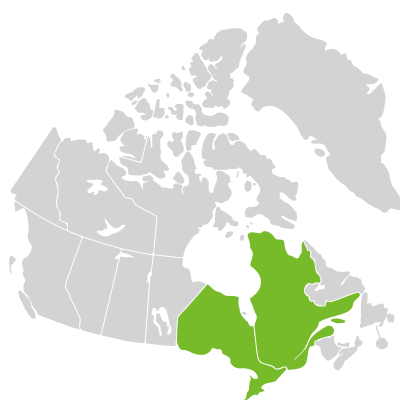
Ephemeral
Native
Introduced
Excluded
Extirpated
Doubtful
Absent
 Canadensis

Thrives in Ecozones
- Boreal Shield
- Mixed Wood Plains
Ecological Benefits
Butterflies Supported by Asclepias exaltata
-
Danaus plexippus
Monarch - Monarque -
Trichordestra legitima
Striped Garden Caterpillar
Specialized Bees Supported by Asclepias exaltata
No bee data available for this plant.
Complementary Plants
- No complementary plants found.
Substitute For Non-Native Plants
- Hydrangea (Hydrangea)
- Asclepias (Milkweed Cultivars)
- Asclepias curassavica (Tropical Milkweed)
Sowing Information
Download Seed Envelope Labels (PDF)
- Sowing depth: Sow just below surface
- Sow by March
- Stratification duration: 30 days
Harvesting and Seed Sharing
- Harvest start month: September
- Harvesting indicator:
- Pods are slightly open and seeds inside are dark
- Harvesting:
- Use hand to detach from main stem
- Seed viability test:
- No test needed before donating
- Packaging measure: 1 rounded 1/8 teaspoon
- Seed storage:
- Air dry in paper bag or open container, for a few days until crisp
- Shake seeds to move them once in a while to prevent molding
- Cultivar: No, you can donate without knowing the source as there are only straight species
- Remove non-seed material
- Harvesting video: Watch here
Toxicity Notes
Toxic to mammals if ingested.