Plant Names

Carex lurida
Sallow Sedge
Carex luisant
Synonyms
bottlebrush sedge
shallow sedge
Plant Characteristics
Bloom Colour: Green
Bloom Period: May - Aug
Max Height: 3.0 feet
Max Width: 2.0 feet (spreads by rhizome)
Light Condition:
 More than 6 hours of direct sun a day
 More than 2 or 3 hours but less than 6 hours of direct sun a day
Soil conditions:
More than 2 or 3 hours but less than 6 hours of direct sun a day
Soil conditions:
 Tolerates wet soil condition
More than 6 hours of direct sun a day
More than 2 or 3 hours but less than 6 hours of direct sun a day
Tolerates wet soil condition
Lifespan:
Perennial
plants that will come back year after year
Gardener Experience:
 Spreads by rhizome
 Easy to germinate
 Self-seeding
Spreads by rhizome
Easy to germinate
Self-seeding
Landscape Uses:
 Suitable for wetland garden
 Suitable for shoreline rehabilitation
Suitable for wetland garden
Suitable for shoreline rehabilitation
Ecological Benefits:
 Butterfly host
Butterfly host
Tolerates:
 Deer resistant
 Rabbit resistant
 Tolerates juglone conditions
 Tolerates transplantation
Deer resistant
Rabbit resistant
Tolerates juglone conditions
Tolerates transplantation
Special Features and Considerations:
 This plant is a GRASP candidate
This plant is a GRASP candidate
Seed and plant distribution status
No seeds available for this plant.
We currently accept seeds for this plant
Fun Facts
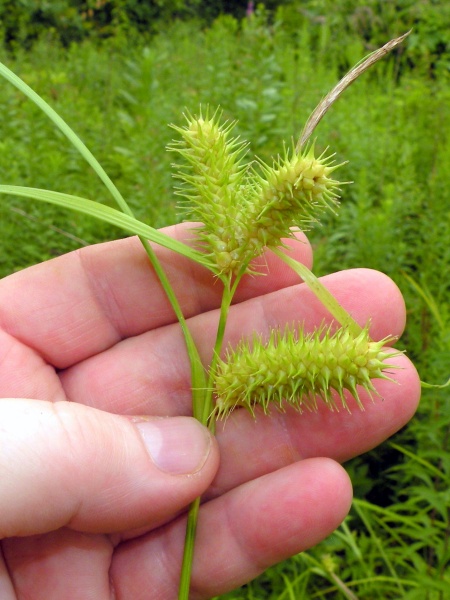
Sallow Sedge grows best in gardens next to water features such as ponds or streams, or in wetland areas, wet meadows and ditches. Its Latin name refers to the “lurid” lime green of its seedhead, whose shape is responsible for another of its names, bottlebrush sedge; sallow also means yellowish. Wetland sedge seeds also feed many waterfowl and songbirds. It is used by many insects including the striped sedge grasshopper, Otto’s sedge grasshopper, and other insects which in turn feed birds and mammals.
Plant Location
Native to Ottawa region: Yes
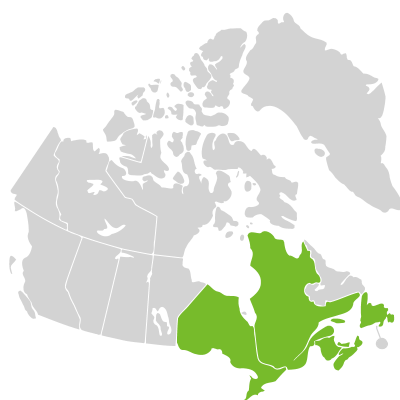
Distribution according to VASCAN
Ephemeral
Native
Introduced
Excluded
Extirpated
Doubtful
Absent
 Canadensis

Thrives in Ecozones
- Atlantic Maritime
- Boreal Shield
- Mixed Wood Plains
Ecological Benefits
Butterflies Supported by Carex lurida
No butterfly data available for this plant.
Specialized Bees Supported by Carex lurida
No bee data available for this plant.
Complementary Plants
- No complementary plants found.
Substitute For Non-Native Plants
- Pennisetum setaceum (Fountain Grass)
Sowing Information
Download Seed Envelope Labels (PDF)
- Sowing depth: Sow just below surface
- Sow by February
- Stratification duration: 60 days
- Self-seeding
Harvesting and Seed Sharing
- Harvest start month: July
- Harvesting indicator:
- Seeds easily fall off when you gently pull them off
- Harvesting:
- Use hand to detach from main stem
- Seed viability test:
- No test needed before donating
- Packaging measure: A dozen (12) seeds (eyeball)
- Seed storage:
- Air dry in paper bag or open container, for a few days until crisp
- Shake seeds to move them once in a while to prevent molding
- Cultivar: Yes, do not donate unless you know source, and there are no known cultivars in your garden or at proximity
- No harvesting video available at this time.
Toxicity Notes
Inadequate information on toxicity found.
GRASP Candidate
Overlooked or difficult to grow plants (eg ghost plants, shrubs, trees, complicated germination etc); sapling sitters, seed sitters, skilled germination, growers with right conditions- aiming for local stock; these plants may not be extinct, but overlooked OR support habitat OR support a vulnerable animal/insect.