Plant Names

Cyperus strigosus
Straw-coloured Flatsedge
Souchet hispide
Synonyms
false flatsedge
false nutsedge
straw-coloured cyperus
straw-coloured umbrella sedge
Plant Characteristics
Bloom Colour: Green
Bloom Period: Jul - Jul
Max Height: 3.0 feet
Max Width: 2.0 feet (spreads by rhizome)
Light Condition:
 More than 6 hours of direct sun a day
 More than 2 or 3 hours but less than 6 hours of direct sun a day
Soil conditions:
More than 2 or 3 hours but less than 6 hours of direct sun a day
Soil conditions:
 Tolerates medium soil condition
 Tolerates wet soil condition
More than 6 hours of direct sun a day
More than 2 or 3 hours but less than 6 hours of direct sun a day
Tolerates medium soil condition
Tolerates wet soil condition
Lifespan:
Perennial
plants that will come back year after year
Gardener Experience:
 Spreads by rhizome
 Easy to germinate
 Self-seeding
Spreads by rhizome
Easy to germinate
Self-seeding
Landscape Uses:
 Suitable for wetland garden
 Suitable for rain gardens
Suitable for wetland garden
Suitable for rain gardens
Ecological Benefits:
No ecological benefits information available.
Tolerates:
 Tolerates transplantation
Tolerates transplantation
Special Features and Considerations:
 This plant causes skin rashes
This plant causes skin rashes
Seed and plant distribution status
No seeds available for this plant.
We currently accept seeds for this plant
Fun Facts
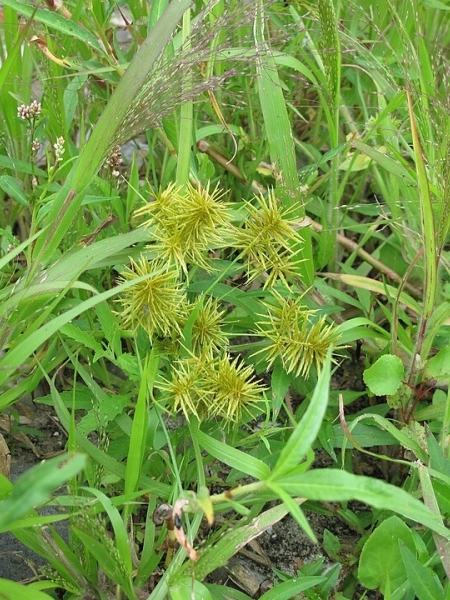
Straw-coloured Flatsedge has slender, upright stems and narrow green leaves. Its small flower clusters mature to a distinctive straw or golden-brown colour, giving the plant its common name. It flowers from summer into fall and naturally occurs in moist meadows, marsh edges, wet fields, shorelines, ditches, and other seasonally wet areas. It is a useful choice for wet meadows, pond edges, native borders and naturalized areas. Let it self-seed to get plants from year to year. It can be useful in areas where conventional lawn grasses perform poorly because of seasonal wetness.
Plant Location
Native to Ottawa region: Yes
Distribution according to VASCAN
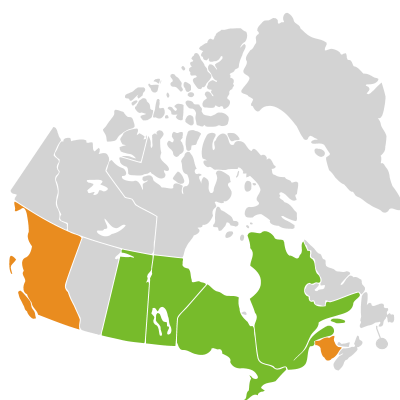
Ephemeral
Native
Introduced
Excluded
Extirpated
Doubtful
Absent
 Canadensis

Thrives in Ecozones
- Atlantic Maritime
- Boreal Shield
- Mixed Wood Plains
Ecological Benefits
Butterflies Supported by Cyperus strigosus
No butterfly data available for this plant.
Specialized Bees Supported by Cyperus strigosus
No bee data available for this plant.
Complementary Plants
- No complementary plants found.
Substitute For Non-Native Plants
- Pennisetum setaceum (Fountain Grass)
Sowing Information
Download Seed Envelope Labels (PDF)
- Sowing depth: Surface sow
- Sow by February
- Stratification duration: 60 days
- Self-seeding
Harvesting and Seed Sharing
- Harvest start month: August
- Harvesting indicator:
- Seeds easily fall off when you gently pull them off
- Harvesting:
- Use hand to detach from main stem
- Seed viability test:
- No test needed before donating
- Packaging measure: 1 rounded 1/4 teaspoon
- Seed storage:
- Air dry in paper bag or open container, for a few days until crisp
- Shake seeds to move them once in a while to prevent molding
- Cultivar: Yes, do not donate unless you know source, and there are no known cultivars in your garden or at proximity
- Harvesting notes: Please note that in 2025 and before, we partly distributed Perennial Yellow Flatsedge (Cyperus esculentus) instead of Straw-Coloured Flatsedge (Cyperus strigosus). Please check your plants before donating. Thanks!
- No harvesting video available at this time.
Toxicity Notes
Inadequate information on toxicity found.