Plant Names

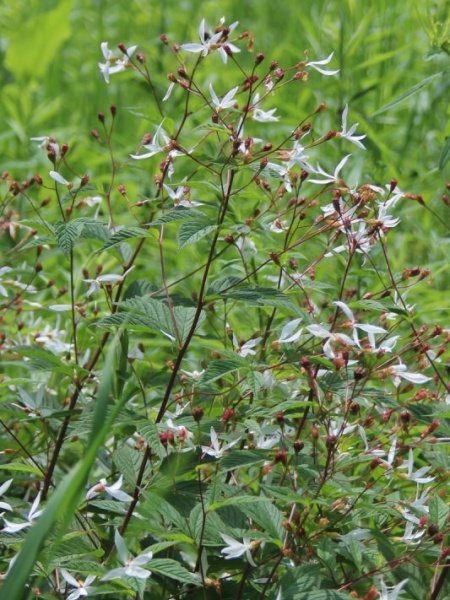
Gillenia trifoliata
Bowman's Root
Gillénie trifoliée
Plant Characteristics
Bloom Colour: White
Bloom Period: May - Jun
Max Height: 3.0 feet
Max Width: 3.0 feet (spreads by rhizome)
Light Condition:
 More than 6 hours of direct sun a day
 More than 2 or 3 hours but less than 6 hours of direct sun a day
Soil conditions:
More than 2 or 3 hours but less than 6 hours of direct sun a day
Soil conditions:
 Tolerates medium soil condition
More than 6 hours of direct sun a day
More than 2 or 3 hours but less than 6 hours of direct sun a day
Tolerates medium soil condition
Lifespan:
Perennial
plants that will come back year after year
Gardener Experience:
 Suitable for beginner gardeners
 Does not spread uncontrollably
 Spreads by rhizome
Suitable for beginner gardeners
Does not spread uncontrollably
Spreads by rhizome
Landscape Uses:
 Suitable for container garden
 Suitable for school gardens
Suitable for container garden
Suitable for school gardens
Ecological Benefits:
No ecological benefits information available.
Tolerates:
 Deer resistant
 Rabbit resistant
 Tolerates limestone conditions
 Tolerates acidic soil conditions
Deer resistant
Rabbit resistant
Tolerates limestone conditions
Tolerates acidic soil conditions
Special Features and Considerations:
 This plant is endangered
This plant is endangered
Seed and plant distribution status
No seeds available for this plant.
We currently accept seeds for this plant
Fun Facts
Bowman’s Root can grow in a variety of conditions, from sunny to shaded areas and in average garden soils. It is slow to establish and to spread, making it a good choice for smaller gardens. In the autumn the foliage turns a beautiful red, adding a pop of colour to the landscape.
Plant Location
Distribution according to VASCAN
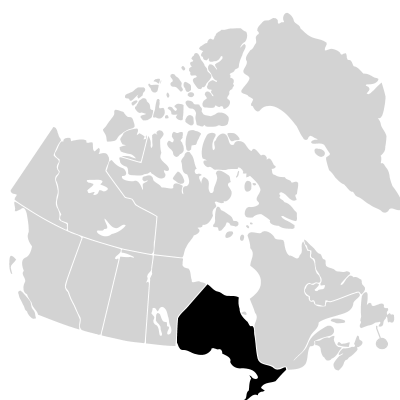
Ephemeral
Native
Introduced
Excluded
Extirpated
Doubtful
Absent
 Canadensis

Thrives in Ecozones
- Mixed Wood Plains
Ecological Benefits
Butterflies Supported by Gillenia trifoliata
No butterfly data available for this plant.
Specialized Bees Supported by Gillenia trifoliata
No bee data available for this plant.
Complementary Plants
- Allium schoenoprasum
Wild Chives
Ciboulette commune - Armeria maritima
Sea Thrift
Arméria maritime - Campanula rotundifolia
Bluebell Of Scotland
Campanule à feuilles rondes - Carex blanda
Woodland Sedge
Carex lisse - Penstemon gracilis
Slender Beardtongue
Penstémon grêle
Substitute For Non-Native Plants
- Buddleia (Butterfly Bush)
- Hydrangea (Hydrangea)
- Aegopodium podagraria (Goutweed)
- Astilbe (Astilbe)
Sowing Information
Download Seed Envelope Labels (PDF)
- Sowing depth: Sow just below surface
- Sow by February
- Stratification duration: 60 days
Harvesting and Seed Sharing
- Harvest start month: August
- Harvesting indicator:
- Pods are brown and crisp and starting to open
- Seeds are dark and tiny stem attaching to the main stem is brown
- Seeds easily fall off pod when shaken
- Little stem connecting the pod to the main stem is brown (not green)
- Harvesting:
- Cut stem (including pods), let air dry in paper bag, then shake seeds off after a few days
- Seed viability test:
- No test needed before donating
- Packaging measure: 1 rounded 1/8 teaspoon
- Seed storage:
- Air dry in paper bag or open container, for a few days until crisp
- Shake seeds to move them once in a while to prevent molding
- Cultivar: No, you can donate without knowing the source as there are only straight species
- No harvesting video available at this time.
Toxicity Notes
Not known to be toxic to mammals if ingested.