Source: OWSL
Plant Names

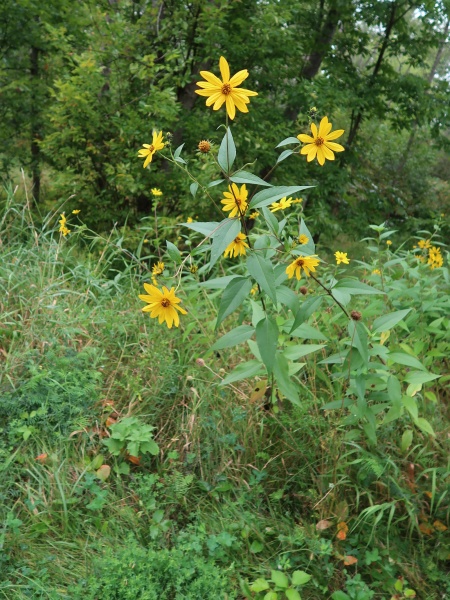
Helianthus tuberosus
Jerusalem Artichoke
Topinambour
Synonyms
hélianthe tubéreux
Plant Characteristics
Bloom Colour: Yellow
Bloom Period: Aug - Sep
Max Height: 6.0 feet
Max Width: 2.0 feet (spreads by rhizome)
Light Condition:
 More than 6 hours of direct sun a day
 More than 2 or 3 hours but less than 6 hours of direct sun a day
Soil conditions:
More than 2 or 3 hours but less than 6 hours of direct sun a day
Soil conditions:
 Tolerates dry soil condition
 Tolerates medium soil condition
More than 6 hours of direct sun a day
More than 2 or 3 hours but less than 6 hours of direct sun a day
Tolerates dry soil condition
Tolerates medium soil condition
Lifespan:
Perennial
plants that will come back year after year
Gardener Experience:
 Spreads by rhizome
 Self-seeding
Spreads by rhizome
Self-seeding
Landscape Uses:
 Suitable for container garden
Suitable for container garden
Ecological Benefits:
 Supports birds
 Butterfly host
 Bee host
 Keystone species
Supports birds
Butterfly host
Bee host
Keystone species
Tolerates:
 Tolerates limestone conditions
 Tolerates juglone conditions
Tolerates limestone conditions
Tolerates juglone conditions
Special Features and Considerations:
Seed and plant distribution status
No seeds available for this plant.
We currently accept seeds for this plant
Fun Facts
Jerusalem Artichoke is not an artichoke at all, and it also has no history with Jerusalem, despite the name. It is a type of tall sunflower with yellow blooms that are cultivated by Indigenous peoples. It is an aggressive spreader so it is not ideal for a smaller garden. It attracts and supports wildlife: rodents will eat its seeds.
Plant Location
Distribution according to VASCAN
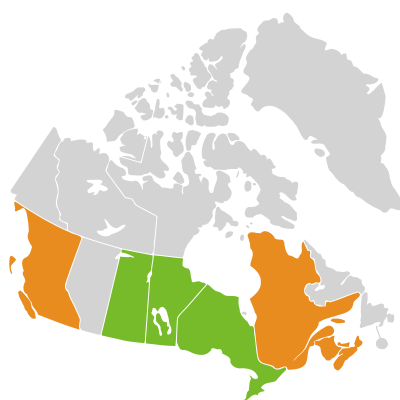
Ephemeral
Native
Introduced
Excluded
Extirpated
Doubtful
Absent
 Canadensis

Thrives in Ecozones
- Atlantic Maritime
- Boreal Plains
- Boreal Shield
- Mixed Wood Plains
Ecological Benefits
Butterflies Supported by Helianthus tuberosus
-
Chlorochlamys chloroleucaria
Blackberry looper - Arpenteuse des ronces -
Euplexia benesimilis
American Angle Shades -
Phragmatobia fuliginosa
Ruby Tiger - Écaille Cramoisie
Specialized Bees Supported by Helianthus tuberosus
- Andrena aliciae
- Andrena chromotricha
- Andrena helianthi
- Complexe Colletes americanus
- Dianthidium simile
- Megachile inimica
- Megachile pugnata
- Melissodes agilis
- Melissodes denticulatus
- Melissodes illatus
- Melissodes trinodis
- Perdita pallidipennis
Complementary Plants
- No complementary plants found.
Substitute For Non-Native Plants
- Leucanthemum (Shasta Daisy)
- Gerbera (Gerbera Daisy)
- NA (Non-native False Sunflower)
Sowing Information
Download Seed Envelope Labels (PDF)
- Sowing depth: Sow just below surface
- Sow anytime
- Stratification duration: 0 days
- Self-seeding
Harvesting and Seed Sharing
- Harvest start month: November
- Harvesting indicator:
- Seeds are dark and dry, and easily fall off when you gently pull them off
- Harvesting:
- Shake seed head in paper bag
- Seed viability test:
- No test needed before donating
- Packaging measure: 1 rounded 1/4 teaspoon
- Seed storage:
- Air dry in paper bag or open container, for a few days until crisp
- Shake seeds to move them once in a while to prevent molding
- Cultivar: Yes, do not donate unless you know source, and there are no known cultivars in your garden or at proximity
- Remove non-seed material
- No harvesting video available at this time.
Toxicity Notes
Inadequate information on toxicity found.