 Known to be toxic - Toxic to mammals if ingested. Berries are toxic to people and pets if eaten in large quantities and may cause stomach upset.
Plant Names

Ilex verticillata
Common Winterberry
Houx verticillé
Synonyms
black holly
Virginia winterberry
Plant Characteristics
Bloom Colour: White
Bloom Period: Jun - Jul
Max Height: 10.0 feet
Max Width: 5.0 feet (spreads by rhizome)
Light Condition:
 More than 6 hours of direct sun a day
 More than 2 or 3 hours but less than 6 hours of direct sun a day
Soil conditions:
More than 2 or 3 hours but less than 6 hours of direct sun a day
Soil conditions:
 Tolerates medium soil condition
More than 6 hours of direct sun a day
More than 2 or 3 hours but less than 6 hours of direct sun a day
Tolerates medium soil condition
Lifespan:
Perennial
plants that will come back year after year
Plant is
dioecious
Need a male and female plant to produce seeds
Gardener Experience:
 Does not spread uncontrollably
 Spreads by rhizome
 Self-seeding
Does not spread uncontrollably
Spreads by rhizome
Self-seeding
Landscape Uses:
 Suitable for wetland garden
 Suitable for rain gardens
 Suitable for shoreline rehabilitation
 Can be used as a hedge
Suitable for wetland garden
Suitable for rain gardens
Suitable for shoreline rehabilitation
Can be used as a hedge
Ecological Benefits:
 Supports birds
 Supports pollinators
Supports birds
Supports pollinators
Tolerates:
 Tolerates salt conditions
 Deer resistant
 Rabbit resistant
 Tolerates limestone conditions
 Tolerates acidic soil conditions
 Tolerates juglone conditions
 Tolerates transplantation
Tolerates salt conditions
Deer resistant
Rabbit resistant
Tolerates limestone conditions
Tolerates acidic soil conditions
Tolerates juglone conditions
Tolerates transplantation
Special Features and Considerations:
Seed and plant distribution status
No seeds available for this plant.
We currently accept seeds for this plant
Fun Facts
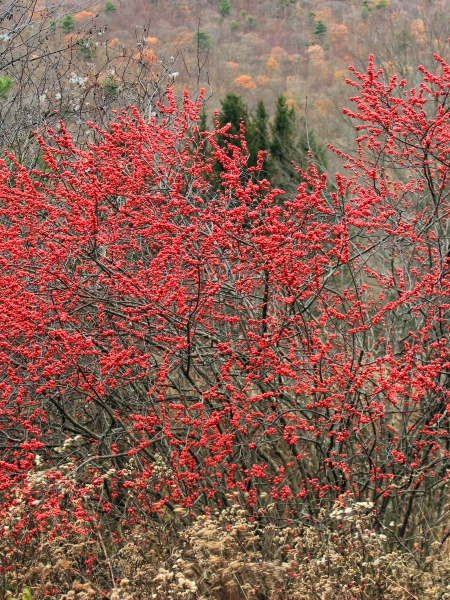
Common Winterberry is best known for its bright red berries that remain on bare branches through fall and winter. Unlike most hollies, it loses its leaves in autumn, allowing the berries to become the main feature of the plant. It grows naturally in wetlands, swamps, damp woodlands, and along shorelines. Winterberry prefers moist, acidic soils and full sun to partial shade. It is an excellent choice for rain gardens, wet areas, native shrub borders, and winter-interest plantings. It tolerates wet soils but adapts to average garden conditions if moisture is reliable.
Common winterberry has a slow to moderate growth rate. It is an excellent low-maintenance shrub once established.
Berries are attractive but may be messy if planted near walkways.
Common winterberry has a slow to moderate growth rate. It is an excellent low-maintenance shrub once established.
Berries are attractive but may be messy if planted near walkways.
Plant Location
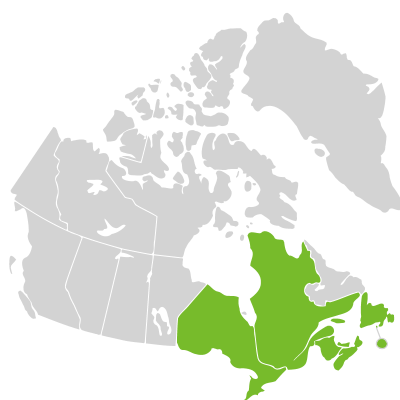
Native to Ottawa region: Yes
Distribution according to VASCAN
Ephemeral
Native
Introduced
Excluded
Extirpated
Doubtful
Absent
 Canadensis

Thrives in Ecozones
- Atlantic Maritime
- Mixed Wood Plains
Ecological Benefits
Butterflies Supported by Ilex verticillata
No butterfly data available for this plant.
Specialized Bees Supported by Ilex verticillata
No bee data available for this plant.
Complementary Plants
- No complementary plants found.
Substitute For Non-Native Plants
- Pachysandra terminalis).1 (Japanese Pachysandra)
- Berberis (Barberry)
Sowing Information
Download Seed Envelope Labels (PDF)
- Sowing depth: Sow just below surface
- Sow anytime
- Stratification duration: 0 days
- Self-seeding
- Notes: Warm moist stratify 60d, then cold moist stratify 60d. Best planted outdoors in fall.
Harvesting and Seed Sharing
- Harvest start month: September
- Harvesting indicator:
- Berries are ripen and easily fall off or have fallen off
- Harvesting:
- Squeeze berries to extract seeds, wash with soapy water, rinse throroughly
- Seed viability test:
- No test needed before donating
- Packaging measure: 1 rounded 1/32 teaspoon
- Seed storage:
- Air dry in paper bag or open container, for a few days until crisp
- Shake seeds to move them once in a while to prevent molding
- Cultivar: Yes, do not donate unless you know source, and there are no known cultivars in your garden or at proximity
- Remove non-seed material
- No harvesting video available at this time.
Toxicity Notes
Toxic to mammals if ingested. Berries are toxic to people and pets if eaten in large quantities and may cause stomach upset.