 Known to be toxic - Toxic! Fatal to cats.
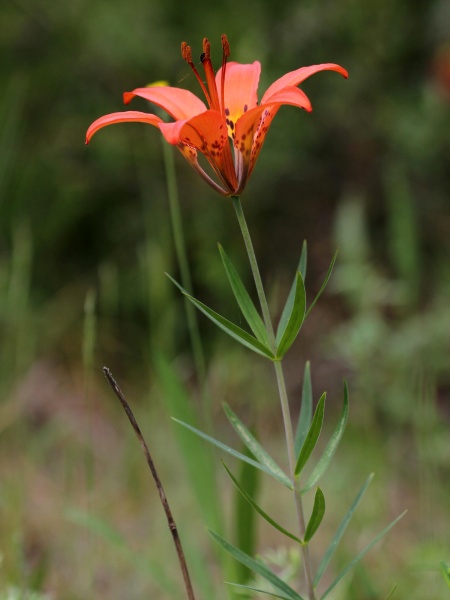
Source: Rob Routledge
Plant Names

Lilium philadelphicum
Wood Lily
Lis de Philadelphie
Synonyms
red lily
red wood lily
Plant Characteristics
Bloom Colour: Orange
Bloom Period: Jul - Aug
Max Height: 2.0 feet
Max Width: 1.0 feet
Light Condition:
 More than 6 hours of direct sun a day
 More than 2 or 3 hours but less than 6 hours of direct sun a day
Soil conditions:
More than 2 or 3 hours but less than 6 hours of direct sun a day
Soil conditions:
 Tolerates dry soil condition
 Tolerates medium soil condition
More than 6 hours of direct sun a day
More than 2 or 3 hours but less than 6 hours of direct sun a day
Tolerates dry soil condition
Tolerates medium soil condition
Lifespan:
Perennial
plants that will come back year after year
Gardener Experience:
 Does not spread uncontrollably
 Easy to germinate
Does not spread uncontrollably
Easy to germinate
Landscape Uses:
 Suitable for rock gardens
 Suitable for rain gardens
 Suitable for container garden
 Suitable for school gardens
Suitable for rock gardens
Suitable for rain gardens
Suitable for container garden
Suitable for school gardens
Ecological Benefits:
 Supports hummingbirds
 Butterfly host
Supports hummingbirds
Butterfly host
Tolerates:
 Tolerates sandy conditions
 Tolerates acidic soil conditions
 Tolerates juglone conditions
 Tolerates transplantation
Tolerates sandy conditions
Tolerates acidic soil conditions
Tolerates juglone conditions
Tolerates transplantation
Special Features and Considerations:
 This plant causes skin rashes
This plant causes skin rashes
Seed and plant distribution status
No seeds available for this plant.
We currently accept seeds for this plant
Fun Facts
Wood Lily is one of Canada's most striking native lilies, producing upright orange-red flowers with dark spots. It grows best in well-drained sandy or rocky soils and is ideal for prairie and meadow gardens. It is visited butterflies, large native bees, and moths. it provides nectar for many summer pollinators. It prefers drier conditions than most lilies. It is sow-growing. Avoid heavy mulch and wet soils. Protect from deer and lily beetles.
Excellent for naturalized meadows.
Excellent for naturalized meadows.
Plant Location
Native to Ottawa region: Yes
Distribution according to VASCAN
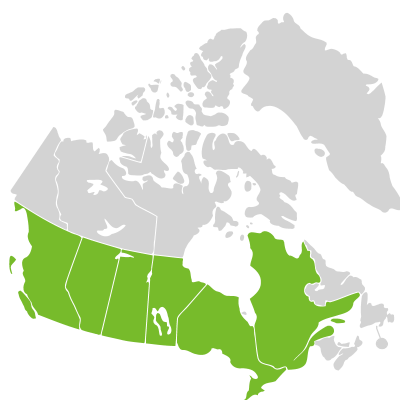
Ephemeral
Native
Introduced
Excluded
Extirpated
Doubtful
Absent
 Canadensis

Thrives in Ecozones
- Atlantic Maritime
- Taiga Shield
- Boreal Plains
- Montane Cordillera
- Prairies
- Boreal Shield
- Mixed Wood Plains
Ecological Benefits
Butterflies Supported by Lilium philadelphicum
-
Euxoa messoria
Reaper dart
Specialized Bees Supported by Lilium philadelphicum
No bee data available for this plant.
Complementary Plants
- No complementary plants found.
Substitute For Non-Native Plants
- Iris pseudacorus (Yellow Iris)
- Iris (Iris Cultivars)
- Hyacinthus (Non-Native Hyacynth)
- Campanula (Non-native Bellflower)
- Petunia (Non-Native Petunias)
- Myosotis sylvatica (Forget-me-not)
- Lamprocapnos spectabilis (Bleeding hearts)
- Phlox subulata (Moss Phlox)
- Acer japonicum (Japanese Maple)
- Acer platanoides (Norway Maple)
- Lamium galeobdolon (Yellow Archangel)
- Buxus sempervirens (Boxwood)
- Forsythieae (Forsythia)
- Cirsium arvense (Canada Thistle)
- Clematis (Non-native Clematis)
- Lonicera).1 (Non-Native Honeysuckle)
- Hedera helix (English Ivy)
- Ipomoea (Morning Glories)
- Glechoma hederacea (Creeping Charlie)
- NA (Coreopsis cultivars)
- Hemerocallis (Daylily)
- Gaillardia (Blanket Flower)
- Elaeagnus angustifolia (Russian Olive)
- Elaeagnus umbellata (Autumn Olive)
- Anethum graveolens (Dill)
- Petroselinum crispum (Parsley)
- Diervilla (Non-Native Honeysuckle)
- Lonicera japonica (Japanese Honesuckle Vine)
- Impatiens glandulifera (Himalayan Balsam)
- Thalictrum (Non-Native Meadow Rue)
- Potentilla (Non-Native Potentilla)
- Leucanthemum (Shasta Daisy)
- Gerbera (Gerbera Daisy)
- NA (Non-native False Sunflower)
- Symphiotrichum (Non-Native Aster)
- Baptisia (False Indigo)
- Cotnius (Smokebush)
- Hibiscus (Non-Native Hibiscus)
- Astilbe (Astilbe)
- Impatiens balsamina (Impatiens Balsamina)
- Pachysandra terminalis).1 (Japanese Pachysandra)
- Berberis (Barberry)
- Canna (Lily)
- Juglans nigra (Black Walnut Cultivar)
- Chamaecyparis (False Cypress)
- Juniperus (Juniper Cultivar)
- Melilotus albus (Sweet White Clover)
- Lavandula (Lavender)
- Hesperis matronalis (Dame Rocket)
- Liatris (Blazing Star Cultivar)
Sowing Information
Download Seed Envelope Labels (PDF)
- Sowing depth: Sow just below surface
- Sow by February
- Stratification duration: 60 days
Harvesting and Seed Sharing
- Harvest start month: September
- Harvesting indicator:
- Pods are slightly open and seeds inside are dark
- Harvesting:
- Shake seed head in paper bag
- Seed viability test:
- Put seed in front of light, if you can clearly see that the middle is opaque, yotu can donate. If the middle is translucent, do not donate
- Packaging measure: 1 rounded 1/8 teaspoon
- Seed storage:
- Air dry in paper bag or open container, for a few days until crisp
- Shake seeds to move them once in a while to prevent molding
- Cultivar: No, you can donate without knowing the source as there are only straight species
- No harvesting video available at this time.
Toxicity Notes
Toxic! Fatal to cats.