Plant Names

Physocarpus opulifolius
Eastern Ninebark
Physocarpe à feuilles d'obier
Synonyms
Atlantic ninebark
viburnum-leaved ninebark
physocarpe
sept écorces
Plant Characteristics
Bloom Colour: White
Bloom Period: Jun - Jun
Max Height: 8.0 feet
Max Width: 6.0 feet (spreads by rhizome)
Light Condition:
 More than 6 hours of direct sun a day
 More than 2 or 3 hours but less than 6 hours of direct sun a day
Soil conditions:
More than 2 or 3 hours but less than 6 hours of direct sun a day
Soil conditions:
 Tolerates medium soil condition
More than 6 hours of direct sun a day
More than 2 or 3 hours but less than 6 hours of direct sun a day
Tolerates medium soil condition
Lifespan:
Perennial
plants that will come back year after year
Gardener Experience:
 Spreads by rhizome
 Self-seeding
Spreads by rhizome
Self-seeding
Landscape Uses:
 Suitable for rock gardens
 Suitable for rain gardens
 Suitable for shoreline rehabilitation
 Suitable for school gardens
 Suitable for woodland gardens
 Can be used as a hedge
Suitable for rock gardens
Suitable for rain gardens
Suitable for shoreline rehabilitation
Suitable for school gardens
Suitable for woodland gardens
Can be used as a hedge
Ecological Benefits:
 Supports birds
 Supports pollinators
Supports birds
Supports pollinators
Tolerates:
 Deer resistant
 Rabbit resistant
 Tolerates limestone conditions
 Tolerates sandy conditions
 Tolerates juglone conditions
 Tolerates transplantation
Deer resistant
Rabbit resistant
Tolerates limestone conditions
Tolerates sandy conditions
Tolerates juglone conditions
Tolerates transplantation
Special Features and Considerations:
Seed and plant distribution status
No seeds available for this plant.
We currently accept seeds for this plant
Fun Facts
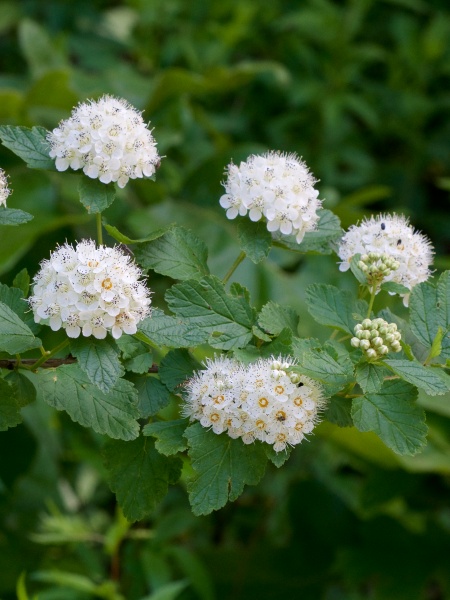
Eastern ninebark is a hardy, adaptable native shrub valued for its arching branches, attractive foliage, clusters of white flowers in late spring, and peeling bark on mature stems. It naturally grows along stream banks, woodland edges, rocky slopes, and open areas. It tolerates a wide range of soils, including clay and moderately dry conditions. Its size and toughness make it useful as a hedge, screen, specimen shrub, or naturalized planting.
Eastern Ninebark is an excellent beginner-friendly shrub. It is fast growing and can become quite large. The established plants tolerate some drought. When planting, give it adequate room rather than planting too close to buildings or paths.
Eastern Ninebark is an excellent beginner-friendly shrub. It is fast growing and can become quite large. The established plants tolerate some drought. When planting, give it adequate room rather than planting too close to buildings or paths.
Plant Location
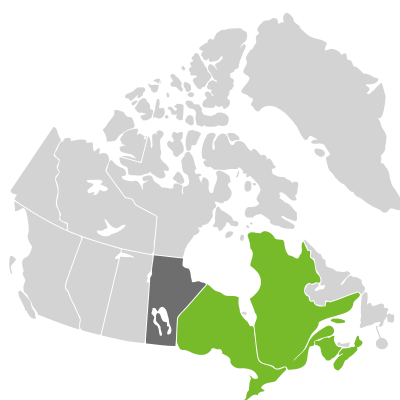
Native to Ottawa region: Yes
Distribution according to VASCAN
Ephemeral
Native
Introduced
Excluded
Extirpated
Doubtful
Absent
 Canadensis

Thrives in Ecozones
- Atlantic Maritime
- Mixed Wood Plains
Ecological Benefits
Butterflies Supported by Physocarpus opulifolius
-
Eulithis molliculata
Dimorphic Eulithis -
Lomographa vestaliata
White Spring Moth -
Olethreutes permundana
Raspberry Leafroller
Specialized Bees Supported by Physocarpus opulifolius
No bee data available for this plant.
Complementary Plants
- No complementary plants found.
Substitute For Non-Native Plants
- Hydrangea (Hydrangea)
- Rhamnus cathartica (Common Buckthorn)
- Rhamnus frangula (Glossy Buckthorn)
- Euonymus alatus (Burning Bush)
- Impatiens glandulifera (Himalayan Balsam)
- Berberis (Barberry)
Sowing Information
Download Seed Envelope Labels (PDF)
- Sowing depth: Surface sow
- Sow by February
- Stratification duration: 60 days
- Self-seeding
- Notes: Plant outdoors in fall.
Harvesting and Seed Sharing
- Harvest start month: September
- Harvesting indicator:
- Pods are brown, seeds are dark, and crisp, and little stem connecting the pod to the main stem is brown (not green)
- Harvesting:
- Cut stem (including pods), let air dry in paper bag, then shake seeds off after a few days
- Seed viability test:
- No test needed before donating
- Packaging measure: A dozen (12) seeds (eyeball)
- Seed storage:
- Air dry in paper bag or open container, for a few days until crisp
- Shake seeds to move them once in a while to prevent molding
- Cultivar: Yes, do not donate unless you know source, and there are no known cultivars in your garden or at proximity
- No harvesting video available at this time.
Toxicity Notes
Inadequate information on toxicity found.