Source: David J Stang
Plant Names

Rudbeckia speciosa wenderoth
Showy Coneflower
Rudbeckie voyante
Plant Characteristics
Bloom Colour: Yellow
Bloom Period: Aug - Oct
Max Height: 2.0 feet
Max Width: 2.0 feet (spreads by rhizome)
Light Condition:
 More than 6 hours of direct sun a day
 More than 2 or 3 hours but less than 6 hours of direct sun a day
Soil conditions:
More than 2 or 3 hours but less than 6 hours of direct sun a day
Soil conditions:
 Tolerates dry soil condition
 Tolerates medium soil condition
More than 6 hours of direct sun a day
More than 2 or 3 hours but less than 6 hours of direct sun a day
Tolerates dry soil condition
Tolerates medium soil condition
Lifespan:
Perennial
plants that will come back year after year
Gardener Experience:
 Does not spread uncontrollably
 Spreads by rhizome
 Easy to germinate
 Self-seeding
Does not spread uncontrollably
Spreads by rhizome
Easy to germinate
Self-seeding
Landscape Uses:
 Suitable for container garden
 Suitable for school gardens
Suitable for container garden
Suitable for school gardens
Ecological Benefits:
 Bee host
Bee host
Tolerates:
 Tolerates juglone conditions
 Tolerates transplantation
Tolerates juglone conditions
Tolerates transplantation
Special Features and Considerations:
Seed and plant distribution status
No seeds available for this plant.
We currently accept seeds for this plant
Fun Facts
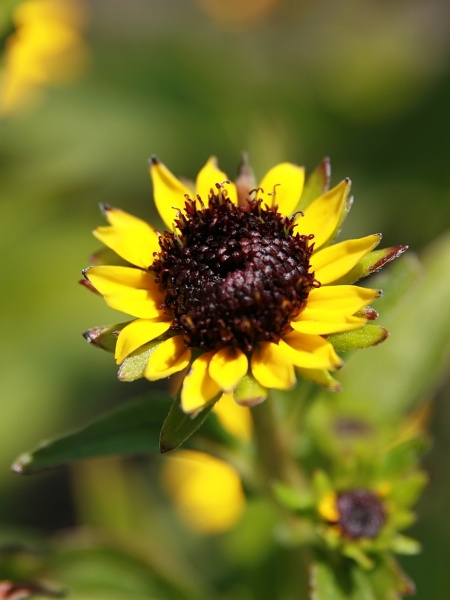
Showy Coneflower is a cheerful native perennial with bright yellow, daisy-like flowers surrounding a dark brown to black central cone. It blooms from summer into early fall and is an excellent choice for a sunny perennial garden. Unlike some of the very tall Rudbeckia species, Showy Coneflower is generally more compact and manageable, making it well suited to home gardens, borders and naturalized plantings.
The dark central cone is actually made up of many tiny individual flowers, called disc florets. The yellow “petals” are individual ray florets.
Showy Coneflower is a member of the sunflower family (Asteraceae) and is related to Black-eyed Susan and coneflowers such as Echinacea.
The dried central cones can remain attractive through winter, giving the plant four-season interest when the stems are left standing.
The dark central cone is actually made up of many tiny individual flowers, called disc florets. The yellow “petals” are individual ray florets.
Showy Coneflower is a member of the sunflower family (Asteraceae) and is related to Black-eyed Susan and coneflowers such as Echinacea.
The dried central cones can remain attractive through winter, giving the plant four-season interest when the stems are left standing.
Plant Location
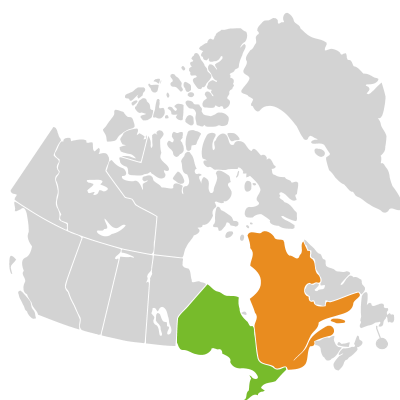
Distribution according to VASCAN
Ephemeral
Native
Introduced
Excluded
Extirpated
Doubtful
Absent
 Canadensis

Thrives in Ecozones
- Boreal Plains
Ecological Benefits
Butterflies Supported by Rudbeckia speciosa wenderoth
-
Eupithecia miserulata
American Common Pug
Specialized Bees Supported by Rudbeckia speciosa wenderoth
- Andrena aliciae
- Andrena rudbeckiae
- Complexe Colletes americanus
- Complexe Colletes compactus
- Megachile inimica
- Megachile pugnata
- Melissodes agilis
- Melissodes illatus
- Melissodes subillatus
- Melissodes trinodis
- Protandrena andrenoides
Complementary Plants
- No complementary plants found.
Substitute For Non-Native Plants
No substitute plant data available for this plant.
Sowing Information
Download Seed Envelope Labels (PDF)
- Sowing depth: Surface sow
- Sow by March
- Stratification duration: 30 days
- Self-seeding
Harvesting and Seed Sharing
- Harvest start month: September
- Harvesting indicator:
- Seeds are dark and dry, and easily fall off when you gently pull them off
- Harvesting:
- Cut top edge then shake seeds off in bag or container with rock or equivalent
- Seed viability test:
- No test needed before donating
- Packaging measure: 1 rounded 1/8 teaspoon
- Seed storage:
- Air dry in paper bag or open container, for a few days until crisp
- Shake seeds to move them once in a while to prevent molding
- Cultivar: No, you can donate without knowing the source as there are only straight species
- No harvesting video available at this time.
Toxicity Notes
Inadequate information on toxicity found however other Rudbeckia are toxic and suspect this species to be toxic if ingested.