 Known to be toxic - Toxic to mammals if ingested. Like CaRaw stems, leaves, bark, roots, and unripe berries contain toxic cyanogenic compounds. Even ripe berries should be cooked before eating.
Plant Names

Sambucus racemosa
Red Elderberry
Sureau à grappes
Synonyms
coastal red elderberry
European red elder
European red elderberry
Pacific coast red elder
red-berried elder
red-berried elder
scarlet elderberry
sureau rouge
Plant Characteristics
Bloom Colour: White
Bloom Period: May - Jun
Max Height: 12.0 feet
Max Width: 10.0 feet (spreads by rhizome)
Light Condition:
 More than 6 hours of direct sun a day
 More than 2 or 3 hours but less than 6 hours of direct sun a day
Soil conditions:
More than 2 or 3 hours but less than 6 hours of direct sun a day
Soil conditions:
 Tolerates medium soil condition
More than 6 hours of direct sun a day
More than 2 or 3 hours but less than 6 hours of direct sun a day
Tolerates medium soil condition
Lifespan:
Perennial
plants that will come back year after year
Gardener Experience:
 Spreads by rhizome
 Self-seeding
Spreads by rhizome
Self-seeding
Landscape Uses:
 Suitable for shoreline rehabilitation
 Can be used as a hedge
Suitable for shoreline rehabilitation
Can be used as a hedge
Ecological Benefits:
 Supports hummingbirds
 Supports birds
 Supports pollinators
Supports hummingbirds
Supports birds
Supports pollinators
Tolerates:
 Tolerates juglone conditions
 Tolerates transplantation
Tolerates juglone conditions
Tolerates transplantation
Special Features and Considerations:
Seed and plant distribution status
No seeds available for this plant.
We currently accept seeds for this plant
Fun Facts
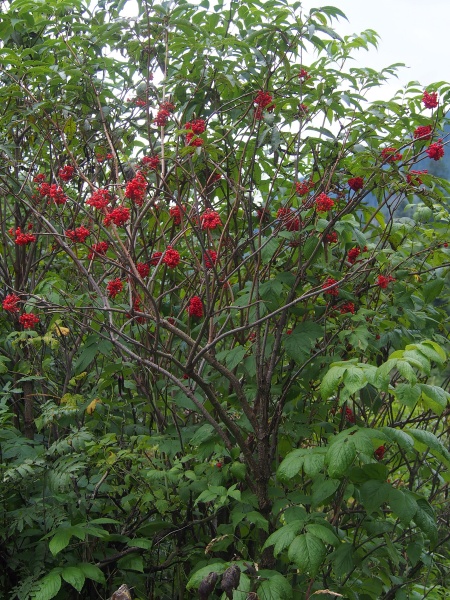
Red elderberry is a native shrub that blooms very early in spring and produces bright red berry clusters by early summer. Flowers attract native bees and early pollinators. The berries provide food for many birds, including grosbeaks, thrushes, waxwings, and grouse, as well as small mammals.
Red Elderberry is fast growing and will spread moderately by suckers. It is an excellent for woodland restoration.
Red Elderberry is fast growing and will spread moderately by suckers. It is an excellent for woodland restoration.
Plant Location
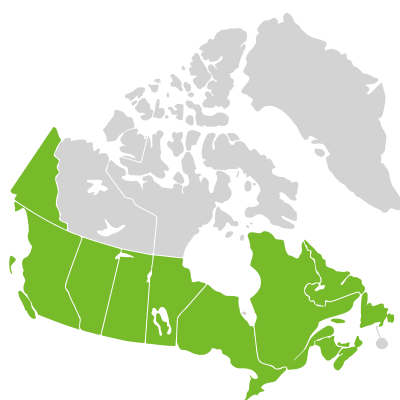
Native to Ottawa region: Yes
Distribution according to VASCAN
Ephemeral
Native
Introduced
Excluded
Extirpated
Doubtful
Absent
 Canadensis

Thrives in Ecozones
- Taiga Plains
- Atlantic Maritime
- Taiga Shield
- Boreal Plains
- Montane Cordillera
- Boreal Shield
- Boreal Cordillera
- Pacific Maritime
- Mixed Wood Plains
Ecological Benefits
Butterflies Supported by Sambucus racemosa
-
Melanchra adjuncta
Hitched Arches
Specialized Bees Supported by Sambucus racemosa
No bee data available for this plant.
Complementary Plants
- No complementary plants found.
Substitute For Non-Native Plants
- Sorbaria sorbifolia (False spirea)
- Hydrangea (Hydrangea)
- Euonymus alatus (Burning Bush)
- Astilbe (Astilbe)
- Melilotus albus (Sweet White Clover)
Sowing Information
Download Seed Envelope Labels (PDF)
- Sowing depth: Surface sow
- Sow anytime
- Stratification duration: 0 days
- Self-seeding
- Notes: 1.Warm moist stratify 3-4m. 2.Cold moist stratify 3m. 3. Warm moist stratify again.
Harvesting and Seed Sharing
- Harvest start month: June
- Harvesting indicator:
- Berries are ripen and easily fall off or have fallen off
- Harvesting:
- Squeeze berries to extract seeds, wash with soapy water, rinse throroughly
- Seed viability test:
- No test needed before donating
- Packaging measure: Six (6) seeds (eyeball)
- Seed storage:
- Air dry in paper bag or open container, for a few days until crisp
- Shake seeds to move them once in a while to prevent molding
- Cultivar: Yes, do not donate unless you know source, and there are no known cultivars in your garden or at proximity
- No harvesting video available at this time.
Toxicity Notes
Toxic to mammals if ingested. Like CaRaw stems, leaves, bark, roots, and unripe berries contain toxic cyanogenic compounds. Even ripe berries should be cooked before eating.