 Known to be toxic - Figworts contain biologically active compounds and have a history of medicinal use, but ingestion can cause adverse effects. Keep plant material away from children and pets.
Plant Names

Scrophularia marilandica
Eastern/carpenter's Figwort
Scrofulaire du Maryland
Synonyms
carpenter's square figwort
Maryland figwort
Plant Characteristics
Bloom Colour: Red
Bloom Period: Jul - Oct
Max Height: 6.0 feet
Max Width: 3.0 feet
Light Condition:
 More than 6 hours of direct sun a day
 More than 2 or 3 hours but less than 6 hours of direct sun a day
 Less than 2 or 3 hours of direct sun a day
Soil conditions:
Less than 2 or 3 hours of direct sun a day
Soil conditions:
 Tolerates medium soil condition
More than 6 hours of direct sun a day
More than 2 or 3 hours but less than 6 hours of direct sun a day
Less than 2 or 3 hours of direct sun a day
Tolerates medium soil condition
Lifespan:
Perennial
plants that will come back year after year
Gardener Experience:
 Does not spread uncontrollably
 Easy to germinate
 Self-seeding
Does not spread uncontrollably
Easy to germinate
Self-seeding
Landscape Uses:
 Suitable for container garden
 Suitable for woodland gardens
Suitable for container garden
Suitable for woodland gardens
Ecological Benefits:
No ecological benefits information available.
Tolerates:
 Deer resistant
 Rabbit resistant
 Tolerates transplantation
Deer resistant
Rabbit resistant
Tolerates transplantation
Special Features and Considerations:
Seed and plant distribution status
No seeds available for this plant.
We currently accept seeds for this plant
Fun Facts
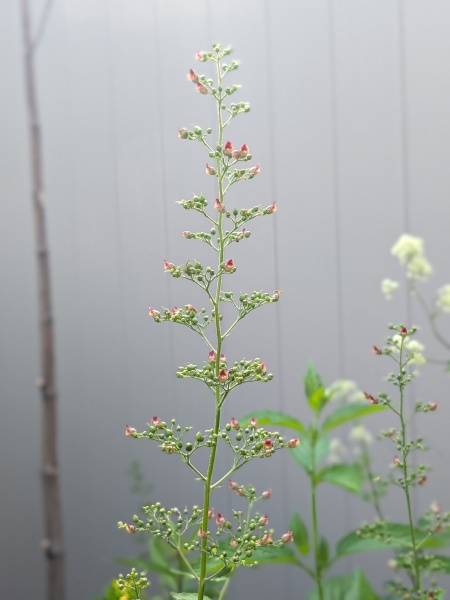
Eastern/carpenter's Figwort likes moist well-drained soil.The name refers to its traditional use to treat swollen lymph nodes in the neck, called "scrofula". It has lots of small flowers that attract a variety of pollinators. It blooms later than others in its family, from July to September.
Check your Seeds for Harvesting
Because this plants blooming time is staggered, the seed pods maturing and opening are also staggered. Some seed pods are ready while the plant is still blooming. This means that this plant is not an ideal candidate for organza bags. Putting the organza bags on before the plant is done blooming means not allowing the pollinators access to the last bits of nectar. You decide what works best for you. You will see that seed pods have started to split open. These are ready to harvest. You can use your fingernail to snip the pod off the stem; then split the pod into two by inserting the fingernail into the split. Care must be taken when removing the pods from the plant because you can break the entire stem holding all the seed pods. Let the seed/pod mix sit to dry out for a week or two, then put the mixture into a closed container and shake. This should remove the seeds from the pod halves. Then pour your mixture through a strainer.
Plant Location
Distribution according to VASCAN
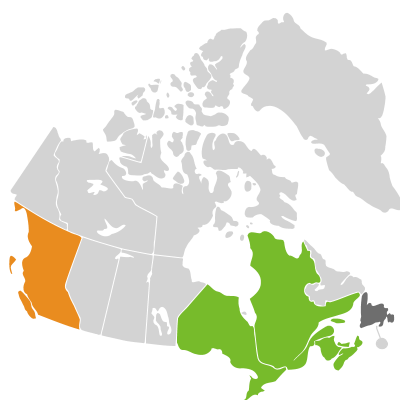
Ephemeral
Native
Introduced
Excluded
Extirpated
Doubtful
Absent
 Canadensis

Thrives in Ecozones
- Atlantic Maritime
- Mixed Wood Plains
Ecological Benefits
Butterflies Supported by Scrophularia marilandica
No butterfly data available for this plant.
Specialized Bees Supported by Scrophularia marilandica
No bee data available for this plant.
Complementary Plants
- Eurybia divaricata
White Wood Aster
Aster à rameaux étalés - Lobelia inflata
Inflated Tobacco
Lobélie gonflée - Muhlenbergia mexicana
Mexican Muhly
Muhlenbergie du Mexique - Solidago flexicaulis
Zigzag Goldenrod
Verge d'or à tige zigzagante - Symphyotrichum cordifolium
Heart-leaved Aster
Aster à feuilles cordées
Substitute For Non-Native Plants
- Perovskia Atriplicifolia (Russian Sage)
- Miscanthus (Silvergrass)
- Pennisetum setaceum (Fountain Grass)
Sowing Information
Download Seed Envelope Labels (PDF)
- Sowing depth: Surface sow
- Sow by February
- Stratification duration: 60 days
- Self-seeding
Harvesting and Seed Sharing
- Harvest start month: November
- Harvesting indicator:
- Pods are brown and crisp and starting to open
- Seeds are dark and tiny stem attaching to the main stem is brown
- Seeds easily fall off pod when shaken
- Little stem connecting the pod to the main stem is brown (not green)
- Harvesting:
- Cut stem (including pods), let air dry in paper bag, then shake seeds off after a few days
- Seed viability test:
- No test needed before donating
- Packaging measure: 1 rounded 1/32 teaspoon
- Seed storage:
- Air dry in paper bag or open container, for a few days until crisp
- Shake seeds to move them once in a while to prevent molding
- Cultivar: Yes, do not donate unless you know source, and there are no known cultivars in your garden or at proximity
- Remove non-seed material
- Harvesting notes: Please note that in 2026 and before, we partly distributed Lance-Leaved Figwort (Scrophularia lanceolata) instead of Eastern Figwort (Scrophularia marilandica). PLease check your plants before donating. Thanks!
- Harvesting video: Watch here
Toxicity Notes
Figworts contain biologically active compounds and have a history of medicinal use, but ingestion can cause adverse effects. Keep plant material away from children and pets.