 Known to be toxic - Toxic to livestock and cats if ingested.
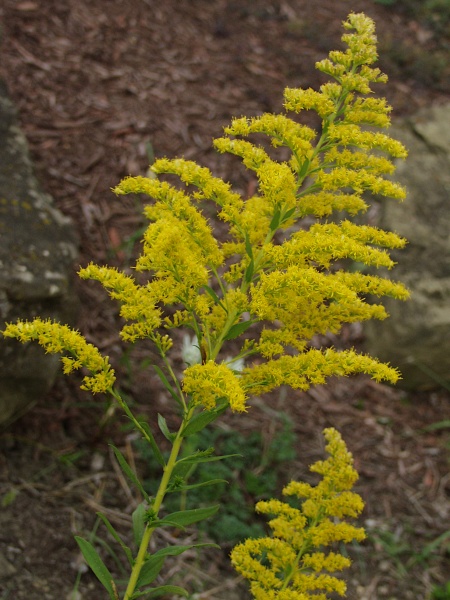
Source: Cbaile19
Plant Names

Solidago altissima
Tall Goldenrod
Verge d’or haute
Synonyms
late goldenrod
solidage très haute
verge d'or très élevée
Plant Characteristics
Bloom Colour: Yellow
Bloom Period: Sep - Oct
Max Height: 6.0 feet
Max Width: 3.0 feet (spreads by rhizome)
Light Condition:
 More than 6 hours of direct sun a day
 More than 2 or 3 hours but less than 6 hours of direct sun a day
Soil conditions:
More than 2 or 3 hours but less than 6 hours of direct sun a day
Soil conditions:
 Tolerates dry soil condition
 Tolerates medium soil condition
More than 6 hours of direct sun a day
More than 2 or 3 hours but less than 6 hours of direct sun a day
Tolerates dry soil condition
Tolerates medium soil condition
Lifespan:
Perennial
plants that will come back year after year
Gardener Experience:
 Spreads by rhizome
 Easy to germinate
 Self-seeding
Spreads by rhizome
Easy to germinate
Self-seeding
Landscape Uses:
 Suitable for rock gardens
 Suitable for shoreline rehabilitation
 Suitable for container garden
Suitable for rock gardens
Suitable for shoreline rehabilitation
Suitable for container garden
Ecological Benefits:
 Butterfly host
 Bee host
 Keystone species
Butterfly host
Bee host
Keystone species
Tolerates:
 Deer resistant
 Rabbit resistant
 Tolerates limestone conditions
 Tolerates juglone conditions
 Tolerates transplantation
Deer resistant
Rabbit resistant
Tolerates limestone conditions
Tolerates juglone conditions
Tolerates transplantation
Special Features and Considerations:
 This plant causes skin rashes
This plant causes skin rashes
Seed and plant distribution status
No seeds available for this plant.
We currently accept seeds for this plant
Fun Facts
Tall Goldenrod is a great addition to a pollinator garden or a wildflower meadow. It is helpful to grow it near other plants that can provide support. It is one of the latest blooming plants, blooming from late August until November and as such it provides late season nectar for monarch butterflies and native bees. Further, this plant's hollow stems provide a nesting side for some bee species. It may become aggressive in small gardens and is an excellent choice for naturalized landscapes and large pollinator gardens. It is drought tolerant once established. You can divide it every few years if it becomes too dominant.
Plant Location
Native to Ottawa region: Yes
Distribution according to VASCAN
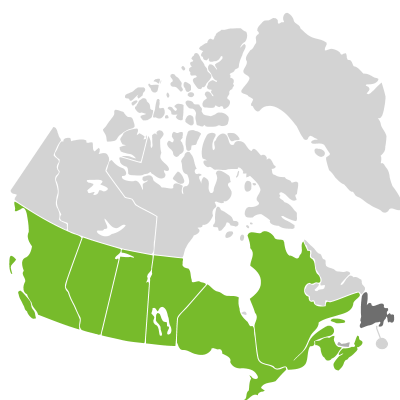
Ephemeral
Native
Introduced
Excluded
Extirpated
Doubtful
Absent
 Canadensis

Thrives in Ecozones
- Atlantic Maritime
- Boreal Plains
- Montane Cordillera
- Prairies
- Boreal Shield
- Mixed Wood Plains
Ecological Benefits
Butterflies Supported by Solidago altissima
-
Chlorochlamys chloroleucaria
Blackberry looper - Arpenteuse des ronces -
Cucullia convexipennis
Brown Hooded Owlet - Noctuelle Huppée de la Verge d'Or -
Eupithecia miserulata
American Common Pug -
Euplexia benesimilis
American Angle Shades -
Leuconycta diphteroides
Green Leuconycta -
Melanchra adjuncta
Hitched Arches -
Phragmatobia fuliginosa
Ruby Tiger - Écaille Cramoisie -
Trichordestra legitima
Striped Garden Caterpillar
Specialized Bees Supported by Solidago altissima
- Andrena aliciae
- Andrena asteris
- Andrena canadensis
- Andrena chromotricha
- Andrena hirticincta
- Andrena nubecula
- Andrena placata
- Andrena simplex
- Complexe Colletes americanus
- Complexe Colletes compactus
- Complexe Colletes simulans
- Dianthidium simile
- Megachile inimica
- Melissodes agilis
- Melissodes illatus
- Melissodes trinodis
- Protandrena andrenoides
- Pseudopanurgus aestivalis
Complementary Plants
- Coreopsis tripteris
Tall Tickseed
Coréopsis trifoliolé - Panicum virgatum
Switch Grass
Panic raide - Solidago squarrosa
Squarrose Goldenrod
Verge d’or squarreuse - Symphyotrichum laeve
Smooth Aster
Aster lisse - Symphyotrichum lanceolatum
White Panicled Aster
Aster lancéolé
Substitute For Non-Native Plants
- Oenothera (Non-Native Primrose)
- Oenothera biennis (Evening Primrose Cultivars)
- Oenothera fructicosa (Sundrops Cultivars)
- Helianthus (Non-Native Sunflower)
- NA (Black Eyed Susan's Cultivars)
- Rudbeckia Triloba (Brown Eyed Susan's)
- Echinacea (Coneflowers)
- NA (Coreopsis cultivars)
- NA (Non-native False Sunflower)
Sowing Information
Download Seed Envelope Labels (PDF)
- Sowing depth: Surface sow
- Sow anytime
- Stratification duration: 0 days
- Self-seeding
Harvesting and Seed Sharing
- Harvest start month: November
- Harvesting indicator:
- Seeds have become fluffy and can be easily removed by shaking on gently pulling off from stem
- Harvesting:
- Shake seed head in paper bag
- Seed viability test:
- No test needed before donating
- Packaging measure: 1 rounded 1/4 teaspoon
- Seed storage:
- Air dry in paper bag or open container, for a few days until crisp
- Shake seeds to move them once in a while to prevent molding
- Cultivar: No, you can donate without knowing the source as there are only straight species
- No harvesting video available at this time.
Toxicity Notes
Toxic to livestock and cats if ingested.