 Known to be toxic - Toxic to livestock and cats if ingested.
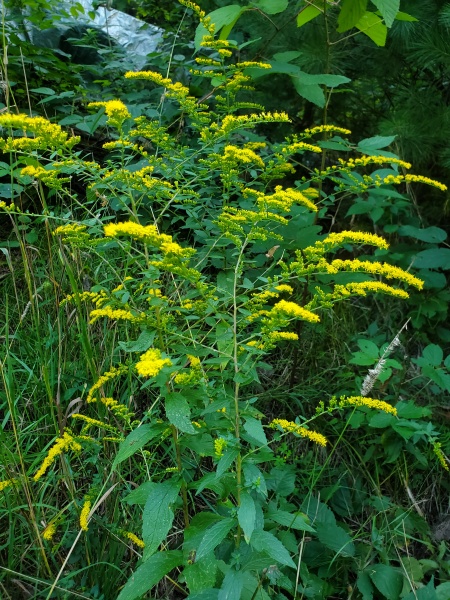
Source: Sundaura Alford-Purvis
Plant Names

Solidago rugosa
Rough-stemmed Goldenrod
Verge d'or rugueuse
Synonyms
rough goldenrod
wrinkle-leaved goldenrod
solidage rugueuse
Plant Characteristics
Bloom Colour: Yellow
Bloom Period: Jul - Oct
Max Height: 3.0 feet
Max Width: 3.0 feet (spreads by rhizome)
Light Condition:
 More than 6 hours of direct sun a day
 More than 2 or 3 hours but less than 6 hours of direct sun a day
Soil conditions:
More than 2 or 3 hours but less than 6 hours of direct sun a day
Soil conditions:
 Tolerates medium soil condition
 Tolerates wet soil condition
More than 6 hours of direct sun a day
More than 2 or 3 hours but less than 6 hours of direct sun a day
Tolerates medium soil condition
Tolerates wet soil condition
Lifespan:
Perennial
plants that will come back year after year
Gardener Experience:
 Spreads by rhizome
 Easy to germinate
 Self-seeding
Spreads by rhizome
Easy to germinate
Self-seeding
Landscape Uses:
 Suitable for wetland garden
 Suitable for container garden
 Suitable for school gardens
Suitable for wetland garden
Suitable for container garden
Suitable for school gardens
Ecological Benefits:
 Butterfly host
 Bee host
 Keystone species
Butterfly host
Bee host
Keystone species
Tolerates:
 Tolerates juglone conditions
 Tolerates transplantation
Tolerates juglone conditions
Tolerates transplantation
Special Features and Considerations:
 This plant causes skin rashes
This plant causes skin rashes
Seed and plant distribution status
No seeds available for this plant.
We currently accept seeds for this plant
Fun Facts
Rough-stemmed Goldenrod has sprays of arching yellow flowers that is clump-forming so would need space to grow. It is not recommended for a small garden. While it tolerates medium soil moisture, it does prefer more consistent moisture. As with all goldenrods, it is a nectar and pollen magnet for a variety of pollinators.
Plant Location
Native to Ottawa region: Yes
Distribution according to VASCAN
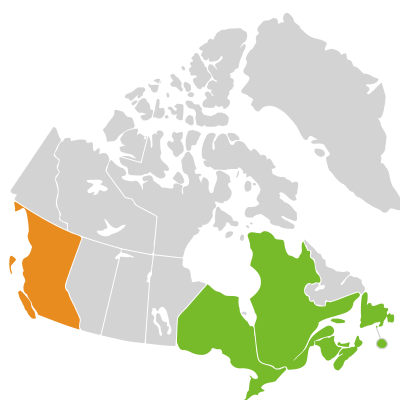
Ephemeral
Native
Introduced
Excluded
Extirpated
Doubtful
Absent
 Canadensis

Thrives in Ecozones
- Atlantic Maritime
- Boreal Shield
- Mixed Wood Plains
Ecological Benefits
Butterflies Supported by Solidago rugosa
-
Chlorochlamys chloroleucaria
Blackberry looper - Arpenteuse des ronces -
Cucullia convexipennis
Brown Hooded Owlet - Noctuelle Huppée de la Verge d'Or -
Eupithecia miserulata
American Common Pug -
Euplexia benesimilis
American Angle Shades -
Leuconycta diphteroides
Green Leuconycta -
Melanchra adjuncta
Hitched Arches -
Phragmatobia fuliginosa
Ruby Tiger - Écaille Cramoisie -
Trichordestra legitima
Striped Garden Caterpillar
Specialized Bees Supported by Solidago rugosa
- Andrena aliciae
- Andrena asteris
- Andrena canadensis
- Andrena chromotricha
- Andrena hirticincta
- Andrena nubecula
- Andrena placata
- Andrena simplex
- Complexe Colletes americanus
- Complexe Colletes compactus
- Complexe Colletes simulans
- Dianthidium simile
- Megachile inimica
- Melissodes agilis
- Melissodes illatus
- Melissodes trinodis
- Protandrena andrenoides
- Pseudopanurgus aestivalis
Complementary Plants
- Carex grayi
Gray's Sedge
Carex de Gray - Doellingeria umbellata
Flat-topped White Aster
Aster à ombelles - Prunella vulgaris var. lanceolata
Lance-leaved Self-heal
Brunelle commune - Symphyotrichum puniceum
Purple-stemmed Aster
Aster ponceau - Vernonia gigantea
Giant Ironweed
Vernonie géante
Substitute For Non-Native Plants
- Oenothera (Non-Native Primrose)
- Oenothera biennis (Evening Primrose Cultivars)
- Oenothera fructicosa (Sundrops Cultivars)
- Helianthus (Non-Native Sunflower)
- NA (Black Eyed Susan's Cultivars)
- Rudbeckia Triloba (Brown Eyed Susan's)
- Echinacea (Coneflowers)
- NA (Coreopsis cultivars)
- NA (Non-native False Sunflower)
Sowing Information
Download Seed Envelope Labels (PDF)
- Sowing depth: Surface sow
- Sow by February
- Stratification duration: 60 days
- Self-seeding
Harvesting and Seed Sharing
- Harvest start month: October
- Harvesting indicator:
- Seeds have become fluffy and can be easily removed by shaking on gently pulling off from stem
- Harvesting:
- Shake seed head in paper bag
- Seed viability test:
- No test needed before donating
- Packaging measure: 1 rounded 1/4 teaspoon
- Seed storage:
- Air dry in paper bag or open container, for a few days until crisp
- Shake seeds to move them once in a while to prevent molding
- Cultivar: Yes, do not donate unless you know source, and there are no known cultivars in your garden or at proximity
- No harvesting video available at this time.
Toxicity Notes
Toxic to livestock and cats if ingested.