 Known to be toxic - The foliage and essential oils contain thujone and other compounds that can be harmful if consumed in quantity. The plant is particularly important to keep away from livestock that might browse heavily.
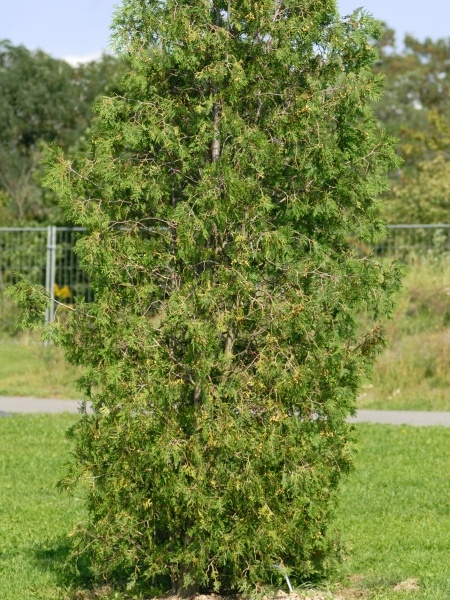
Source: Andre Karwath
Plant Names

Thuja occidentalis
Eastern White Cedar
Thuya occidental
Synonyms
arborvitae
eastern arborvitae
northern white cedar
northern white-cedar
swamp cedar
balai
cèdre
cèdre blanc
thuier cèdre
Plant Characteristics
Bloom Colour: Green
Bloom Period: Apr - May
Max Height: 50.0 feet
Max Width: 15.0 feet
Light Condition:
 More than 6 hours of direct sun a day
 More than 2 or 3 hours but less than 6 hours of direct sun a day
Soil conditions:
More than 2 or 3 hours but less than 6 hours of direct sun a day
Soil conditions:
 Tolerates medium soil condition
More than 6 hours of direct sun a day
More than 2 or 3 hours but less than 6 hours of direct sun a day
Tolerates medium soil condition
Lifespan:
Perennial
plants that will come back year after year
Gardener Experience:
 Does not spread uncontrollably
 Easy to germinate
Does not spread uncontrollably
Easy to germinate
Landscape Uses:
 Suitable for rock gardens
 Suitable for shoreline rehabilitation
 Can be used as a hedge
Suitable for rock gardens
Suitable for shoreline rehabilitation
Can be used as a hedge
Ecological Benefits:
 Butterfly host
Butterfly host
Tolerates:
 Tolerates limestone conditions
 Tolerates juglone conditions
 Tolerates transplantation
Tolerates limestone conditions
Tolerates juglone conditions
Tolerates transplantation
Special Features and Considerations:
Seed and plant distribution status
No seeds available for this plant.
We currently accept seeds for this plant
Fun Facts
Eastern White Cedar can eventually become a large, narrow to broadly conical tree, although it also responds well to pruning and is commonly used as a hedge. It is an excellent choice for native hedges, privacy screens, windbreaks, and year-round structure.
Eastern White Cedar can be pruned in late spring or early summer if shaping is needed. It establishes more quickly when watered regularly during its first few years. It can tolerate wet soil and is particularly useful in moist locations. In dry conditions, young trees benefit from supplemental watering. Give individual trees enough space to develop rather than planting them too close together. It generally well behaved and long-lived; it does not spread aggressively. It is one of the most useful native evergreen trees for a garden because it provides winter shelter and screening while also tolerating a surprisingly wide range of conditions.
Eastern White Cedar can be pruned in late spring or early summer if shaping is needed. It establishes more quickly when watered regularly during its first few years. It can tolerate wet soil and is particularly useful in moist locations. In dry conditions, young trees benefit from supplemental watering. Give individual trees enough space to develop rather than planting them too close together. It generally well behaved and long-lived; it does not spread aggressively. It is one of the most useful native evergreen trees for a garden because it provides winter shelter and screening while also tolerating a surprisingly wide range of conditions.
Plant Location
Native to Ottawa region: Yes
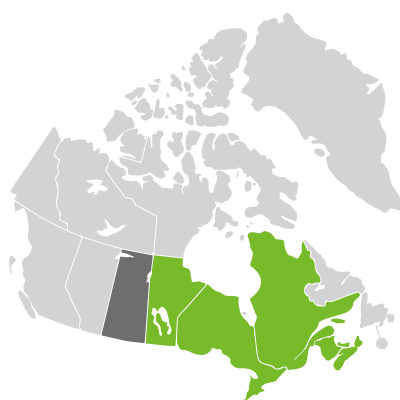
Distribution according to VASCAN
Ephemeral
Native
Introduced
Excluded
Extirpated
Doubtful
Absent
 Canadensis

Thrives in Ecozones
- Atlantic Maritime
- Boreal Plains
- Hudson Plains
- Boreal Shield
- Mixed Wood Plains
Ecological Benefits
Butterflies Supported by Thuja occidentalis
-
Cingilia catenaria
Chain-dotted geometer - Arpenteuse caténaire
Specialized Bees Supported by Thuja occidentalis
No bee data available for this plant.
Complementary Plants
- No complementary plants found.
Substitute For Non-Native Plants
- Thuja occidentalis (Eastern White-cedar)
Sowing Information
Download Seed Envelope Labels (PDF)
- Sowing depth: Sow just below surface
- Sow by February
- Stratification duration: 60 days
- Notes: Soak for 24h.
Harvesting and Seed Sharing
- Harvest start month: August
- Harvesting indicator:
- Pods are brown and crisp and starting to open
- Seeds are dark and tiny stem attaching to the main stem is brown
- Seeds easily fall off pod when shaken
- Little stem connecting the pod to the main stem is brown (not green)
- Harvesting:
- Cut stem (including pods), let air dry in paper bag, then shake seeds off after a few days
- Seed viability test:
- No test needed before donating
- Packaging measure: Six (6) seeds (eyeball)
- Seed storage:
- Air dry in paper bag or open container, for a few days until crisp
- Shake seeds to move them once in a while to prevent molding
- Cultivar: Yes, do not donate unless you know source, and there are no known cultivars in your garden or at proximity
- No harvesting video available at this time.
Toxicity Notes
The foliage and essential oils contain thujone and other compounds that can be harmful if consumed in quantity. The plant is particularly important to keep away from livestock that might browse heavily.