Plant Names

Viburnum cassinoides
Wild Raisin
Viorne cassinoïde
Synonyms
northern wild raisin
swamp haw
witherod
alises
alisier
bleuets sains
bourdaine
Plant Characteristics
Bloom Colour: White
Bloom Period: May - Jun
Max Height: 12.0 feet
Max Width: 12.0 feet
Light Condition:
 More than 6 hours of direct sun a day
 More than 2 or 3 hours but less than 6 hours of direct sun a day
Soil conditions:
More than 2 or 3 hours but less than 6 hours of direct sun a day
Soil conditions:
 Tolerates medium soil condition
More than 6 hours of direct sun a day
More than 2 or 3 hours but less than 6 hours of direct sun a day
Tolerates medium soil condition
Lifespan:
Perennial
plants that will come back year after year
Gardener Experience:
 Does not spread uncontrollably
 Self-seeding
Does not spread uncontrollably
Self-seeding
Landscape Uses:
 Suitable for wetland garden
 Suitable for rain gardens
 Suitable for woodland gardens
 Can be used as a hedge
Suitable for wetland garden
Suitable for rain gardens
Suitable for woodland gardens
Can be used as a hedge
Ecological Benefits:
 Keystone species
Keystone species
Tolerates:
 Tolerates acidic soil conditions
 Tolerates juglone conditions
 Tolerates transplantation
Tolerates acidic soil conditions
Tolerates juglone conditions
Tolerates transplantation
Special Features and Considerations:
 This plant causes skin rashes
This plant causes skin rashes
Seed and plant distribution status
No seeds available for this plant.
We currently accept seeds for this plant
Fun Facts
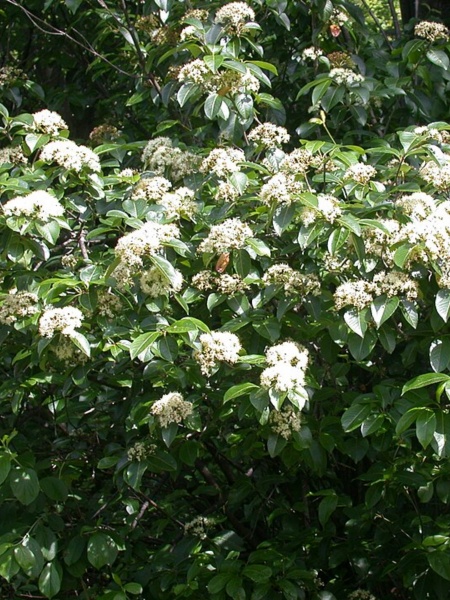
Wild Raisin has glossy, oval leaves and clusters of creamy-white flowers that appear in late spring to early summer. The flowers are followed by berries that ripen from pink to blue-black in late summer and wrinkle as they mature, giving the plant its common name. The fall foliage can become attractive shades of pink, red and purple. It is an excellent choice for a wet woodland, pond edge, native hedge or naturalized planting. It forms a dense, rounded shrub and is generally well behaved. It's a multi-season plant: it offers spring flowers, summer fruit, fall colour and winter structure, making it particularly useful in a naturalized garden. Avoid heavy pruning, which can remove next year's flower-producing wood. It performs best with reliable moisture but can tolerate some drying once established. Flowering and fruiting are generally better with more sunlight. Plant where it has room to reach its mature size.
Plant Location
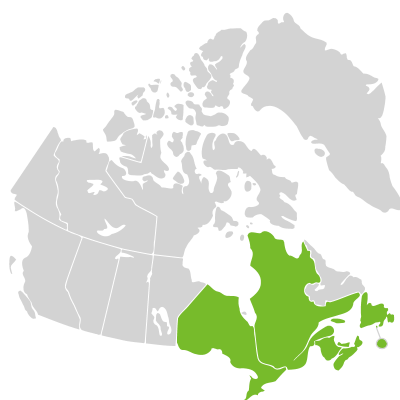
Native to Ottawa region: Yes
Distribution according to VASCAN
Ephemeral
Native
Introduced
Excluded
Extirpated
Doubtful
Absent
 Canadensis

Thrives in Ecozones
- Atlantic Maritime
- Boreal Shield
- Mixed Wood Plains
Ecological Benefits
Butterflies Supported by Viburnum cassinoides
-
Agriopodes teratophora
Green Marvel -
Amblyscirtes hegon
Pepper and salt skipper - Hespérie Poivrée -
Celastrina ladon
Spring Azure - Azur Printanier -
Lomographa vestaliata
White Spring Moth
Specialized Bees Supported by Viburnum cassinoides
No bee data available for this plant.
Complementary Plants
- No complementary plants found.
Substitute For Non-Native Plants
- Hydrangea (Hydrangea)
- Rhamnus cathartica (Common Buckthorn)
- Rhamnus frangula (Glossy Buckthorn)
- Euonymus alatus (Burning Bush)
- Buxus sempervirens (Boxwood)
- Impatiens glandulifera (Himalayan Balsam)
- Berberis (Barberry)
Sowing Information
Download Seed Envelope Labels (PDF)
- Sowing depth: Sow just below surface
- Sow anytime
- Stratification duration: 150 days
- Self-seeding
- Notes: Warm moist stratify 60d, then cold moist stratify 90d.
Harvesting and Seed Sharing
- Harvest start month: September
- Harvesting indicator:
- Berries are ripen and easily fall off or have fallen off
- Harvesting:
- Squeeze berries to extract seeds, wash with soapy water to remove flesh, rinse throroughly
- Seed viability test:
- No test needed before donating
- Packaging measure: A dozen (12) seeds (eyeball)
- Seed storage:
- Air dry in paper bag or open container, for a few days until crisp
- Shake seeds to move them once in a while to prevent molding
- Cultivar: Yes, do not donate unless you know source, and there are no known cultivars in your garden or at proximity
- No harvesting video available at this time.
Toxicity Notes
Inadequate information on toxicity found but caution around dogs as grapes are toxic to dogs.