 Known to be toxic - The leaves and acorns are particularly important to keep away from grazing livestock due to tannins.
Plant Names

Quercus muehlenbergii
Chinquapin Oak
Chêne jaune
Plant Characteristics
Bloom Colour: Green
Bloom Period: Apr - Apr
Max Height: 80.0 feet
Max Width: 70.0 feet
Light Condition:
 More than 6 hours of direct sun a day
Soil conditions:
More than 6 hours of direct sun a day
Soil conditions:
 Tolerates dry soil condition
 Tolerates medium soil condition
More than 6 hours of direct sun a day
Tolerates dry soil condition
Tolerates medium soil condition
Lifespan:
Perennial
plants that will come back year after year
Gardener Experience:
Landscape Uses:
No landscape information available.
Ecological Benefits:
 Butterfly host
Butterfly host
Tolerates:
 Tolerates limestone conditions
 Tolerates sandy conditions
Tolerates limestone conditions
Tolerates sandy conditions
Special Features and Considerations:
Seed and plant distribution status
No seeds available for this plant.
We currently accept seeds for this plant
Fun Facts
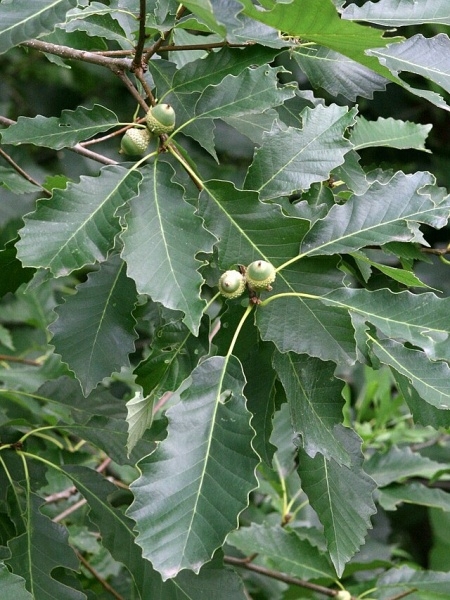
Chinquapin Oak is a medium to large native oak tree with attractive, glossy green leaves and unusually sweet-tasting acorns. Its rounded crown can provide excellent shade as the tree matures, while its acorns are an important food source for wildlife.
Chinquapin Oak belongs to the white oak group, so its acorns generally mature in a single growing season rather than taking two years like those of red-group oaks.
It can become a very long-lived tree, potentially surviving for several centuries under favourable conditions.
Despite being a large tree, it is relatively slow growing when young. The investment in a substantial root system helps mature trees withstand periods of drought.
Plan carefully before planting. Chinquapin Oak can become a large shade tree.
Prune young trees selectively to establish a good central structure and remove damaged or crossing branches.
Give it plenty of room away from buildings, overhead wires and other large trees.
The leaves and acorns are particularly important to keep away from grazing livestock due to tannins.
Chinquapin Oak belongs to the white oak group, so its acorns generally mature in a single growing season rather than taking two years like those of red-group oaks.
It can become a very long-lived tree, potentially surviving for several centuries under favourable conditions.
Despite being a large tree, it is relatively slow growing when young. The investment in a substantial root system helps mature trees withstand periods of drought.
Plan carefully before planting. Chinquapin Oak can become a large shade tree.
Prune young trees selectively to establish a good central structure and remove damaged or crossing branches.
Give it plenty of room away from buildings, overhead wires and other large trees.
The leaves and acorns are particularly important to keep away from grazing livestock due to tannins.
Plant Location
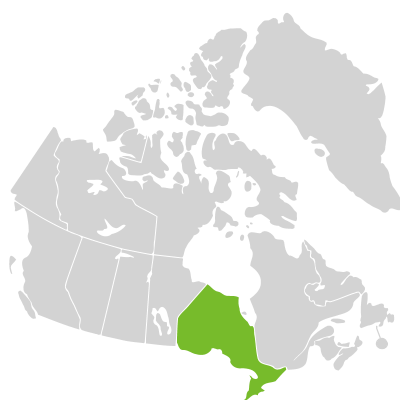
Distribution according to VASCAN
Ephemeral
Native
Introduced
Excluded
Extirpated
Doubtful
Absent
 Canadensis

Thrives in Ecozones
- Mixed Wood Plains
Ecological Benefits
Butterflies Supported by Quercus muehlenbergii
-
Amphipyra tragopoginis
Mouse moth - Triponctuée -
Cingilia catenaria
Chain-dotted geometer - Arpenteuse caténaire -
Haploa clymene
Clymene -
Parrhasius m-album
White-M Hairstreak - Parrhasius m-album
Specialized Bees Supported by Quercus muehlenbergii
No bee data available for this plant.
Complementary Plants
- No complementary plants found.
Substitute For Non-Native Plants
- Rhamnus cathartica (Common Buckthorn)
- Rhamnus frangula (Glossy Buckthorn)
Sowing Information
Download Seed Envelope Labels (PDF)
- Sowing depth: Sow 1 inch deep
- Sow by February
- Stratification duration: 60 days
Harvesting and Seed Sharing
- Harvest start month: September
- Harvesting indicator:
- Pods are released from plant
- Harvesting:
- Nut has been released from tree
- Seed viability test:
- Put seed in container filled with water
- If the seed goes at the bottom of the container, you can donate
- If seed floats, do not donate
- Packaging measure: Six (6) seeds (eyeball)
- Seed storage:
- Air Dry in paper bag or open container, for a few days until crisp
- Shake seeds to move them once in a while to prevent molding
- Cultivar: No, you can donate without knowing the source as there are only straight species
- No harvesting video available at this time.
Toxicity Notes
The leaves and acorns are particularly important to keep away from grazing livestock due to tannins.