 Known to be toxic - The seeds (pits), leaves and twigs contain cyanogenic compounds and can be poisonous if eaten, particularly when the plant material is damaged or wilted.
Plant Names

Prunus virginiana
Chokecherry
cerisier de Virginie
Plant Characteristics
Bloom Colour: White
Bloom Period: Apr - May
Max Height: 30.0 feet
Max Width: 20.0 feet (spreads by rhizome)
Light Condition:
 More than 6 hours of direct sun a day
 More than 2 or 3 hours but less than 6 hours of direct sun a day
Soil conditions:
More than 2 or 3 hours but less than 6 hours of direct sun a day
Soil conditions:
 Tolerates dry soil condition
 Tolerates medium soil condition
More than 6 hours of direct sun a day
More than 2 or 3 hours but less than 6 hours of direct sun a day
Tolerates dry soil condition
Tolerates medium soil condition
Lifespan:
Perennial
plants that will come back year after year
Gardener Experience:
 Spreads by rhizome
Spreads by rhizome
Landscape Uses:
 Suitable for shoreline rehabilitation
 Can be used as a hedge
Suitable for shoreline rehabilitation
Can be used as a hedge
Ecological Benefits:
 Supports birds
 Butterfly host
Supports birds
Butterfly host
Tolerates:
 Deer resistant
 Rabbit resistant
 Tolerates limestone conditions
 Tolerates sandy conditions
 Tolerates acidic soil conditions
 Tolerates juglone conditions
Deer resistant
Rabbit resistant
Tolerates limestone conditions
Tolerates sandy conditions
Tolerates acidic soil conditions
Tolerates juglone conditions
Special Features and Considerations:
Seed and plant distribution status
No seeds available for this plant.
We currently accept seeds for this plant
Fun Facts
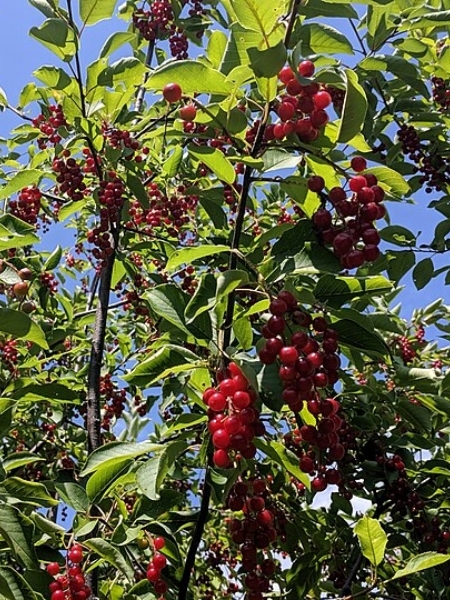
Chokecherry has an upright, spreading form. Clusters of fragrant white flowers appear in spring, followed by small dark red to purple-black cherries that ripen in late summer. The leaves turn yellow to reddish in fall. It can forming dense thickets and is best suited to larger naturalized gardens and property edges.
Plant Location
Distribution according to VASCAN
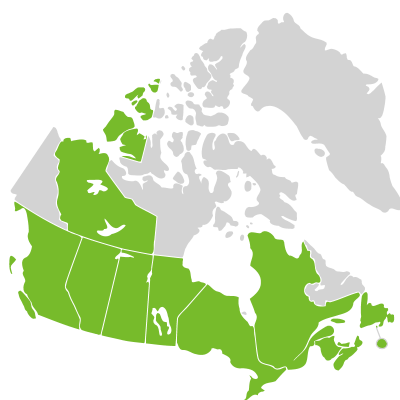
Ephemeral
Native
Introduced
Excluded
Extirpated
Doubtful
Absent
 Canadensis
No ecozone information available for this plant.
Ecological Benefits
Butterflies Supported by Prunus virginiana
-
Acronicta radcliffei
Radcliffe’s dagger -
Euxoa tessellata
Tessellate dart -
Limenitis arthemis ssp. astyanax
Red Spotted Purple -
Lomographa semiclarata
Bluish Spring - Arpenteuse du cerisier -
Malacosoma americanum
Eastern Tent Caterpillar - Livrée d'Amérique -
Melanchra picta
Zebra caterpillar -
Satyrium titus
Coral Hairstreak - Porte-queue Abrogé -
Scopula limboundata
Large lace-border
Specialized Bees Supported by Prunus virginiana
No bee data available for this plant.
Complementary Plants
- No complementary plants found.
Substitute For Non-Native Plants
No substitute plant data available for this plant.
Sowing Information
Download Seed Envelope Labels (PDF)
- Sowing depth: 3/8 inch
- Sow by January
- Stratification duration: 90 days
Harvesting and Seed Sharing
- Harvest start month: June
- Seed per envelope: 6
- Harvesting indicator:
- Berries are ripen and easily fall off or have fallen off
- Harvesting:
- Squeeze berries to extract seeds, wash with soapy water to remove flesh, rinse throroughly using a strainer
- Seed viability test:
- No test needed before donating
- Packaging measure: Six (6) seeds (eyeball)
- Seed storage:
- Air Dry in paper bag or open container, for a few days until crisp
- Shake seeds to move them once in a while to prevent molding
- Cultivar: Yes, do not donate unless you know source, and there are no known cultivars in your garden or at proximity
- No harvesting video available at this time.
Toxicity Notes
The seeds (pits), leaves and twigs contain cyanogenic compounds and can be poisonous if eaten, particularly when the plant material is damaged or wilted.