 Known to be toxic - Berry ingestion may cause mouth irritation, stomach upset
Plant Names

Parthenocissus vitacea
Thicket Creeper
Vigne vierge commune
Plant Characteristics
Bloom Colour: White
Bloom Period: Apr - Jun
Max Height: 80.0 feet
Max Width: 1.0 feet
Light Condition:
 More than 6 hours of direct sun a day
 More than 2 or 3 hours but less than 6 hours of direct sun a day
Soil conditions:
 Tolerates medium soil condition
More than 6 hours of direct sun a day
More than 2 or 3 hours but less than 6 hours of direct sun a day
Tolerates medium soil condition
Lifespan:
Perennial
plants that will come back year after year
Gardener Experience:
Landscape Uses:
No landscape information available.
Ecological Benefits:
 Supports birds
Tolerates:
 Tolerates salt conditions
 Deer resistant
 Tolerates limestone conditions
 Tolerates sandy conditions
Tolerates salt conditions
Deer resistant
Tolerates limestone conditions
Tolerates sandy conditions
Special Features and Considerations:
Seed and plant distribution status
No seeds available for this plant.
We currently accept seeds for this plant
Fun Facts
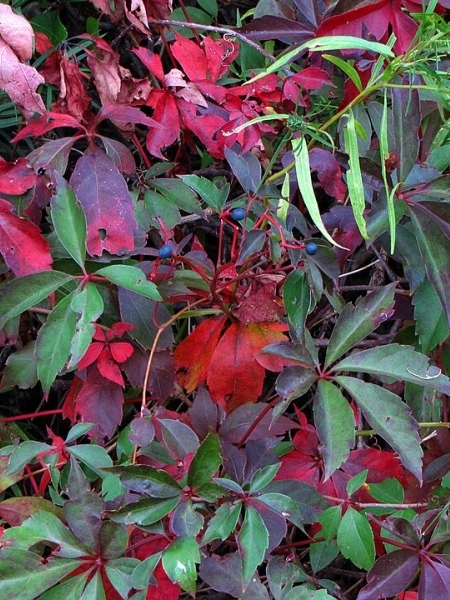
Woodbine is a vigorous native climbing vine recognized for its five-part leaves and spectacular red autumn colour.
Woodbine typically climbs by tendrils that wrap around supports. Its small flowers attract pollinators, while its blue-black berries provide valuable food for birds throughout the fall.
In the garden, woodbine is excellent for covering fences, arbors, and large trellises, or for naturalizing along woodland edges.
Plant Location
Distribution according to VASCAN

Ephemeral
Native
Introduced
Excluded
Extirpated
Doubtful
Absent
 Canadensis
No ecozone information available for this plant.
Ecological Benefits
Butterflies Supported by Parthenocissus vitacea
No butterfly data available for this plant.
Specialized Bees Supported by Parthenocissus vitacea
No bee data available for this plant.
Complementary Plants
- No complementary plants found.
Substitute For Non-Native Plants
No substitute plant data available for this plant.
Sowing Information
Download Seed Envelope Labels (PDF)
- Sowing depth: 3/8 inch
- Sow by February
- Stratification duration: 60 days
- Notes: Soak 24h
Harvesting and Seed Sharing
- Harvest start month: August
- Harvesting indicator:
- Berries are ripen and easily fall off or have fallen off
- Harvesting:
- Squeeze berries to extract seeds, wash with soapy water to remove flesh, rinse throroughly using a strainer
- Seed viability test:
- No test needed before donating
- Packaging measure: 1 rounded 1/8 teaspoon
- Seed storage:
- Air Dry in paper bag or open container, for a few days until crisp
- Shake seeds to move them once in a while to prevent molding
- Cultivar: No, you can donate without knowing the source as there are only straight species
- Remove non-seed material
- No harvesting video available at this time.
Toxicity Notes
Berry ingestion may cause mouth irritation, stomach upset