 Pas connu comme étant toxique - Not known to be toxic to mammals if ingested.
Plant Names

Amphicarpaea bracteata
American Hog Peanut
Amphicarpe bractéolée
Synonyms
hog peanut
Plant Characteristics
Couleur de floraison: Rose
Bloom Period: Aug - Sep
Hauteur max: 5,0 feet
Max Width: 3,0 feet
Light Condition:
 Plus de 6 heures d'ensoleillement par jour
 More than 2 or 3 hours but less than 6 hours of direct sun a day
 Less than 2 or 3 hours of direct sun a day
Soil conditions:
Less than 2 or 3 hours of direct sun a day
Soil conditions:
 Tolerates medium soil condition
Plus de 6 heures d'ensoleillement par jour
More than 2 or 3 hours but less than 6 hours of direct sun a day
Less than 2 or 3 hours of direct sun a day
Tolerates medium soil condition
Lifespan:
Annuel
des plantes qui ont une durée de vie d'un an
Gardener Experience:
 Ne se propage pas de manière incontrôlable
 Facile à germer
 Self-seeding
Ne se propage pas de manière incontrôlable
Facile à germer
Self-seeding
Landscape Uses:
 Suitable for school gardens
 Suitable for woodland gardens
Suitable for school gardens
Suitable for woodland gardens
Ecological Benefits:
 Butterfly host
 Fixes nitrogen in the soil
Butterfly host
Fixes nitrogen in the soil
Tolerates:
 Tolerates limestone conditions
 Tolerates juglone conditions
 Tolerates transplantation
Tolerates limestone conditions
Tolerates juglone conditions
Tolerates transplantation
Special Features and Considerations:
Seed and plant distribution status
No seeds available for this plant.
Nous acceptions les semences de cette plante
Faits intéressants
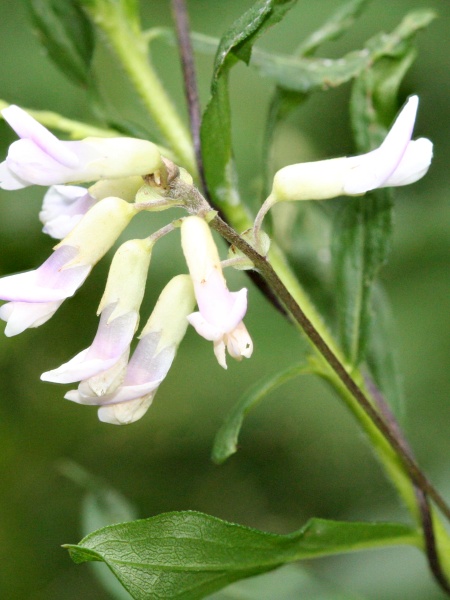
American Hog Peanut is a vine has pea-like, long lasting flowers. It lacks tendrils and therefore needs supports to coil around or it can also be allowed to sprawl along the ground as a ground cover. Once the plant goes to seed, the pods resemble dangling snow peas.
Plant Location
Native to Ottawa region: Oui
Distribution according to VASCAN
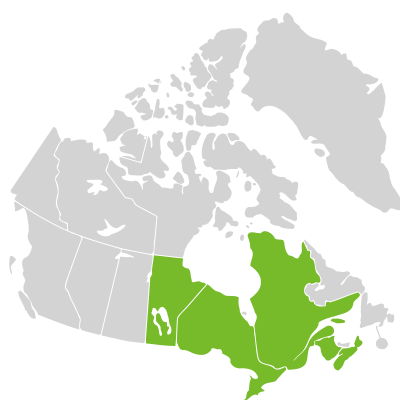
Ephemeral
Native
Introduced
Excluded
Extirpated
Doubtful
Absent
 Canadensis

Thrives in Ecozones
- Plaines à forêts mixtes
Ecological Benefits
Butterflies Supported by Amphicarpaea bracteata
-
Epargyreus clarus
Silver Spotted Skipper - Hespérie à Taches Argentées
Specialized Bees Supported by Amphicarpaea bracteata
No bee data available for this plant.
Complementary Plants
- No complementary plants found.
Substitute For Non-Native Plants
- Wisteria frutescens (American Wisteria)
- Lonicera (Non-Native Honeysuckle)
Sowing Information
Download Seed Envelope Labels (PDF)
- Sowing depth: Surface sow
- Sow anytime
- Stratification duration: 0 days
- Self-seeding
- Notes: Pre-soak for 12 hours in warm water. Can be sown in late spring in warm soil.
Harvesting and Seed Sharing
- Harvest start month: October
- Harvesting indicator:
- Pods are brown and crisp and starting to open
- Seeds are dark and tiny stem attaching to the main stem is brown
- Seeds easily fall off pod when shaken
- Little stem connecting the pod to the main stem is brown (not green)
- Harvesting:
- Utiliser la main pour détacher de la tige principale
- Seed viability test:
- Pas de test requis avant le don
- Packaging measure: 1 rounded 1/32 teaspoon
- Seed storage:
- Sécher à l'air dans un sac en papier ou contenant ouvert, pour quelques jours jusqu'à sec
- Secouer de temps à autre pour prévenir la moisissure
- Cultivar: No, you can donate without knowing the source as there are only straight species
- No harvesting video available at this time.
Toxicity Notes
Not known to be toxic to mammals if ingested.