 Connu comme étant toxique - Toxic to humans (and suspect other mammals) if ingested.
Plant Names

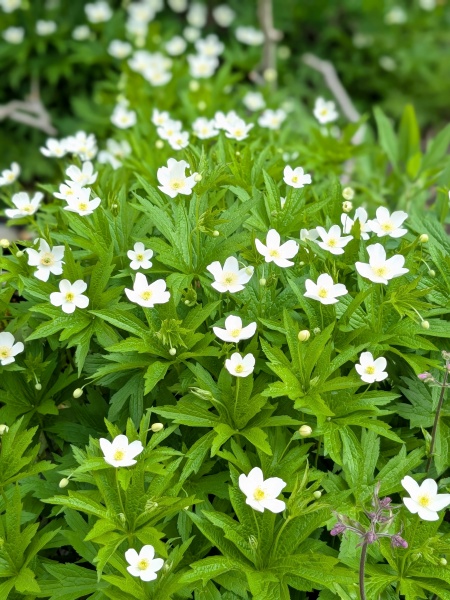
Anemonastrum canadense
Canada Anemone
Anémone du Canada
Synonyms
Canada windflower
meadow anemone
round-leaved anemone
round-leaved thimbleweed
Plant Characteristics
Couleur de floraison: Blanc
Bloom Period: May - Jun
Hauteur max: 1,0 feet
Max Width: 1,0 feet (spreads by rhizome)
Light Condition:
 Plus de 6 heures d'ensoleillement par jour
 More than 2 or 3 hours but less than 6 hours of direct sun a day
Soil conditions:
More than 2 or 3 hours but less than 6 hours of direct sun a day
Soil conditions:
 Tolerates medium soil condition
Plus de 6 heures d'ensoleillement par jour
More than 2 or 3 hours but less than 6 hours of direct sun a day
Tolerates medium soil condition
Lifespan:
Vivace
des plantes qui reviennent année après année
Gardener Experience:
 Spreads by rhizome
 Self-seeding
Spreads by rhizome
Self-seeding
Landscape Uses:
 Suitable for Right of Way gardens
 Souhaitable dans les jardins de zone humide
 Suitable for rain gardens
 Suitable for shoreline rehabilitation
 Suitable for container garden
 Tolerates boulevard garden conditions
Suitable for Right of Way gardens
Souhaitable dans les jardins de zone humide
Suitable for rain gardens
Suitable for shoreline rehabilitation
Suitable for container garden
Tolerates boulevard garden conditions
Ecological Benefits:
 Butterfly host
Butterfly host
Tolerates:
 Deer resistant
 Rabbit resistant
 Tolerates limestone conditions
 Tolerates sandy conditions
 Tolerates juglone conditions
 Tolerates transplantation
Deer resistant
Rabbit resistant
Tolerates limestone conditions
Tolerates sandy conditions
Tolerates juglone conditions
Tolerates transplantation
Special Features and Considerations:
Seed and plant distribution status
Semences disponible
Disponible à la table Mi-soleil, humide
Disponible à la table Mi-soleil, humide
Nous acceptions les semences de cette plante
Faits intéressants
Canada Anemone is best planted in larger spaces, rain gardens, or naturalized areas, where it can spread freely and form a dense carpet of white spring blooms. In smaller garden beds, it can quickly outcompete neighbouring plants, but in the right setting, it works well for covering ground and stabilizing moist soils. It tolerates moist conditions and even occasional flooding, making it a strong choice for low areas and stream edges. The white petals are actually sepals, and it attracts early-season pollinators.
Plant Location
Native to Ottawa region: Oui
Distribution according to VASCAN

Ephemeral
Native
Introduced
Excluded
Extirpated
Doubtful
Absent
 Canadensis

Thrives in Ecozones
- Taïga des plaines
- Taïga du Bouclier
- Plaines boréales
- Prairies
- Plaines à forêts mixtes
Ecological Benefits
Butterflies Supported by Anemonastrum canadense
-
Loscopia velata
Veiled ear
Specialized Bees Supported by Anemonastrum canadense
No bee data available for this plant.
Complementary Plants
- No complementary plants found.
Substitute For Non-Native Plants
- Hydrangea (Hydrangea)
- Aegopodium podagraria (Goutweed)
- Convallaria majalis (Lily of the Valley)
- Polygonatum odoratum).1 (Solomon's Seal)
- Lysimachia nummularia (Creeping Jenny)
Sowing Information
Download Seed Envelope Labels (PDF)
- Sowing depth: Couvrir très légèrement
- Sow anytime
- Stratification duration: 0 days
- Self-seeding
- Notes: Might need double dormancy. Sow promptly. Can be kept in fridge up to 2 months.
Harvesting and Seed Sharing
- Harvest start month: August
- Harvesting indicator:
- Seeds easily fall off when you gently pull them off
- Harvesting:
- Utiliser la main pour détacher de la tige principale
- Seed viability test:
- Pas de test requis avant le don
- Packaging measure: 1 rounded 1/4 teaspoon
- Seed storage:
- Garder humide et frais, danssac refermable au frigo, avec graines dans de terre, papier essuie-tout, filtre à café ou vermiculite, jusqu'au don
- Cultivar: Yes, do not donate unless you know source, and there are no known cultivars in your garden or at proximity
- No harvesting video available at this time.
Toxicity Notes
Toxic to humans (and suspect other mammals) if ingested.