 Inconnu - Can be toxic if ingested. Sources do not specify which species but assume all.
Plant Names

Aralia racemosa
American Spikenard
Aralie à grappes
Synonyms
anis sauvage
grande salsepareille
Plant Characteristics
Couleur de floraison: Vert
Bloom Period: Jul - Aug
Hauteur max: 4,0 feet
Max Width: 4,0 feet (spreads by rhizome)
Light Condition:
 More than 2 or 3 hours but less than 6 hours of direct sun a day
Soil conditions:
More than 2 or 3 hours but less than 6 hours of direct sun a day
Soil conditions:
 Tolerates medium soil condition
More than 2 or 3 hours but less than 6 hours of direct sun a day
Tolerates medium soil condition
Lifespan:
Vivace
des plantes qui reviennent année après année
Gardener Experience:
 Ne se propage pas de manière incontrôlable
 Spreads by rhizome
 Self-seeding
Ne se propage pas de manière incontrôlable
Spreads by rhizome
Self-seeding
Landscape Uses:
 Suitable for container garden
Suitable for container garden
Ecological Benefits:
 Supports birds
 Butterfly host
Supports birds
Butterfly host
Tolerates:
 Tolerates limestone conditions
 Tolerates transplantation
Tolerates limestone conditions
Tolerates transplantation
Special Features and Considerations:
Seed and plant distribution status
Semences disponible
Disponible à la table Ombre
Disponible à la table Ombre
Nous acceptions les semences de cette plante
Faits intéressants
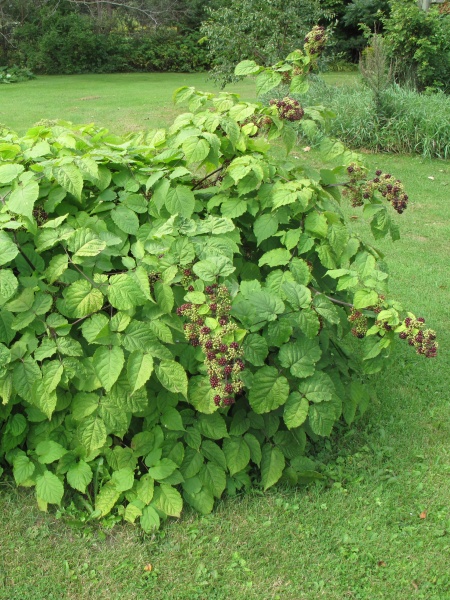
American Spikenard has large compound leaves and upright clusters of greenish-white summer flowers. Later in the season, it produces dark purple berries that persist into fall and provide food for birds. It is clump-forming and slow to establish, it prefers part to full shade and rich, moist soils. Its stately height, textured foliage, and architectural flower clusters make it ideal for shady borders, woodland gardens, or naturalized plantings.
Plant Location
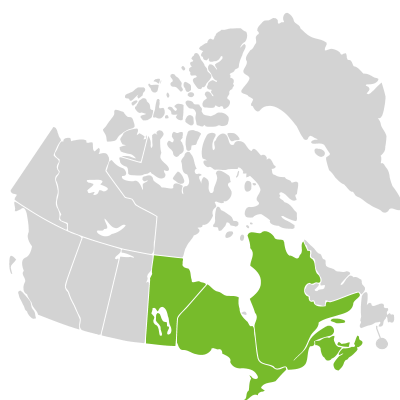
Native to Ottawa region: Oui
Distribution according to VASCAN
Ephemeral
Native
Introduced
Excluded
Extirpated
Doubtful
Absent
 Canadensis

Thrives in Ecozones
- Plaines boréales
- Bouclier boréal
- Plaines à forêts mixtes
Ecological Benefits
Butterflies Supported by Aralia racemosa
-
Argyrotaenia repertana
Argyrotaenia repertana -
Eupithecia satyrata
Satyr pug - Eupithécie Satyre
Specialized Bees Supported by Aralia racemosa
No bee data available for this plant.
Complementary Plants
- No complementary plants found.
Substitute For Non-Native Plants
- Sorbaria sorbifolia (False spirea)
- Aruncus dioicus (Goat's Beard)
- Polygonatum odoratum (Solomon's Seal)
- Hydrangea (Hydrangea)
- Aegopodium podagraria (Goutweed)
Sowing Information
Download Seed Envelope Labels (PDF)
- Sowing depth: Couvrir très légèrement
- Sow by February
- Stratification duration: 60 days
- Self-seeding
- Notes: Scarify and cold moist stratify.
Harvesting and Seed Sharing
- Harvest start month: September
- Harvesting indicator:
- Berries are ripen and easily fall off or have fallen off
- Harvesting:
- Squeeze berries to extract seeds, wash with soapy water, rinse throroughly
- Seed viability test:
- Pas de test requis avant le don
- Packaging measure: Six (6) seeds (eyeball)
- Seed storage:
- Garder humide et frais, danssac refermable au frigo, avec graines dans de terre, papier essuie-tout, filtre à café ou vermiculite, jusqu'au don
- Cultivar: No, you can donate without knowing the source as there are only straight species
- Remove non-seed material
- Harvesting video: Watch here
Toxicity Notes
Can be toxic if ingested. Sources do not specify which species but assume all.