 Connu comme étant toxique - Toxic to humans and other mammals if ingested.
Plant Names

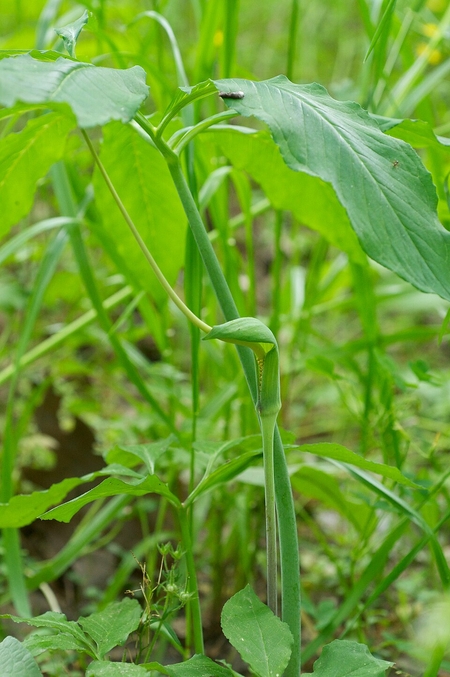
Arisaema dracontium
Green Dragon
Arisème dragon
Synonyms
dragon-root
ariséma dragon
Plant Characteristics
Couleur de floraison: Vert
Bloom Period: May - Jun
Hauteur max: 3,0 feet
Max Width: 2,0 feet
Light Condition:
 Less than 2 or 3 hours of direct sun a day
Soil conditions:
Less than 2 or 3 hours of direct sun a day
Soil conditions:
 Tolerates medium soil condition
Less than 2 or 3 hours of direct sun a day
Tolerates medium soil condition
Lifespan:
Vivace
des plantes qui reviennent année après année
Plant is
dioecious
Need a male and female plant to produce seeds
Gardener Experience:
 Ne se propage pas de manière incontrôlable
Ne se propage pas de manière incontrôlable
Landscape Uses:
 Suitable for woodland gardens
Suitable for woodland gardens
Ecological Benefits:
No ecological benefits information available.
Tolerates:
 Deer resistant
 Rabbit resistant
 Tolerates transplantation
Deer resistant
Rabbit resistant
Tolerates transplantation
Special Features and Considerations:
Seed and plant distribution status
No seeds available for this plant.
Nous acceptions les semences de cette plante
Faits intéressants
Green Dragon is a quirky woodland perennial that produces a single divided leaf in spring and a slender green spadix, the dragon, wrapped in a hooded spathe. Its unusual vertical flowers make it a striking addition to shaded woodland gardens or naturalized understories. It is slow to spread, it forms small clumps via underground tubers and prefers rich, moist, well-drained soils. In fall, bright red berries appear, adding wildlife interest, while specialized flies pollinate its unique flowers, making it both ecologically and visually distinctive.
Plant Location
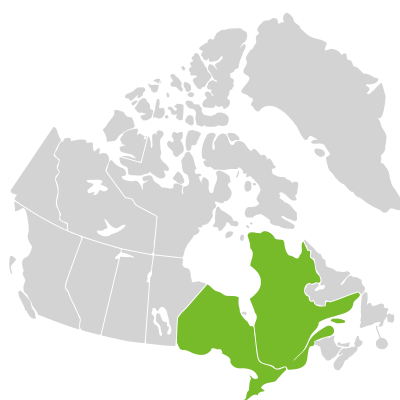
Distribution according to VASCAN
Ephemeral
Native
Introduced
Excluded
Extirpated
Doubtful
Absent
 Canadensis

Thrives in Ecozones
- Plaines à forêts mixtes
Ecological Benefits
Butterflies Supported by Arisaema dracontium
No butterfly data available for this plant.
Specialized Bees Supported by Arisaema dracontium
No bee data available for this plant.
Complementary Plants
- No complementary plants found.
Substitute For Non-Native Plants
- Convallaria majalis (Lily of the Valley)
- Lysimachia nummularia (Creeping Jenny)
- Iridaceae (Crocus)
- Scilla siberica (Siberian Squill)
- Tulipa (Tulips)
Sowing Information
Download Seed Envelope Labels (PDF)
- Sowing depth: Couvrir très légèrement
- Sow anytime
- Stratification duration: 0 days
- Notes: Sow promptly. Can be kept in fridge up to 2 months.
Harvesting and Seed Sharing
- Harvest start month: September
- Harvesting indicator:
- Berries are ripen and easily fall off or have fallen off
- Harvesting:
- Squeeze berries to extract seeds, wash with soapy water, rinse throroughly
- Seed viability test:
- Pas de test requis avant le don
- Packaging measure: A dozen (12) seeds (eyeball)
- Seed storage:
- Garder humide et frais, danssac refermable au frigo, avec graines dans de terre, papier essuie-tout, filtre à café ou vermiculite, jusqu'au don
- Cultivar: No, you can donate without knowing the source as there are only straight species
- Remove non-seed material
- No harvesting video available at this time.
Toxicity Notes
Toxic to humans and other mammals if ingested.