 Connu comme étant toxique - Toxic to mammals if ingested.
Plant Names

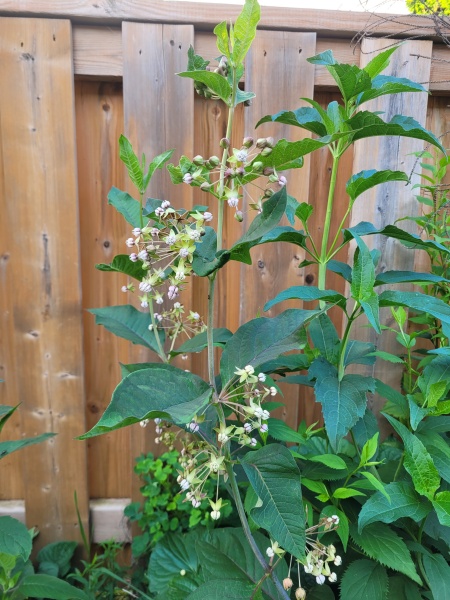
Asclepias exaltata
Poke Milkweed
Asclépiade très grande
Synonyms
tall milkweed
grande asclépiade
Plant Characteristics
Couleur de floraison: Blanc
Bloom Period: Jun - Jul
Hauteur max: 5,0 feet
Max Width: 3,0 feet (spreads by rhizome)
Light Condition:
 Less than 2 or 3 hours of direct sun a day
Soil conditions:
Less than 2 or 3 hours of direct sun a day
Soil conditions:
 Tolerates medium soil condition
Less than 2 or 3 hours of direct sun a day
Tolerates medium soil condition
Lifespan:
Vivace
des plantes qui reviennent année après année
Gardener Experience:
 Ne se propage pas de manière incontrôlable
 Spreads by rhizome
Ne se propage pas de manière incontrôlable
Spreads by rhizome
Landscape Uses:
 Suitable for container garden
 Suitable for woodland gardens
 Tolerates boulevard garden conditions
Suitable for container garden
Suitable for woodland gardens
Tolerates boulevard garden conditions
Ecological Benefits:
 Butterfly host
Butterfly host
Tolerates:
 Deer resistant
 Rabbit resistant
 Tolerates limestone conditions
 Tolerates transplantation
Deer resistant
Rabbit resistant
Tolerates limestone conditions
Tolerates transplantation
Special Features and Considerations:
Seed and plant distribution status
No seeds available for this plant.
Nous acceptions les semences de cette plante
Faits intéressants
Asclepias exaltata, commonly called poke milkweed, is a native perennial found in open woodlands and forest edges across eastern North America, making it a good choice for lightly shaded gardens. It produces drooping clusters of soft pink to white flowers in early to mid-summer. By late summer, slender seed pods form, releasing silky-tufted seeds that disperse by wind.
Plant Location
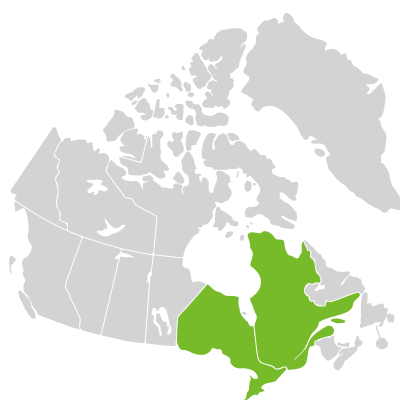
Distribution according to VASCAN
Ephemeral
Native
Introduced
Excluded
Extirpated
Doubtful
Absent
 Canadensis

Thrives in Ecozones
- Bouclier boréal
- Plaines à forêts mixtes
Ecological Benefits
Butterflies Supported by Asclepias exaltata
-
Cycnia tenera
Delicate cycnia -
Danaus plexippus
Monarch - Monarque -
Euchaetes egle
Milkweed tussock - Arctiide de l'Asclépiade -
Papaipema nebris
Stalk borer - Noctuelle à Taches En Grains -
Trichordestra legitima
Striped Garden Caterpillar
Specialized Bees Supported by Asclepias exaltata
No bee data available for this plant.
Complementary Plants
- No complementary plants found.
Substitute For Non-Native Plants
- Hydrangea (Hydrangea)
- Asclepias (Milkweed Cultivars)
- Asclepias curassavica (Tropical Milkweed)
Sowing Information
Download Seed Envelope Labels (PDF)
- Sowing depth: Couvrir très légèrement
- Sow by March
- Stratification duration: 30 days
Harvesting and Seed Sharing
- Harvest start month: September
- Harvesting indicator:
- Pods are slightly open and seeds inside are dark
- Harvesting:
- Utiliser la main pour détacher de la tige principale
- Seed viability test:
- Pas de test requis avant le don
- Packaging measure: 1 rounded 1/8 teaspoon
- Seed storage:
- Sécher à l'air dans un sac en papier ou contenant ouvert, pour quelques jours jusqu'à sec
- Secouer de temps à autre pour prévenir la moisissure
- Cultivar: No, you can donate without knowing the source as there are only straight species
- Remove non-seed material
- Harvesting video: Watch here
Toxicity Notes
Toxic to mammals if ingested.