 Connu comme étant toxique - All parts of whorled milkweed contain cardiac glycosides and are toxic if eaten in sufficient quantities. These compounds can affect the heart and digestive system.
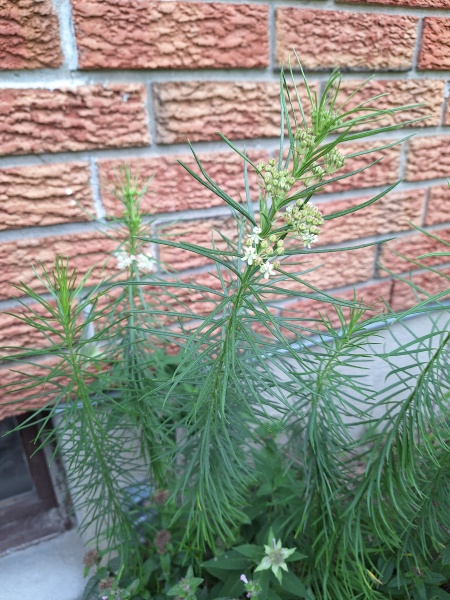
Plant Names

Asclepias verticillata
Whorled Milkweed
Asclépiade verticillée
Synonyms
eastern whorled milkweed
Plant Characteristics
Couleur de floraison: Blanc
Bloom Period: Jul - Sep
Hauteur max: 2,0 feet
Max Width: 2,0 feet
Light Condition:
 Plus de 6 heures d'ensoleillement par jour
 More than 2 or 3 hours but less than 6 hours of direct sun a day
Soil conditions:
More than 2 or 3 hours but less than 6 hours of direct sun a day
Soil conditions:
 Tolère des conditions de sol sec
 Tolerates medium soil condition
Plus de 6 heures d'ensoleillement par jour
More than 2 or 3 hours but less than 6 hours of direct sun a day
Tolère des conditions de sol sec
Tolerates medium soil condition
Lifespan:
Vivace
des plantes qui reviennent année après année
Gardener Experience:
 Suitable for beginner gardeners
 Ne se propage pas de manière incontrôlable
 Self-seeding
Suitable for beginner gardeners
Ne se propage pas de manière incontrôlable
Self-seeding
Landscape Uses:
 Suitable for rock gardens
 Suitable for Right of Way gardens
 Suitable for container garden
 Suitable for school gardens
 Tolerates boulevard garden conditions
Suitable for rock gardens
Suitable for Right of Way gardens
Suitable for container garden
Suitable for school gardens
Tolerates boulevard garden conditions
Ecological Benefits:
 Butterfly host
Butterfly host
Tolerates:
 Deer resistant
 Rabbit resistant
 Tolerates limestone conditions
 Tolerates transplantation
Deer resistant
Rabbit resistant
Tolerates limestone conditions
Tolerates transplantation
Special Features and Considerations:
 This plant causes skin rashes
This plant causes skin rashes
Seed and plant distribution status
No seeds available for this plant.
Nous acceptions les semences de cette plante
Faits intéressants
Whorled Milkweed is best suited for sunny, dry to medium soils and works well in prairies, meadows, and naturalized plantings. It is typically less aggressive than common milkweed, making it easier to manage in garden settings. Its fine, thread-like leaves give it a softer texture compared to other milkweeds. It is an excellent choice for prairie gardens, dry meadows, sunny borders and naturalized plantings. It forms upright clumps and is generally well behaved. It is very drought tolerant once established and does not need regular watering. Avoid rich, heavily amended soil; lean, well-drained soil helps maintain a sturdy plant. Its airy form allows it to mix well with other native plants, adding diversity and movement to late-season plantings.
Plant Location
Native to Ottawa region: Oui
Distribution according to VASCAN
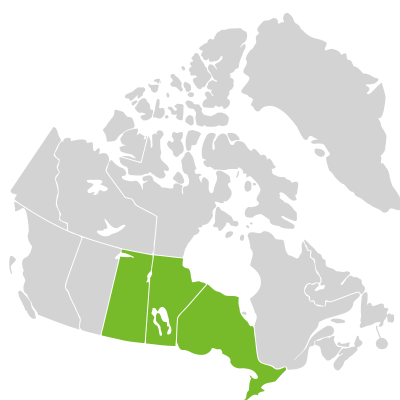
Ephemeral
Native
Introduced
Excluded
Extirpated
Doubtful
Absent
 Canadensis

Thrives in Ecozones
- Plaines boréales
- Prairies
- Plaines à forêts mixtes
Ecological Benefits
Butterflies Supported by Asclepias verticillata
-
Danaus plexippus
Monarch - Monarque -
Trichordestra legitima
Striped Garden Caterpillar
Specialized Bees Supported by Asclepias verticillata
No bee data available for this plant.
Complementary Plants
- No complementary plants found.
Substitute For Non-Native Plants
- Buddleia (Butterfly Bush)
- Asclepias (Milkweed Cultivars)
- Asclepias curassavica (Tropical Milkweed)
- Butomus umbellatus (Flowering Rush)
Sowing Information
Download Seed Envelope Labels (PDF)
- Sowing depth: Couvrir très légèrement
- Sow by March
- Stratification duration: 30 days
- Self-seeding
Harvesting and Seed Sharing
- Harvest start month: September
- Harvesting indicator:
- Pods are slightly open and seeds inside are dark
- Harvesting:
- Utiliser la main pour détacher de la tige principale
- Seed viability test:
- Pas de test requis avant le don
- Packaging measure: 1 rounded 1/8 teaspoon
- Seed storage:
- Sécher à l'air dans un sac en papier ou contenant ouvert, pour quelques jours jusqu'à sec
- Secouer de temps à autre pour prévenir la moisissure
- Cultivar: No, you can donate without knowing the source as there are only straight species
- Remove non-seed material
- Harvesting video: Watch here
Toxicity Notes
All parts of whorled milkweed contain cardiac glycosides and are toxic if eaten in sufficient quantities. These compounds can affect the heart and digestive system.