 Connu comme étant toxique - Toxic if ingested.
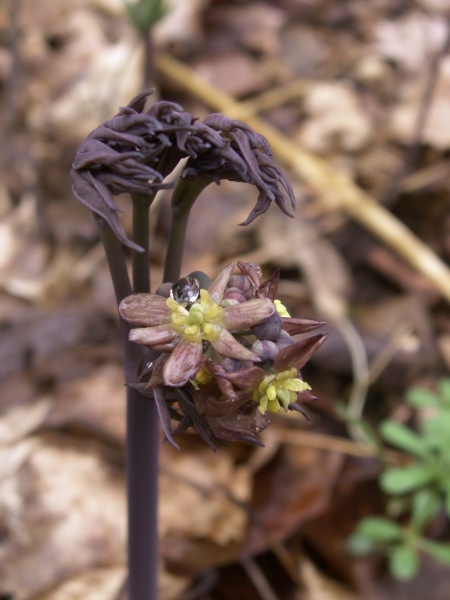
Plant Names

Caulophyllum thalictroides
Blue Cohosh
Caulophylle faux-pigamon
Synonyms
papoose-root
cohosh bleu
léontice faux-pigamon
Plant Characteristics
Couleur de floraison: Vert
Bloom Period: Apr - Apr
Hauteur max: 2,0 feet
Max Width: 2,0 feet (spreads by rhizome)
Light Condition:
 Less than 2 or 3 hours of direct sun a day
Soil conditions:
Less than 2 or 3 hours of direct sun a day
Soil conditions:
 Tolerates medium soil condition
Less than 2 or 3 hours of direct sun a day
Tolerates medium soil condition
Lifespan:
Vivace
des plantes qui reviennent année après année
(Spring Ephemeral)
Gardener Experience:
 Ne se propage pas de manière incontrôlable
 Spreads by rhizome
Ne se propage pas de manière incontrôlable
Spreads by rhizome
Landscape Uses:
 Suitable for woodland gardens
Suitable for woodland gardens
Ecological Benefits:
No ecological benefits information available.
Tolerates:
 Deer resistant
 Rabbit resistant
 Tolerates acidic soil conditions
 Tolerates juglone conditions
 Tolerates transplantation
Deer resistant
Rabbit resistant
Tolerates acidic soil conditions
Tolerates juglone conditions
Tolerates transplantation
Special Features and Considerations:
 This plant causes skin rashes
This plant causes skin rashes
Seed and plant distribution status
No seeds available for this plant.
Nous acceptions les semences de cette plante
Faits intéressants
Blue Cohosh a shade-loving plant valued for its bluish-green foliage that emerges smoky-purple in spring, as well as its clusters of blue, fruit-like seeds that appear in summer and last into fall. It is best grown in shady areas in rich, moist soils typical of a woodland floor where it is found naturally. It needs consistently moist soil that does not dry out. Plants grown from seed typically take three to four years to flower. It eventually forms colonies, making it a suitable option for naturalizing shade gardens or establishing vegetation in the understory of deciduous trees.
Plant Location
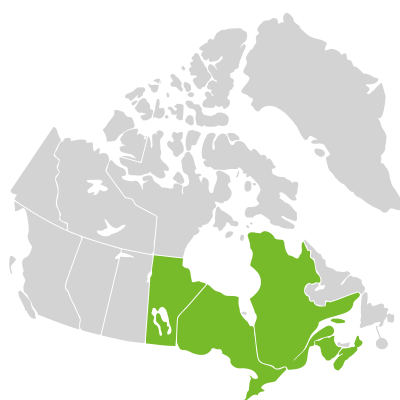
Native to Ottawa region: Oui
Distribution according to VASCAN
Ephemeral
Native
Introduced
Excluded
Extirpated
Doubtful
Absent
 Canadensis

Thrives in Ecozones
- Maritime de l'Atlantique
- Bouclier boréal
- Plaines à forêts mixtes
Ecological Benefits
Butterflies Supported by Caulophyllum thalictroides
No butterfly data available for this plant.
Specialized Bees Supported by Caulophyllum thalictroides
No bee data available for this plant.
Complementary Plants
- No complementary plants found.
Substitute For Non-Native Plants
- Lamium (Dead nettle)
- Funkia (Hosta)
- Myosotis sylvatica (Forget-me-not)
- Lamium galeobdolon (Yellow Archangel)
Sowing Information
Download Seed Envelope Labels (PDF)
- Sowing depth: Couvrir très légèrement
- Sow anytime
- Stratification duration: 0 days
- Notes: Multiple dormancy may be needed. Sow promptly. Can be kept in fridge up to 2 months.
Harvesting and Seed Sharing
- Harvest start month: September
- Harvesting indicator:
- Berries are ripen and easily fall off or have fallen off
- Harvesting:
- Squeeze berries to extract seeds, wash with soapy water, rinse throroughly
- Seed viability test:
- Pas de test requis avant le don
- Packaging measure: Six (6) seeds (eyeball)
- Seed storage:
- Garder humide et frais, danssac refermable au frigo, avec graines dans de terre, papier essuie-tout, filtre à café ou vermiculite, jusqu'au don
- Cultivar: No, you can donate without knowing the source as there are only straight species
- No harvesting video available at this time.
Toxicity Notes
Toxic if ingested.