 Pas connu comme étant toxique - Not known to be toxic to mammals if ingested.
Plant Names

Ceanothus herbaceus
Narrow-leaved New Jersey Tea
Céanothe à feuilles étroites
Synonyms
inland ceanothus
inland Jersey tea
prairie redroot
smaller redroot
céanothus à feuilles ovées
Plant Characteristics
Couleur de floraison: Blanc
Bloom Period: May - Jun
Hauteur max: 3,0 feet
Max Width: 3,0 feet
Light Condition:
 Plus de 6 heures d'ensoleillement par jour
Soil conditions:
Plus de 6 heures d'ensoleillement par jour
Soil conditions:
 Tolère des conditions de sol sec
 Tolerates medium soil condition
Plus de 6 heures d'ensoleillement par jour
Tolère des conditions de sol sec
Tolerates medium soil condition
Lifespan:
Vivace
des plantes qui reviennent année après année
Gardener Experience:
 Ne se propage pas de manière incontrôlable
 Self-seeding
Ne se propage pas de manière incontrôlable
Self-seeding
Landscape Uses:
 Suitable for rock gardens
 Suitable for school gardens
Suitable for rock gardens
Suitable for school gardens
Ecological Benefits:
 Butterfly host
 Fixes nitrogen in the soil
Butterfly host
Fixes nitrogen in the soil
Tolerates:
 Tolerates transplantation
Tolerates transplantation
Special Features and Considerations:
Seed and plant distribution status
No seeds available for this plant.
Nous acceptions les semences de cette plante
Faits intéressants
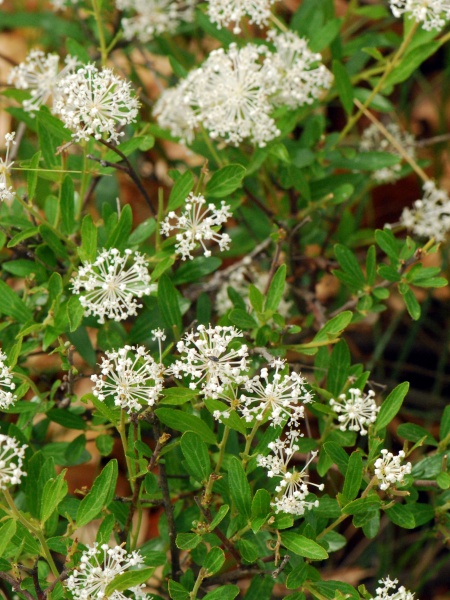
Narrow-leaved New Jersey Tea is a small, upright, deciduous shrub that is an early spring bloomer. Its fragrant white flowers give way to black, triangular fruits that mature in late summer. Although somewhat slow to establish, its extensive root system and drought tolerance make it an excellent choice for poor soil sites. It is a good choice as ground cover on dry, sunny and rocky locations or for erosion control on slopes. It should remain undisturbed once fully established.
Plant Location
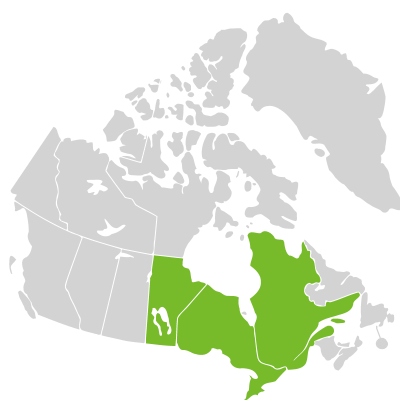
Native to Ottawa region: Oui
Distribution according to VASCAN
Ephemeral
Native
Introduced
Excluded
Extirpated
Doubtful
Absent
 Canadensis

Thrives in Ecozones
- Maritime du Pacifique
- Plaines à forêts mixtes
Ecological Benefits
Butterflies Supported by Ceanothus herbaceus
-
Chlorochlamys chloroleucaria
Blackberry looper - Arpenteuse des ronces
Specialized Bees Supported by Ceanothus herbaceus
No bee data available for this plant.
Complementary Plants
- No complementary plants found.
Substitute For Non-Native Plants
- Buddleia (Butterfly Bush)
- Hydrangea (Hydrangea)
- Buxus sempervirens (Boxwood)
Sowing Information
Download Seed Envelope Labels (PDF)
- Sowing depth: Surface sow
- Sow by February
- Stratification duration: 60 days
- Self-seeding
- Notes: Pour boiling water over seeds and soak for 24 hrs
Harvesting and Seed Sharing
- Harvest start month: July
- Harvesting indicator:
- Pods are brown, seeds are dark, and crisp, and little stem connecting the pod to the main stem is brown (not green)
- Harvesting:
- Secouer le porte-graines dans un sac de papier
- Seed viability test:
- Pas de test requis avant le don
- Packaging measure: Six (6) seeds (eyeball)
- Seed storage:
- Sécher à l'air dans un sac en papier ou contenant ouvert, pour quelques jours jusqu'à sec
- Secouer de temps à autre pour prévenir la moisissure
- Cultivar: No, you can donate without knowing the source as there are only straight species
- Remove non-seed material
- No harvesting video available at this time.
Toxicity Notes
Not known to be toxic to mammals if ingested.