 Inconnu - Inadequate information on toxicity found.
Plant Names

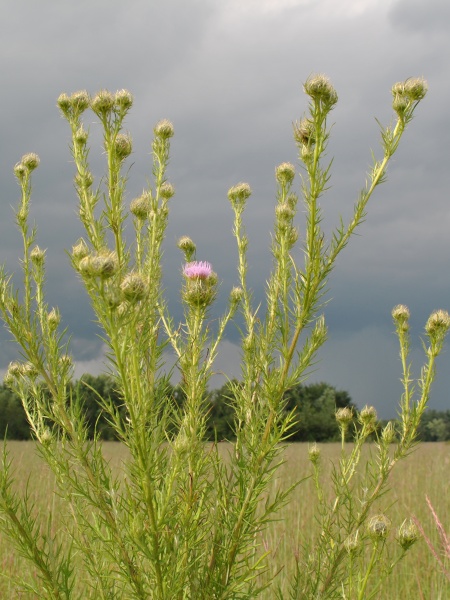
Cirsium discolor
Field Thistle
Chardon discolore
Synonyms
pasture thistle
circe discolore
Plant Characteristics
Couleur de floraison: Violet
Bloom Period: Aug - Oct
Hauteur max: 6,0 feet
Max Width: 2,0 feet (spreads by rhizome)
Light Condition:
 Plus de 6 heures d'ensoleillement par jour
 More than 2 or 3 hours but less than 6 hours of direct sun a day
Soil conditions:
More than 2 or 3 hours but less than 6 hours of direct sun a day
Soil conditions:
 Tolerates medium soil condition
Plus de 6 heures d'ensoleillement par jour
More than 2 or 3 hours but less than 6 hours of direct sun a day
Tolerates medium soil condition
Lifespan:
Bisannuel
des plantes qui mettront deux ans à fleurir, puis mourront
Gardener Experience:
 Ne se propage pas de manière incontrôlable
 Spreads by rhizome
 Facile à germer
 Self-seeding
Ne se propage pas de manière incontrôlable
Spreads by rhizome
Facile à germer
Self-seeding
Landscape Uses:
 Suitable for rock gardens
 Suitable for woodland gardens
Suitable for rock gardens
Suitable for woodland gardens
Ecological Benefits:
 Butterfly host
 Bee host
Butterfly host
Bee host
Tolerates:
 Tolerates limestone conditions
Tolerates limestone conditions
Special Features and Considerations:
 This plant produces burs
This plant produces burs
Seed and plant distribution status
Semences disponible
Disponible à la table Plein soleil, moyen
Disponible à la table Plein soleil, moyen
Nous acceptions les semences de cette plante
Faits intéressants
Field thistle has deeply divided leaves and pale pink to lavender flower heads in summer. It is found in meadows, fields, roadsides, woodland edges, and other open areas. Its upright form makes it appropriate for meadow and naturalized plantings rather than formal gardens. It is usually better suited to large naturalized areas than small gardens. Unlike invasive thistles, it is a native species and is not considered an invasive weed.
Plant Location
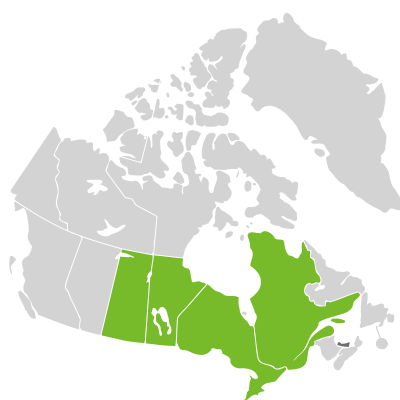
Native to Ottawa region: Oui
Distribution according to VASCAN
Ephemeral
Native
Introduced
Excluded
Extirpated
Doubtful
Absent
 Canadensis

Thrives in Ecozones
- Maritime de l'Atlantique
- Bouclier boréal
- Plaines à forêts mixtes
Ecological Benefits
Butterflies Supported by Cirsium discolor
-
Papaipema nebris
Stalk borer - Noctuelle à Taches En Grains
Specialized Bees Supported by Cirsium discolor
- Megachile inimica
- Megachile pugnata
- Melissodes agilis
- Melissodes desponsus
- Melissodes subillatus
- Osmia chalybea
- Osmia texana
Complementary Plants
- No complementary plants found.
Substitute For Non-Native Plants
- Cirsium arvense (Canada Thistle)
Sowing Information
Download Seed Envelope Labels (PDF)
- Sowing depth: Surface sow
- Sow by February
- Stratification duration: 60 days
- Self-seeding
Harvesting and Seed Sharing
- Harvest start month: October
- Harvesting indicator:
- Seeds easily fall off when you gently pull them off
- Harvesting:
- Secouer le porte-graines dans un sac de papier
- Seed viability test:
- Pas de test requis avant le don
- Packaging measure: 1 rounded 1/8 teaspoon
- Seed storage:
- Sécher à l'air dans un sac en papier ou contenant ouvert, pour quelques jours jusqu'à sec
- Secouer de temps à autre pour prévenir la moisissure
- Cultivar: No, you can donate without knowing the source as there are only straight species
- No harvesting video available at this time.
Toxicity Notes
Inadequate information on toxicity found.