 Connu comme étant toxique - The plant itself is not generally considered poisonous, but the mature seed heads are a physical hazard. The barbed awns can become lodged in the mouths, noses, ears, eyes, skin, or digestive tracts of animals. This can result in serious injury or infection.
Plant Names

Hordeum jubatum
Foxtail Barley
Orge queue-d’écureuil
Synonyms
foxtail
squirreltail barley
squirreltail grass
wild barley
finette
orge agréable
orge barbue
petit minou
queue d'écureuil
Plant Characteristics
Couleur de floraison: Vert
Bloom Period: Jun - Aug
Hauteur max: 1,0 feet
Max Width: 2,0 feet
Light Condition:
 Plus de 6 heures d'ensoleillement par jour
Soil conditions:
Plus de 6 heures d'ensoleillement par jour
Soil conditions:
 Tolère des conditions de sol sec
 Tolerates medium soil condition
Plus de 6 heures d'ensoleillement par jour
Tolère des conditions de sol sec
Tolerates medium soil condition
Lifespan:
Vivace
des plantes qui reviennent année après année
Gardener Experience:
 Facile à germer
 Self-seeding
Facile à germer
Self-seeding
Landscape Uses:
 Suitable for rock gardens
 Suitable for Right of Way gardens
 Tolerates boulevard garden conditions
Suitable for rock gardens
Suitable for Right of Way gardens
Tolerates boulevard garden conditions
Ecological Benefits:
No ecological benefits information available.
Tolerates:
 Tolerates juglone conditions
Tolerates juglone conditions
Special Features and Considerations:
Seed and plant distribution status
Semences disponible
Disponible à la table Plein soleil
Disponible à la table Plein soleil
Nous acceptions les semences de cette plante
Faits intéressants
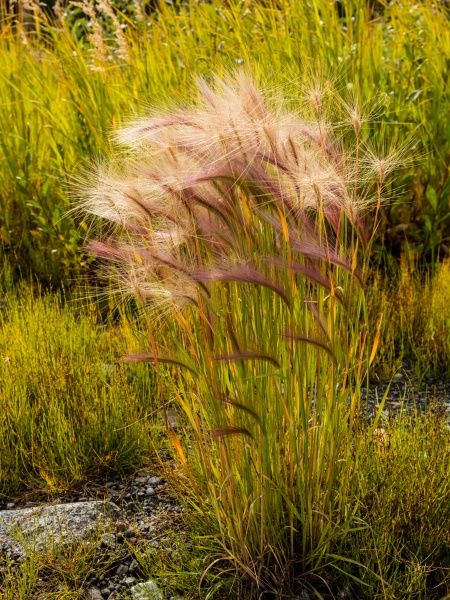
Foxtail Barley is a distinctive native cool-season grass with narrow leaves and attractive, long, bristly seed heads that resemble a fox's tail. The seed heads often have a pinkish, purplish, or reddish tint when young and turn straw-coloured as they mature. It is a short-lived perennial or sometimes annual/biennial grass that readily establishes from seed. It is generally tolerant of difficult soils. It can self-seed readily, particularly where soil is disturbed. its awns can become particularly problematic for dogs, cats, livestock, and wildlife if they become embedded in fur, skin, eyes, ears, or mouths. For this reason, it is not a good choice beside paths, play areas, dog runs, or livestock areas. It can be useful in a naturalized or restoration planting where its distinctive seed heads are desirable and the site is away from people and animals.
Plant Location
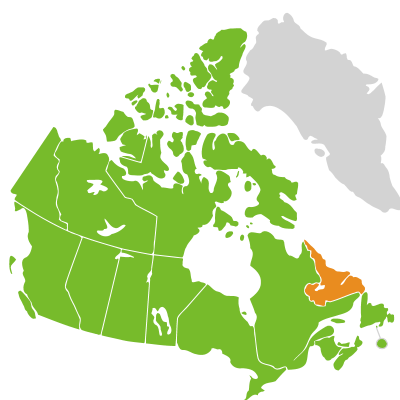
Distribution according to VASCAN
Ephemeral
Native
Introduced
Excluded
Extirpated
Doubtful
Absent
 Canadensis

Thrives in Ecozones
- Taïga des plaines
- Taïga du Bouclier
- Plaines boréales
- Cordillière montagnarde
- Prairies
- Bouclier boréal
- Maritime du Pacifique
Ecological Benefits
Butterflies Supported by Hordeum jubatum
No butterfly data available for this plant.
Specialized Bees Supported by Hordeum jubatum
No bee data available for this plant.
Complementary Plants
- No complementary plants found.
Substitute For Non-Native Plants
- Miscanthus (Silvergrass)
- Cortaderia selloana (Pampas Grass)
- Pennisetum setaceum (Fountain Grass)
Sowing Information
Download Seed Envelope Labels (PDF)
- Sowing depth: Couvrir très légèrement
- Sow anytime
- Stratification duration: 0 days
- Self-seeding
- Notes: Can be sown in late spring in warm soil.
Harvesting and Seed Sharing
- Harvest start month: May
- Harvesting indicator:
- Seeds easily fall off when you gently pull them off
- Harvesting:
- Utiliser la main pour détacher de la tige principale
- Seed viability test:
- Pas de test requis avant le don
- Packaging measure: A dozen (12) seeds (eyeball)
- Seed storage:
- Sécher à l'air dans un sac en papier ou contenant ouvert, pour quelques jours jusqu'à sec
- Secouer de temps à autre pour prévenir la moisissure
- Cultivar: No, you can donate without knowing the source as there are only straight species
- No harvesting video available at this time.
Toxicity Notes
The plant itself is not generally considered poisonous, but the mature seed heads are a physical hazard. The barbed awns can become lodged in the mouths, noses, ears, eyes, skin, or digestive tracts of animals. This can result in serious injury or infection.