 Inconnu - Inadequate information on toxicity found.
Plant Names

Oenothera biennis
Common Evening-primrose
Onagre bisannuelle
Synonyms
hoary evening-primrose
king's cureall
yellow evening-primrose
herbe aux ânes
onagre de Victorin
Plant Characteristics
Couleur de floraison: Jaune
Bloom Period: Jun - Sep
Hauteur max: 6,0 feet
Max Width: 2,0 feet
Light Condition:
 Plus de 6 heures d'ensoleillement par jour
 More than 2 or 3 hours but less than 6 hours of direct sun a day
Soil conditions:
More than 2 or 3 hours but less than 6 hours of direct sun a day
Soil conditions:
 Tolère des conditions de sol sec
 Tolerates medium soil condition
Plus de 6 heures d'ensoleillement par jour
More than 2 or 3 hours but less than 6 hours of direct sun a day
Tolère des conditions de sol sec
Tolerates medium soil condition
Lifespan:
Bisannuel
des plantes qui mettront deux ans à fleurir, puis mourront
Gardener Experience:
 Facile à germer
 Self-seeding
Facile à germer
Self-seeding
Landscape Uses:
 Suitable for rock gardens
 Suitable for shoreline rehabilitation
 Suitable for container garden
 Tolerates boulevard garden conditions
Suitable for rock gardens
Suitable for shoreline rehabilitation
Suitable for container garden
Tolerates boulevard garden conditions
Ecological Benefits:
 Supports birds
 Butterfly host
 Bee host
 Keystone species
Supports birds
Butterfly host
Bee host
Keystone species
Tolerates:
 Tolerates salt conditions
 Tolerates limestone conditions
 Tolerates juglone conditions
Tolerates salt conditions
Tolerates limestone conditions
Tolerates juglone conditions
Special Features and Considerations:
Seed and plant distribution status
Semences disponible
Disponible à la table Mi-soleil, sec
Disponible à la table Mi-soleil, sec
Nous acceptions les semences de cette plante
Faits intéressants
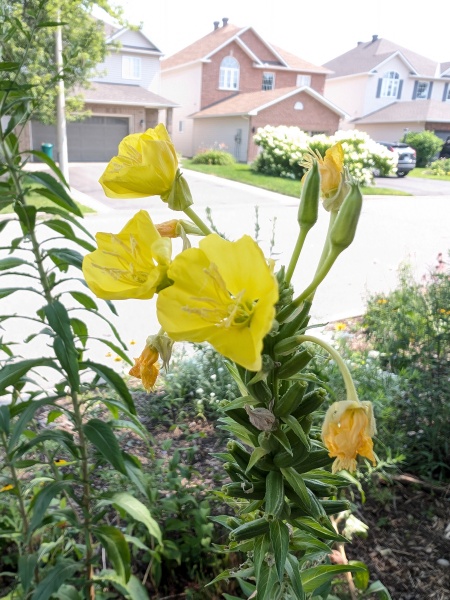
Common Evening Primrose's flowers open in the evening and close by noon. The plant takes 2 years to complete its life cycle, with leaves prominent the first year and yellow flowers appear during the second year. The roots are eaten by some wildlife. It does well in newly established landscapes and any seeds remaining on the ground will self germinate if the ground is disturbed.
Plant Location
Native to Ottawa region: Oui
Distribution according to VASCAN
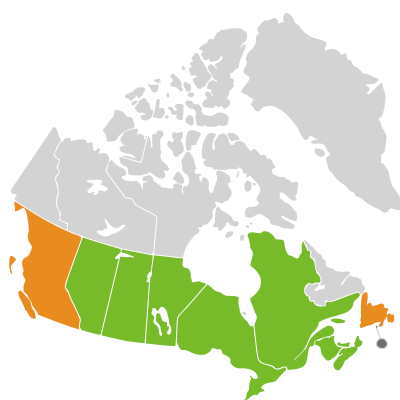
Ephemeral
Native
Introduced
Excluded
Extirpated
Doubtful
Absent
 Canadensis

Thrives in Ecozones
- Taïga des plaines
- Maritime de l'Atlantique
- Taïga du Bouclier
- Plaines boréales
- Cordillière montagnarde
- Prairies
- Plaines hudsoniennes
- Bouclier boréal
- Cordillière boréale
- Maritime du Pacifique
- Plaines à forêts mixtes
Ecological Benefits
Butterflies Supported by Oenothera biennis
-
Eudryas unio
Pearly Wood Nymph - Agaristine à Bande Courbe -
Hyles lineata
White lined Sphinx - Sphinx à Lignes Blanches -
Mompha eloisella
Red streaked Mompha -
Schinia florida
Primrose
Specialized Bees Supported by Oenothera biennis
- Lasioglossum oenotherae
Complementary Plants
- No complementary plants found.
Substitute For Non-Native Plants
- Oenothera (Non-Native Primrose)
- Oenothera biennis (Evening Primrose Cultivars)
Sowing Information
Download Seed Envelope Labels (PDF)
- Sowing depth: Surface sow
- Sow anytime
- Stratification duration: 0 days
- Self-seeding
- Notes: Can be sown in early spring in cool soil.
Harvesting and Seed Sharing
- Harvest start month: September
- Harvesting indicator:
- Pods are brown, seeds are dark, and crisp, and little stem connecting the pod to the main stem is brown (not green)
- Harvesting:
- Cut stem (including pods), let air dry in paper bag, then shake seeds off after a few days
- Seed viability test:
- Pas de test requis avant le don
- Packaging measure: 1 rounded 1/32 teaspoon
- Seed storage:
- Sécher à l'air dans un sac en papier ou contenant ouvert, pour quelques jours jusqu'à sec
- Secouer de temps à autre pour prévenir la moisissure
- Cultivar: Yes, do not donate unless you know source, and there are no known cultivars in your garden or at proximity
- Remove non-seed material
- Harvesting video: Watch here
Toxicity Notes
Inadequate information on toxicity found.