 Inconnu - Not known to be toxic to mammals if ingested.
Plant Names

Rubus odoratus
Purple-flowering Raspberry
Ronce odorante
Synonyms
eastern maple-leaved raspberry
flowering raspberry
Calottes
framboisier sauvage
Plant Characteristics
Couleur de floraison: Rose
Bloom Period: Jun - Aug
Hauteur max: 6,0 feet
Max Width: 12,0 feet (spreads by rhizome)
Light Condition:
 Plus de 6 heures d'ensoleillement par jour
 More than 2 or 3 hours but less than 6 hours of direct sun a day
Soil conditions:
More than 2 or 3 hours but less than 6 hours of direct sun a day
Soil conditions:
 Tolerates medium soil condition
Plus de 6 heures d'ensoleillement par jour
More than 2 or 3 hours but less than 6 hours of direct sun a day
Tolerates medium soil condition
Lifespan:
Vivace
des plantes qui reviennent année après année
Gardener Experience:
 Spreads by rhizome
 Self-seeding
Spreads by rhizome
Self-seeding
Landscape Uses:
 Suitable for rock gardens
 Suitable for rain gardens
 Suitable for shoreline rehabilitation
 Suitable for school gardens
 Can be used as a hedge
Suitable for rock gardens
Suitable for rain gardens
Suitable for shoreline rehabilitation
Suitable for school gardens
Can be used as a hedge
Ecological Benefits:
 Supports birds
 Butterfly host
 Keystone species
Supports birds
Butterfly host
Keystone species
Tolerates:
 Tolerates limestone conditions
 Tolerates juglone conditions
 Tolerates transplantation
Tolerates limestone conditions
Tolerates juglone conditions
Tolerates transplantation
Special Features and Considerations:
Seed and plant distribution status
Semences disponible
Disponible à la table Vignes, arbustes, arbres
Disponible à la table Vignes, arbustes, arbres
Nous acceptions les semences de cette plante
Faits intéressants
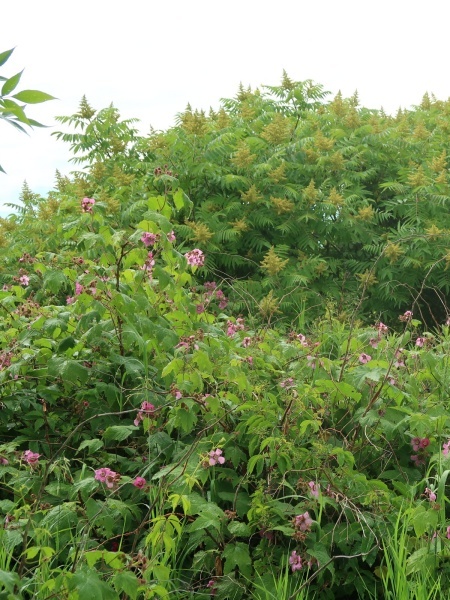
Purple-flowering Raspberry has maple-like leaves and showy, rose-purple to pink flowers that appear from late spring through summer. Unlike many raspberries, its stems are thornless, making it much easier to handle in a garden. It's flowers are followed by small, raspberry-like fruits. It spreads readily by suckers and underground stems, often forming large colonies and can quickly outgrow a small perennial bed. It is an excellent choice for woodland edges, naturalized areas, slopes, and large gardens where it has room to spread. Once established, it requires relatively little maintenance.
The large maple-like leaves can become a significant visual feature in the garden. The large foliage and showy flowers make it much more visually dramatic than many native shrubs.
The large maple-like leaves can become a significant visual feature in the garden. The large foliage and showy flowers make it much more visually dramatic than many native shrubs.
Plant Location
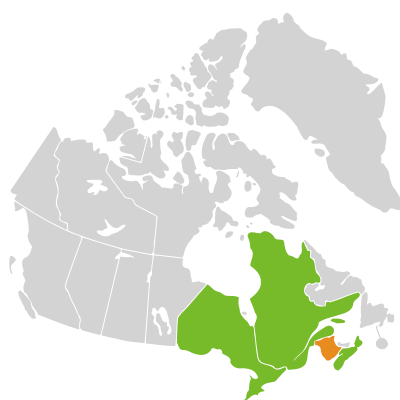
Native to Ottawa region: Oui
Distribution according to VASCAN
Ephemeral
Native
Introduced
Excluded
Extirpated
Doubtful
Absent
 Canadensis

Thrives in Ecozones
- Maritime de l'Atlantique
- Bouclier boréal
- Plaines à forêts mixtes
Ecological Benefits
Butterflies Supported by Rubus odoratus
-
Automeris io
Io moth -
Chlorochlamys chloroleucaria
Blackberry looper - Arpenteuse des ronces -
Cingilia catenaria
Chain-dotted geometer - Arpenteuse caténaire -
Trichordestra legitima
Striped Garden Caterpillar
Specialized Bees Supported by Rubus odoratus
No bee data available for this plant.
Complementary Plants
- No complementary plants found.
Substitute For Non-Native Plants
- Rosa (Non-native Roses)
- Rosa multiflora (Multiflora Rose)
Sowing Information
Download Seed Envelope Labels (PDF)
- Sowing depth: Couvrir très légèrement
- Sow by January
- Stratification duration: 90 days
- Self-seeding
- Notes: Soak in hot water for 24h.
Harvesting and Seed Sharing
- Harvest start month: July
- Harvesting indicator:
- Berries are ripen and easily fall off or have fallen off
- Harvesting:
- Squeeze berries to extract seeds, wash with soapy water, rinse throroughly
- Seed viability test:
- Pas de test requis avant le don
- Packaging measure: A dozen (12) seeds (eyeball)
- Seed storage:
- Sécher à l'air dans un sac en papier ou contenant ouvert, pour quelques jours jusqu'à sec
- Secouer de temps à autre pour prévenir la moisissure
- Cultivar: No, you can donate without knowing the source as there are only straight species
- No harvesting video available at this time.
Toxicity Notes
Not known to be toxic to mammals if ingested.