 Inconnu - Generally non-toxic. Contains salicin (similar to aspirin), so pets should not consume large quantities.
Plant Names

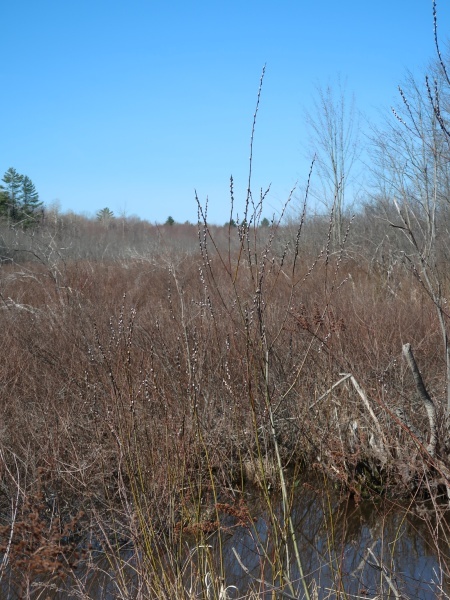
Salix discolor
Pussy Willow
Saule discolore
Synonyms
American pussy willow
glaucous willow
large pussy willow
lowland pussy willow
chatons
saule p'tits-minous
Plant Characteristics
Couleur de floraison: Blanc
Bloom Period: Apr - May
Hauteur max: 15,0 feet
Max Width: 12,0 feet (spreads by rhizome)
Light Condition:
 Plus de 6 heures d'ensoleillement par jour
 More than 2 or 3 hours but less than 6 hours of direct sun a day
 Less than 2 or 3 hours of direct sun a day
Soil conditions:
Less than 2 or 3 hours of direct sun a day
Soil conditions:
 Tolerates medium soil condition
Plus de 6 heures d'ensoleillement par jour
More than 2 or 3 hours but less than 6 hours of direct sun a day
Less than 2 or 3 hours of direct sun a day
Tolerates medium soil condition
Lifespan:
Vivace
des plantes qui reviennent année après année
Plant is
dioecious
Need a male and female plant to produce seeds
Gardener Experience:
 Spreads by rhizome
 Self-seeding
Spreads by rhizome
Self-seeding
Landscape Uses:
 Souhaitable dans les jardins de zone humide
 Suitable for shoreline rehabilitation
 Suitable for school gardens
 Suitable for woodland gardens
 Can be used as a hedge
Souhaitable dans les jardins de zone humide
Suitable for shoreline rehabilitation
Suitable for school gardens
Suitable for woodland gardens
Can be used as a hedge
Ecological Benefits:
 Butterfly host
 Bee host
 Keystone species
Butterfly host
Bee host
Keystone species
Tolerates:
 Tolerates salt conditions
 Tolerates limestone conditions
 Tolerates sandy conditions
 Tolerates juglone conditions
 Tolerates transplantation
Tolerates salt conditions
Tolerates limestone conditions
Tolerates sandy conditions
Tolerates juglone conditions
Tolerates transplantation
Special Features and Considerations:
Seed and plant distribution status
No seeds available for this plant.
Nous acceptions les semences de cette plante
Faits intéressants
Pussy willow is a fast-growing native shrub best known for its soft, silvery catkins that appear in very early spring. One of the earliest and most valuable native plants for pollinators. Its pollen and nectar support emerging queen bumble bees, mining bees, mason bees, sweat bees, hoverflies, and many other insects. Birds nest in the dense branches, while beavers and rabbits browse the twigs. It is fast growing and you can prune it every few years to encourage vigorous new stems.
Plant Location
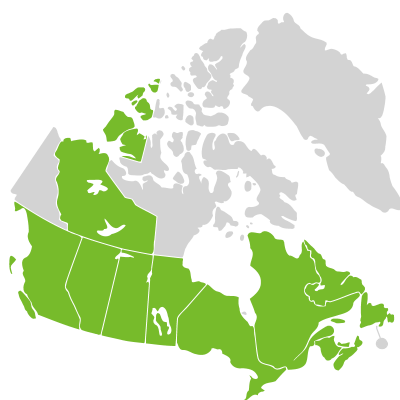
Native to Ottawa region: Oui
Distribution according to VASCAN
Ephemeral
Native
Introduced
Excluded
Extirpated
Doubtful
Absent
 Canadensis

Thrives in Ecozones
- Taïga des plaines
- Maritime de l'Atlantique
- Taïga du Bouclier
- Plaines boréales
- Cordillière montagnarde
- Prairies
- Plaines hudsoniennes
- Bouclier boréal
- Cordillière boréale
- Maritime du Pacifique
- Plaines à forêts mixtes
Ecological Benefits
Butterflies Supported by Salix discolor
-
Acronicta radcliffei
Radcliffe’s dagger -
Antheraea polyphemus
Polyphemus - Polyphème d'Amérique -
Automeris io
Io moth -
Cingilia catenaria
Chain-dotted geometer - Arpenteuse caténaire -
Erynnis icelus
Dreamy Duskywing - Hespérie Givrée -
Eupithecia miserulata
American Common Pug -
Eupithecia nimbicolor
Attenuated pug -
Euplexia benesimilis
American Angle Shades -
Haploa clymene
Clymene -
Hyalophora cecropia
Cecropia moth - Saturnie Cécropia -
Hyphantria cunea
Fall webworm - Écaille Fileuse -
Limenitis archippus
Viceroy - Vice-Roi -
Limenitis arthemis ssp. astyanax
Red Spotted Purple -
Melanchra adjuncta
Hitched Arches -
Melanchra picta
Zebra caterpillar -
Nymphalis antiopa
Mourning Cloak - Morio -
Nymphalis vaualbum
Compton Tortoiseshell - Vanesse du Peuplier -
Paonias excaecata
Blinded Sphinx - Sphinx Aveugle -
Papilio glaucus
Eastern Tiger Swallowtail - Papillon Tigré de l'Est -
Prochoerodes lineola
Large Maple Spanworm -
Satyrium liparops
Striped hairstreak - Porte-queue à Bandes Brisées -
Schizura unicornis
Unicorn Caterpillar -
Trichordestra legitima
Striped Garden Caterpillar
Specialized Bees Supported by Salix discolor
- Andrena bisalicis
- Andrena clarkella
- Andrena erythrogaster
- Andrena frigida
- Andrena mariae
- Andrena sigmundi
- Andrena wellesleyana
- Megachile pugnata
- Protandrena andrenoides
Complementary Plants
- No complementary plants found.
Substitute For Non-Native Plants
- Forsythieae (Forsythia)
Sowing Information
Download Seed Envelope Labels (PDF)
- Sowing depth: Surface sow
- Sow anytime
- Stratification duration: 0 days
- Self-seeding
- Notes: Can be sown in late spring in warm soil.
Harvesting and Seed Sharing
- Harvest start month: May
- Harvesting indicator:
- Seeds have become fluffy and can be easily removed by shaking on gently pulling off from stem
- Harvesting:
- Secouer le porte-graines dans un sac de papier
- Seed viability test:
- Pas de test requis avant le don
- Packaging measure: Six (6) seeds (eyeball)
- Seed storage:
- Sécher à l'air dans un sac en papier ou contenant ouvert, pour quelques jours jusqu'à sec
- Secouer de temps à autre pour prévenir la moisissure
- Cultivar: No, you can donate without knowing the source as there are only straight species
- No harvesting video available at this time.
Toxicity Notes
Generally non-toxic. Contains salicin (similar to aspirin), so pets should not consume large quantities.