 Connu comme étant toxique - Toxic to mammals if ingested. Raw leaves, stems, roots, bark, and unripe berries contain cyanogenic compounds and should not be eaten.
Plant Names

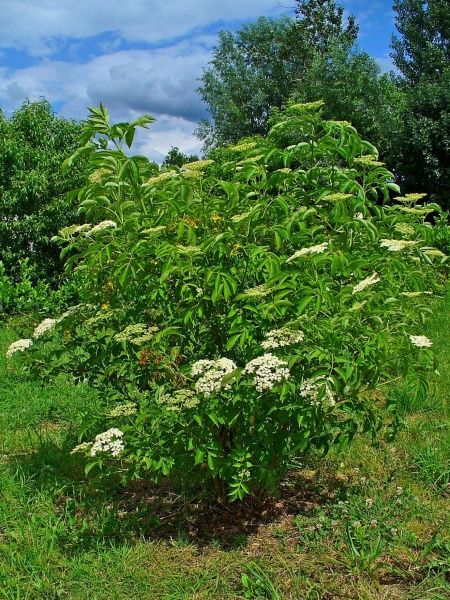
Sambucus canadensis
Common Elderberry
Sureau blanc
Synonyms
American black elderberry
American elder
Canada elderberry
white elder
sirop blanc
sureau du Canada
Plant Characteristics
Couleur de floraison: Blanc
Bloom Period: Jun - Jul
Hauteur max: 12,0 feet
Max Width: 12,0 feet (spreads by rhizome)
Light Condition:
 Plus de 6 heures d'ensoleillement par jour
 More than 2 or 3 hours but less than 6 hours of direct sun a day
Soil conditions:
More than 2 or 3 hours but less than 6 hours of direct sun a day
Soil conditions:
 Tolerates medium soil condition
Plus de 6 heures d'ensoleillement par jour
More than 2 or 3 hours but less than 6 hours of direct sun a day
Tolerates medium soil condition
Lifespan:
Vivace
des plantes qui reviennent année après année
Gardener Experience:
 Spreads by rhizome
 Self-seeding
Spreads by rhizome
Self-seeding
Landscape Uses:
 Suitable for rain gardens
 Suitable for shoreline rehabilitation
 Can be used as a hedge
Suitable for rain gardens
Suitable for shoreline rehabilitation
Can be used as a hedge
Ecological Benefits:
 Supports hummingbirds
 Supports birds
 Butterfly host
Supports hummingbirds
Supports birds
Butterfly host
Tolerates:
 Tolerates salt conditions
 Deer resistant
 Rabbit resistant
 Tolerates juglone conditions
 Tolerates transplantation
Tolerates salt conditions
Deer resistant
Rabbit resistant
Tolerates juglone conditions
Tolerates transplantation
Special Features and Considerations:
Seed and plant distribution status
Semences disponible
Disponible à la table Vignes, arbustes, arbres
Disponible à la table Vignes, arbustes, arbres
Nous acceptions les semences de cette plante
Faits intéressants
Canada elderberry is a large native shrub that produces flat clusters of fragrant white flowers in early summer followed by dark purple berries in late summer. It grows best in full sun to partial shade with moist, fertile soil. The flowers attract native bees, butterflies, hoverflies, beetles, and many beneficial insects. The berries are an important food source for more than 50 species of birds, including robins, cedar waxwings, thrushes, woodpeckers, and grouse. Small mammals also feed on the fruit.
Canada Elderberry is fast growing and will spread by suckers to form colonies. You can prune older stems every few years to maintain vigor. Please only harvest only fully ripe berries.
Canada Elderberry is fast growing and will spread by suckers to form colonies. You can prune older stems every few years to maintain vigor. Please only harvest only fully ripe berries.
Plant Location
Native to Ottawa region: Oui
Distribution according to VASCAN
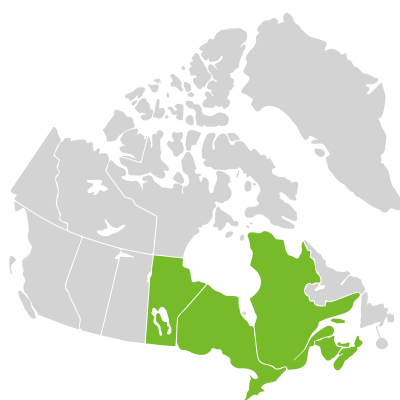
Ephemeral
Native
Introduced
Excluded
Extirpated
Doubtful
Absent
 Canadensis

Thrives in Ecozones
- Maritime de l'Atlantique
- Bouclier boréal
- Plaines à forêts mixtes
Ecological Benefits
Butterflies Supported by Sambucus canadensis
-
Eupithecia tripunctaria
White spotted pug - Eupithécie Triponctuée -
Melanchra adjuncta
Hitched Arches -
Xestia smithii
Smith's Dart
Specialized Bees Supported by Sambucus canadensis
No bee data available for this plant.
Complementary Plants
- No complementary plants found.
Substitute For Non-Native Plants
- Sorbaria sorbifolia (False spirea)
- Hydrangea (Hydrangea)
- Euonymus alatus (Burning Bush)
- Astilbe (Astilbe)
- Melilotus albus (Sweet White Clover)
Sowing Information
Download Seed Envelope Labels (PDF)
- Sowing depth: Couvrir très légèrement
- Sow by November
- Stratification duration: 180 days
- Self-seeding
- Notes: Soak 24h. Warm moist stratify 60d. Then cold moist stratify 120d. Best planted outdoors in fall.
Harvesting and Seed Sharing
- Harvest start month: August
- Harvesting indicator:
- Berries are ripen and easily fall off or have fallen off
- Harvesting:
- Squeeze berries to extract seeds, wash with soapy water, rinse throroughly
- Seed viability test:
- Pas de test requis avant le don
- Packaging measure: Six (6) seeds (eyeball)
- Seed storage:
- Sécher à l'air dans un sac en papier ou contenant ouvert, pour quelques jours jusqu'à sec
- Secouer de temps à autre pour prévenir la moisissure
- Cultivar: Yes, do not donate unless you know source, and there are no known cultivars in your garden or at proximity
- No harvesting video available at this time.
Toxicity Notes
Toxic to mammals if ingested. Raw leaves, stems, roots, bark, and unripe berries contain cyanogenic compounds and should not be eaten.