 Pas connu comme étant toxique - Not known to be toxic to mammals if ingested.
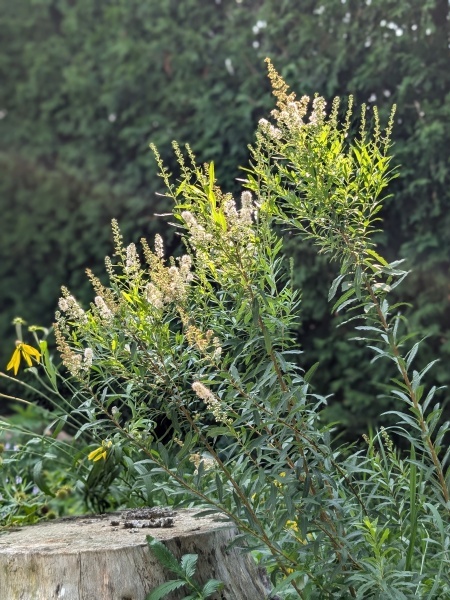
Plant Names

Spiraea alba
White Meadowsweet
Spirée blanche
Plant Characteristics
Couleur de floraison: Blanc
Bloom Period: Jun - Aug
Hauteur max: 4,0 feet
Max Width: 3,0 feet (spreads by rhizome)
Light Condition:
 Plus de 6 heures d'ensoleillement par jour
 More than 2 or 3 hours but less than 6 hours of direct sun a day
Soil conditions:
More than 2 or 3 hours but less than 6 hours of direct sun a day
Soil conditions:
 Tolerates medium soil condition
Plus de 6 heures d'ensoleillement par jour
More than 2 or 3 hours but less than 6 hours of direct sun a day
Tolerates medium soil condition
Lifespan:
Vivace
des plantes qui reviennent année après année
Gardener Experience:
 Suitable for beginner gardeners
 Ne se propage pas de manière incontrôlable
 Spreads by rhizome
 Facile à germer
 Self-seeding
Suitable for beginner gardeners
Ne se propage pas de manière incontrôlable
Spreads by rhizome
Facile à germer
Self-seeding
Landscape Uses:
 Suitable for rain gardens
 Suitable for shoreline rehabilitation
 Suitable for container garden
 Suitable for school gardens
Suitable for rain gardens
Suitable for shoreline rehabilitation
Suitable for container garden
Suitable for school gardens
Ecological Benefits:
 Butterfly host
Butterfly host
Tolerates:
 Tolerates salt conditions
 Deer resistant
 Rabbit resistant
 Tolerates sandy conditions
 Tolerates transplantation
Tolerates salt conditions
Deer resistant
Rabbit resistant
Tolerates sandy conditions
Tolerates transplantation
Special Features and Considerations:
 This plant causes skin rashes
This plant causes skin rashes
Seed and plant distribution status
Semences disponible
Disponible à la table Vignes, arbustes, arbres
Disponible à la table Vignes, arbustes, arbres
Nous acceptions les semences de cette plante
Faits intéressants
White Meadowsweet is not picky about its conditions. The shrub has white fuzzy spires of flowers that will be buzzing with pollinators in mid to late summer. Its stems are somewhat reddish in colour. It occurs from dry sandy wooded areas to swamps and lakeshores. It might not be suitable for small gardens.
Plant Location
Native to Ottawa region: Oui
Distribution according to VASCAN
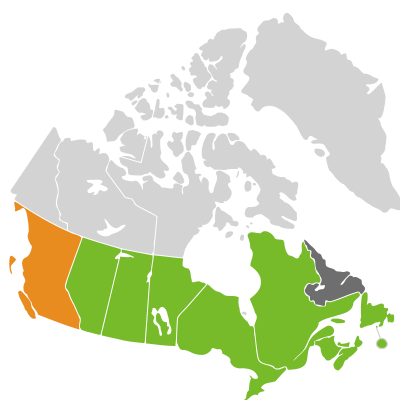
Ephemeral
Native
Introduced
Excluded
Extirpated
Doubtful
Absent
 Canadensis

Thrives in Ecozones
- Maritime de l'Atlantique
- Plaines à forêts mixtes
Ecological Benefits
Butterflies Supported by Spiraea alba
-
Celastrina ladon
Spring Azure - Azur Printanier -
Cingilia catenaria
Chain-dotted geometer - Arpenteuse caténaire -
Hyphantria cunea
Fall webworm - Écaille Fileuse -
Olethreutes permundana
Raspberry Leafroller -
Papaipema nebris
Stalk borer - Noctuelle à Taches En Grains
Specialized Bees Supported by Spiraea alba
No bee data available for this plant.
Complementary Plants
- No complementary plants found.
Substitute For Non-Native Plants
- Sorbaria sorbifolia (False spirea)
- Aruncus dioicus (Goat's Beard)
- Buddleia (Butterfly Bush)
- Hydrangea (Hydrangea)
- Euonymus alatus (Burning Bush)
- Hibiscus (Non-Native Hibiscus)
- Astilbe (Astilbe)
- Berberis (Barberry)
- Melilotus albus (Sweet White Clover)
Sowing Information
Download Seed Envelope Labels (PDF)
- Sowing depth: Surface sow
- Sow by February
- Stratification duration: 60 days
- Self-seeding
Harvesting and Seed Sharing
- Harvest start month: September
- Harvesting indicator:
- Pods are brown and crisp and starting to open
- Seeds are dark and tiny stem attaching to the main stem is brown
- Seeds easily fall off pod when shaken
- Little stem connecting the pod to the main stem is brown (not green)
- Harvesting:
- Secouer le porte-graines dans un sac de papier
- Seed viability test:
- Pas de test requis avant le don
- Packaging measure: 1 rounded 1/32 teaspoon
- Seed storage:
- Sécher à l'air dans un sac en papier ou contenant ouvert, pour quelques jours jusqu'à sec
- Secouer de temps à autre pour prévenir la moisissure
- Cultivar: No, you can donate without knowing the source as there are only straight species
- No harvesting video available at this time.
Toxicity Notes
Not known to be toxic to mammals if ingested.