 Pas connu comme étant toxique - Not known to be toxic to mammals if ingested.
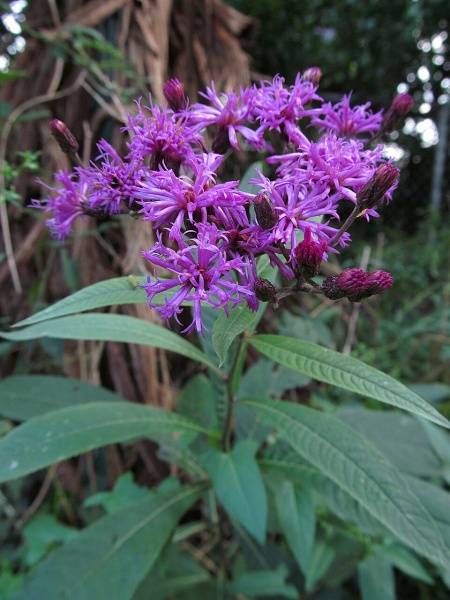
Plant Names

Vernonia gigantea
Giant Ironweed
Vernonie géante
Synonyms
tall ironweed
Plant Characteristics
Couleur de floraison: Violet
Bloom Period: Aug - Sep
Hauteur max: 5,0 feet
Max Width: 3,0 feet (spreads by rhizome)
Light Condition:
 Plus de 6 heures d'ensoleillement par jour
 More than 2 or 3 hours but less than 6 hours of direct sun a day
Soil conditions:
More than 2 or 3 hours but less than 6 hours of direct sun a day
Soil conditions:
 Tolerates medium soil condition
Plus de 6 heures d'ensoleillement par jour
More than 2 or 3 hours but less than 6 hours of direct sun a day
Tolerates medium soil condition
Lifespan:
Vivace
des plantes qui reviennent année après année
Gardener Experience:
 Ne se propage pas de manière incontrôlable
 Spreads by rhizome
 Facile à germer
 Self-seeding
Ne se propage pas de manière incontrôlable
Spreads by rhizome
Facile à germer
Self-seeding
Landscape Uses:
 Souhaitable dans les jardins de zone humide
Souhaitable dans les jardins de zone humide
Ecological Benefits:
 Supports pollinators
 Butterfly host
 Bee host
Supports pollinators
Butterfly host
Bee host
Tolerates:
 Deer resistant
 Rabbit resistant
 Tolerates sandy conditions
 Tolerates acidic soil conditions
 Tolerates juglone conditions
 Tolerates transplantation
Deer resistant
Rabbit resistant
Tolerates sandy conditions
Tolerates acidic soil conditions
Tolerates juglone conditions
Tolerates transplantation
Special Features and Considerations:
Seed and plant distribution status
Semences disponible
Disponible à la table Mi-soleil, humide
Disponible à la table Mi-soleil, humide
Nous acceptions les semences de cette plante
Faits intéressants
Giant Ironweed has sturdy, upright stems and clusters of rich purple flowers from late summer into fall. Its strong vertical form makes it an excellent plant for the back of a native border or meadow. The arching seed heads add movement and interest from summer into fall. It forms attractive clumps and is generally well behaved. It spreads gradually rather than aggressively. It tolerates occasional flooding and performs best in consistently moist soil but can tolerate average conditions once established. You can divide established clumps in spring if they become crowded.
Plant Location
Distribution according to VASCAN
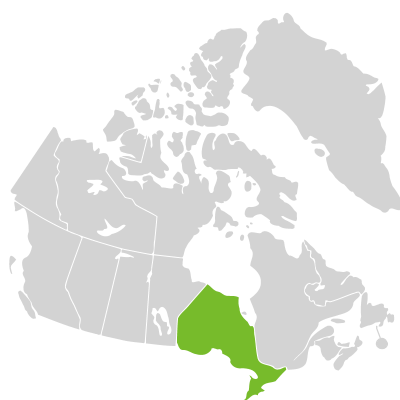
Ephemeral
Native
Introduced
Excluded
Extirpated
Doubtful
Absent
 Canadensis

Thrives in Ecozones
- Plaines à forêts mixtes
Ecological Benefits
Butterflies Supported by Vernonia gigantea
-
Phragmatobia fuliginosa
Ruby Tiger - Écaille Cramoisie -
Vanessa virginiensis
American Lady - Vanesse de Virginie
Specialized Bees Supported by Vernonia gigantea
- Megachile inimica
- Melissodes denticulatus
- Melissodes subillatus
Complementary Plants
- Carex grayi
Gray's Sedge
Carex de Gray - Doellingeria umbellata
Flat-topped White Aster
Aster à ombelles - Prunella vulgaris var. lanceolata
Lance-leaved Self-heal
Brunelle commune - Solidago rugosa
Rough-stemmed Goldenrod
Verge d'or rugueuse - Symphyotrichum puniceum
Purple-stemmed Aster
Aster ponceau
Substitute For Non-Native Plants
- Perovskia Atriplicifolia (Russian Sage)
- Lupinus (Non-Native Lupins)
- Buddleia (Butterfly Bush)
- Delphinium (Delphinium)
- Melilotus albus (Sweet White Clover)
- Lavandula (Lavender)
- Hesperis matronalis (Dame Rocket)
- Liatris (Blazing Star Cultivar)
Sowing Information
Download Seed Envelope Labels (PDF)
- Sowing depth: Couvrir très légèrement
- Sow by February
- Stratification duration: 60 days
- Self-seeding
Harvesting and Seed Sharing
- Harvest start month: October
- Harvesting indicator:
- Seeds have become fluffy and can be easily removed by shaking on gently pulling off from stem
- Harvesting:
- Secouer le porte-graines dans un sac de papier
- Seed viability test:
- Pas de test requis avant le don
- Packaging measure: 1 rounded 1/4 teaspoon
- Seed storage:
- Sécher à l'air dans un sac en papier ou contenant ouvert, pour quelques jours jusqu'à sec
- Secouer de temps à autre pour prévenir la moisissure
- Cultivar: Yes, do not donate unless you know source, and there are no known cultivars in your garden or at proximity
- No harvesting video available at this time.
Toxicity Notes
Not known to be toxic to mammals if ingested.