
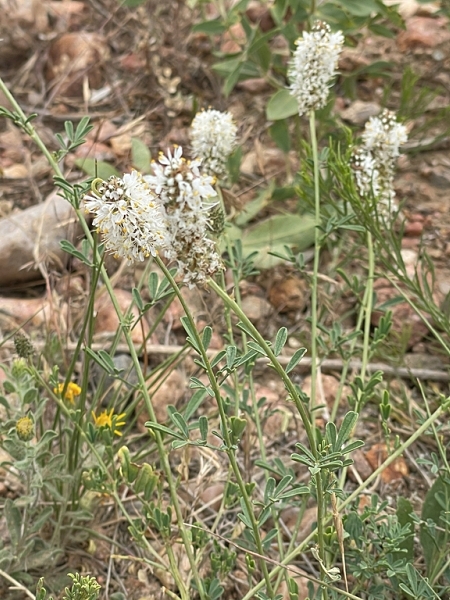
Plant Names

Dalea candida
White Prairie-clover
Dalée blanche
Plant Characteristics
Couleur de floraison: Blanc
Bloom Period: Jul - Aug
Hauteur max: 3,0 feet
Max Width: 1,5 feet
Light Condition:
 Plus de 6 heures d'ensoleillement par jour
 More than 2 or 3 hours but less than 6 hours of direct sun a day
Soil conditions:
More than 2 or 3 hours but less than 6 hours of direct sun a day
Soil conditions:
 Tolère des conditions de sol sec
 Tolerates medium soil condition
Plus de 6 heures d'ensoleillement par jour
More than 2 or 3 hours but less than 6 hours of direct sun a day
Tolère des conditions de sol sec
Tolerates medium soil condition
Lifespan:
Vivace
des plantes qui reviennent année après année
Gardener Experience:
 Ne se propage pas de manière incontrôlable
Ne se propage pas de manière incontrôlable
Landscape Uses:
 Suitable for rock gardens
Suitable for rock gardens
Ecological Benefits:
No ecological benefits information available.
Tolerates:
Special Features and Considerations:
Seed and plant distribution status
Semences disponible
Disponible à la table Mi-soleil, sec
Disponible à la table Mi-soleil, sec
Nous acceptions les semences de cette plante
Faits intéressants
White Prairie-clover is a legume with slender stems and distinctive cylindrical spikes covered in tiny white flowers. Despite its common name, it is not a true clover; it belongs to the pea family (Fabaceae). It has a remarkable root system. Its thick taproot can extend up to about 2 meters deep, allowing the plant to reach moisture well below the surface during dry periods. Like other legumes, White Prairie Clover forms relationships with nitrogen-fixing bacteria around its roots, helping make nitrogen available within the plant-soil system. The flowers on each spike open from the bottom upward, so you can actually watch the flower head develop as the season progresses.
White Prairie-clover is surprisingly long-lived and slow-growing at first, investing considerable energy in establishing its deep root before putting on a lot of top growth. Water regularly during its first growing season, but once established it is quite drought tolerant. Avoid moving an established plant if possible. Its deep taproot makes transplanting difficult. It is much better grown from seed and planted where you want it to remain. Don't give it rich soil or lots of water. White Prairie Clover is built for tough conditions and usually performs best when its prairie-style growing conditions are respected.
White Prairie-clover is surprisingly long-lived and slow-growing at first, investing considerable energy in establishing its deep root before putting on a lot of top growth. Water regularly during its first growing season, but once established it is quite drought tolerant. Avoid moving an established plant if possible. Its deep taproot makes transplanting difficult. It is much better grown from seed and planted where you want it to remain. Don't give it rich soil or lots of water. White Prairie Clover is built for tough conditions and usually performs best when its prairie-style growing conditions are respected.
Plant Location
Distribution according to VASCAN
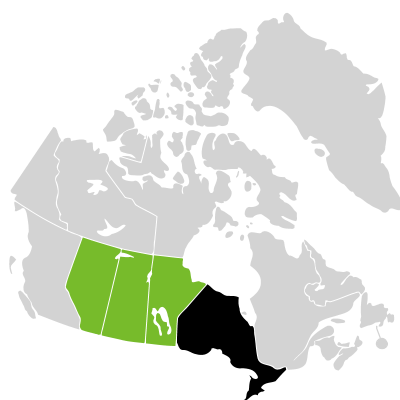
Ephemeral
Native
Introduced
Excluded
Extirpated
Doubtful
Absent
 Canadensis
Thrives in Ecozones
- Plaines boréales
- Prairies
- Plaines à forêts mixtes
Ecological Benefits
Butterflies Supported by Dalea candida
-
Zerene cesonia
Southern Dogface - Zerene cesonia
Specialized Bees Supported by Dalea candida
No bee data available for this plant.
Complementary Plants
- Asclepias syriaca
Common Milkweed
Asclépiade commune - Asclepias tuberosa
Butterfly Milkweed
Asclépiade tubéreuse - Dalea purpurea
Purple Prairie-clover
Dalée violette
Sowing Information
Download Seed Envelope Labels (PDF)
- Sowing depth: Couvrir très légèrement
- Sow anytime
- Stratification conditions: Scarify if unhulled.
- Stratification duration: 0 days
- Notes: Can be sown in late spring in warm soil.
Harvesting and Seed Sharing
- Harvest start month: September
- Harvesting indicator:
- Seeds easily fall off when you gently pull them off
- Harvesting:
- Utiliser la main pour détacher de la tige principale
- Seed viability test:
- None
- Packaging measure: 1 rounded 1/8 teaspoon
- Seed storage:
- Sécher à l'air dans un sac en papier ou contenant ouvert, pour quelques jours jusqu'à sec
- Secouer de temps à autre pour prévenir la moisissure
- Cultivar: Yes, do not donate unless you know source, and there are no known cultivars in your garden or at proximity
- No harvesting video available at this time.