 Known to be toxic - Toxic to mammals if ingested. Members of the Eupatorium group can contain compounds that may be harmful if consumed. Avoid ingestion by people and pets, and take particular care around livestock.
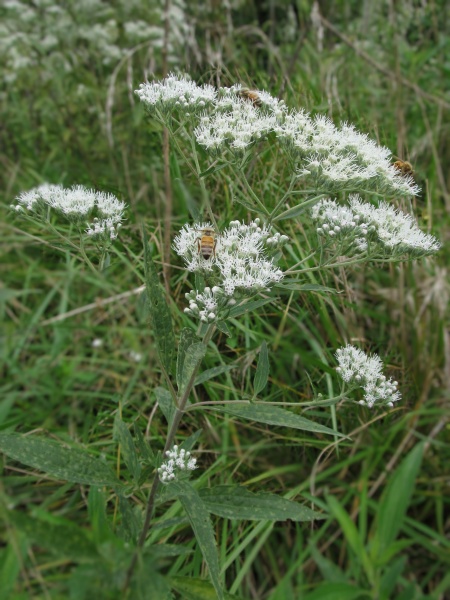
Plant Names

Eupatorium altissimum
Tall Boneset
Eupatoire élevée
Synonyms
tall thoroughwort
upland boneset
Plant Characteristics
Bloom Colour: White
Bloom Period: Aug - Oct
Max Height: 4.0 feet
Max Width: 3.0 feet (spreads by rhizome)
Light Condition:
 More than 6 hours of direct sun a day
 More than 2 or 3 hours but less than 6 hours of direct sun a day
Soil conditions:
More than 2 or 3 hours but less than 6 hours of direct sun a day
Soil conditions:
 Tolerates dry soil condition
 Tolerates medium soil condition
More than 6 hours of direct sun a day
More than 2 or 3 hours but less than 6 hours of direct sun a day
Tolerates dry soil condition
Tolerates medium soil condition
Lifespan:
Perennial
plants that will come back year after year
Gardener Experience:
 Does not spread uncontrollably
 Spreads by rhizome
 Self-seeding
Does not spread uncontrollably
Spreads by rhizome
Self-seeding
Landscape Uses:
 Suitable for rock gardens
 Suitable for container garden
 Suitable for school gardens
Suitable for rock gardens
Suitable for container garden
Suitable for school gardens
Ecological Benefits:
 Supports pollinators
 Butterfly host
Supports pollinators
Butterfly host
Tolerates:
 Deer resistant
 Rabbit resistant
 Tolerates limestone conditions
 Tolerates juglone conditions
Deer resistant
Rabbit resistant
Tolerates limestone conditions
Tolerates juglone conditions
Special Features and Considerations:
 This plant is endangered
This plant is endangered
Seed and plant distribution status
No seeds available for this plant.
We currently accept seeds for this plant
Fun Facts
Tall Boneset has upright, branching stems and clusters of small white flowers appearing in late summer and fall. It naturally occurs in dry prairies, open woodlands, roadsides, and fields. It is considerably more tolerant of dry conditions than many other bonesets. Its tall, airy form works well at the back of a native border or in a meadow-style planting. It tolerates dry, poor soils once established. Give it enough space to accommodate its height and branching habit.
Plant Location
Distribution according to VASCAN
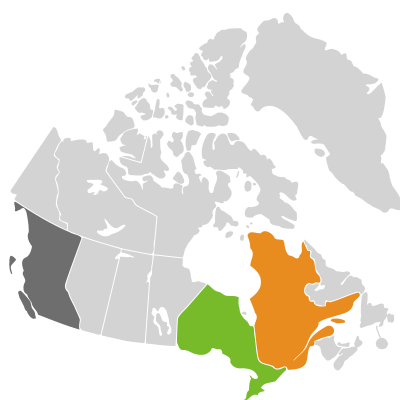
Ephemeral
Native
Introduced
Excluded
Extirpated
Doubtful
Absent
 Canadensis

Thrives in Ecozones
- Mixed Wood Plains
Ecological Benefits
Butterflies Supported by Eupatorium altissimum
-
Carmenta pyralidiformis
Boneset Borer -
Haploa clymene
Clymene -
Phragmatobia fuliginosa
Ruby Tiger - Écaille Cramoisie -
Schinia trifascia
Three lined flower
Specialized Bees Supported by Eupatorium altissimum
No bee data available for this plant.
Complementary Plants
- Chamaenerion angustifolium
Fireweed
Épilobe à feuilles étroites - Elymus virginicus
Virginia Wild Rye
Élyme de Virginie - Ratibida pinnata
Grey-headed Prairie Coneflower
Ratibida à feuilles pennées - Vernonia missurica
Missouri Ironweed
Vernonie du Missouri
Substitute For Non-Native Plants
- Thalictrum (Non-Native Meadow Rue)
Sowing Information
Download Seed Envelope Labels (PDF)
- Sowing depth: Surface sow
- Sow by February
- Stratification duration: 60 days
- Self-seeding
Harvesting and Seed Sharing
- Harvest start month: July
- Harvesting indicator:
- Seeds have become fluffy and can be easily removed by shaking on gently pulling off from stem
- Harvesting:
- Shake seed head in paper bag
- Seed viability test:
- No test needed before donating
- Packaging measure: 1 rounded 1/4 teaspoon
- Seed storage:
- Air dry in paper bag or open container, for a few days until crisp
- Shake seeds to move them once in a while to prevent molding
- Cultivar: Yes, do not donate unless you know source, and there are no known cultivars in your garden or at proximity
- No harvesting video available at this time.
Toxicity Notes
Toxic to mammals if ingested. Members of the Eupatorium group can contain compounds that may be harmful if consumed. Avoid ingestion by people and pets, and take particular care around livestock.