 Known to be toxic - Toxic to mammals if ingested and is a skin irritant.
Plant Names

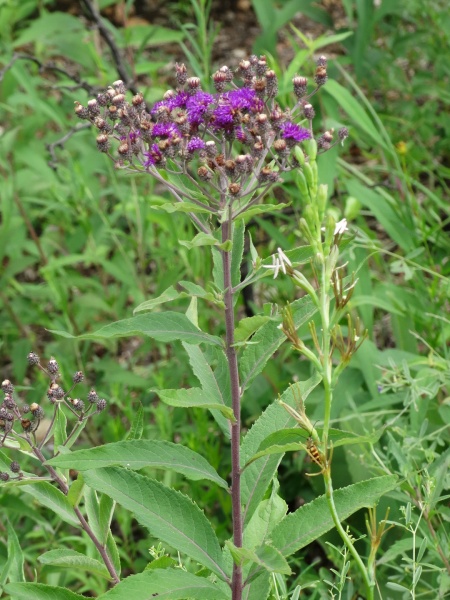
Vernonia missurica
Missouri Ironweed
Vernonie du Missouri
Plant Characteristics
Bloom Colour: Purple
Bloom Period: Jul - Aug
Max Height: 5.0 feet
Max Width: 3.0 feet (spreads by rhizome)
Light Condition:
 More than 6 hours of direct sun a day
Soil conditions:
More than 6 hours of direct sun a day
Soil conditions:
 Tolerates medium soil condition
More than 6 hours of direct sun a day
Tolerates medium soil condition
Lifespan:
Perennial
plants that will come back year after year
Gardener Experience:
 Does not spread uncontrollably
 Spreads by rhizome
 Self-seeding
Does not spread uncontrollably
Spreads by rhizome
Self-seeding
Landscape Uses:
No landscape information available.
Ecological Benefits:
 Supports pollinators
 Butterfly host
 Bee host
Supports pollinators
Butterfly host
Bee host
Tolerates:
 Tolerates limestone conditions
 Tolerates juglone conditions
 Tolerates transplantation
Tolerates limestone conditions
Tolerates juglone conditions
Tolerates transplantation
Special Features and Considerations:
 This plant is endangered
This plant is endangered
Seed and plant distribution status
No seeds available for this plant.
We currently accept seeds for this plant
Fun Facts
Missouri Ironweed is a tall, upright native perennial with sturdy stems and clusters of vivid purple flowers that appear from late summer into early fall. It is best planted toward the back of a border or in a meadow where its height can be appreciated. It prefers consistent moisture but is adaptable once established. Give it plenty of room to develop. Cutting the stems back by about one-third in early summer can encourage a shorter, sturdier plant and reduce flopping. You can divide established clumps in spring if they become too large.
Plant Location
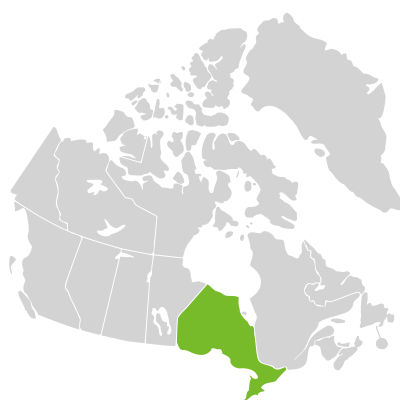
Distribution according to VASCAN
Ephemeral
Native
Introduced
Excluded
Extirpated
Doubtful
Absent
 Canadensis

Thrives in Ecozones
- Mixed Wood Plains
Ecological Benefits
Butterflies Supported by Vernonia missurica
-
Phragmatobia fuliginosa
Ruby Tiger - Écaille Cramoisie -
Vanessa virginiensis
American Lady - Vanesse de Virginie
Specialized Bees Supported by Vernonia missurica
- Megachile inimica
- Melissodes denticulatus
- Melissodes subillatus
Complementary Plants
- Chamaenerion angustifolium
Fireweed
Épilobe à feuilles étroites - Elymus virginicus
Virginia Wild Rye
Élyme de Virginie - Eupatorium altissimum
Tall Boneset
Eupatoire élevée - Ratibida pinnata
Grey-headed Prairie Coneflower
Ratibida à feuilles pennées
Substitute For Non-Native Plants
- Perovskia Atriplicifolia (Russian Sage)
- Lupinus (Non-Native Lupins)
- Buddleia (Butterfly Bush)
- Delphinium (Delphinium)
- Melilotus albus (Sweet White Clover)
- Lavandula (Lavender)
- Hesperis matronalis (Dame Rocket)
- Liatris (Blazing Star Cultivar)
Sowing Information
Download Seed Envelope Labels (PDF)
- Sowing depth: Sow just below surface
- Sow by February
- Stratification duration: 60 days
- Self-seeding
Harvesting and Seed Sharing
- Harvest start month: October
- Harvesting indicator:
- Seeds have become fluffy and can be easily removed by shaking on gently pulling off from stem
- Harvesting:
- Shake seed head in paper bag
- Seed viability test:
- No test needed before donating
- Packaging measure: 1 rounded 1/4 teaspoon
- Seed storage:
- Air dry in paper bag or open container, for a few days until crisp
- Shake seeds to move them once in a while to prevent molding
- Cultivar: Yes, do not donate unless you know source, and there are no known cultivars in your garden or at proximity
- No harvesting video available at this time.
Toxicity Notes
Toxic to mammals if ingested and is a skin irritant.