Plant Names

Plantago rugelii
Rugel's Plantain
Plantain de Rugel
Synonyms
American plantain
black-seed plantain
pale plantain
Plant Characteristics
Bloom Colour: Green
Bloom Period: Jun - Sep
Max Height: 1.0 feet
Max Width: 1.0 feet
Light Condition:
 More than 6 hours of direct sun a day
 More than 2 or 3 hours but less than 6 hours of direct sun a day
Soil conditions:
More than 2 or 3 hours but less than 6 hours of direct sun a day
Soil conditions:
 Tolerates dry soil condition
 Tolerates medium soil condition
More than 6 hours of direct sun a day
More than 2 or 3 hours but less than 6 hours of direct sun a day
Tolerates dry soil condition
Tolerates medium soil condition
Lifespan:
Perennial
plants that will come back year after year
Gardener Experience:
 Suitable for beginner gardeners
 Easy to germinate
 Self-seeding
Suitable for beginner gardeners
Easy to germinate
Self-seeding
Landscape Uses:
 Suitable for rock gardens
 Suitable for school gardens
 Suitable for ground cover
Suitable for rock gardens
Suitable for school gardens
Suitable for ground cover
Ecological Benefits:
 Butterfly host
Butterfly host
Tolerates:
 Tolerates transplantation
Tolerates transplantation
Special Features and Considerations:
Seed and plant distribution status
No seeds available for this plant.
We currently accept seeds for this plant
Fun Facts
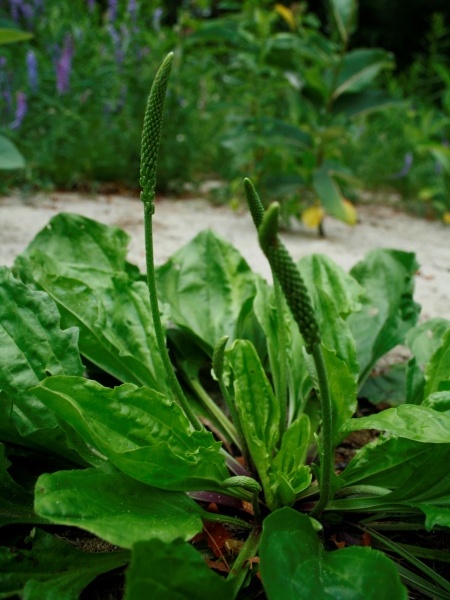
Rugel's Plantain forms a low rosette of broad, glossy green leaves. The flower stalks rise above the foliage and carry inconspicuous greenish flower clusters in summer. It naturally occurs in lawns, paths, compacted areas, fields, and disturbed soils. It tolerates a wide range of soil conditions. It is extremely adaptable and tolerant of compacted soil. It can tolerate occasional foot traffic. It is best suited to naturalized or low-maintenance areas than formal flower beds.
Plant Location
Native to Ottawa region: Yes
Distribution according to VASCAN
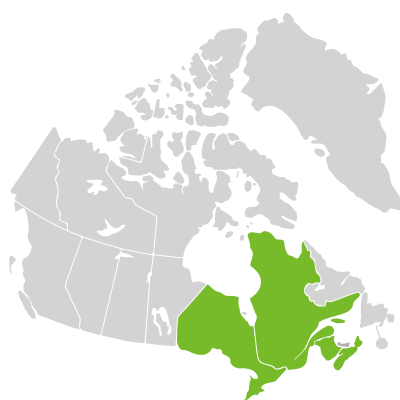
Ephemeral
Native
Introduced
Excluded
Extirpated
Doubtful
Absent
 Canadensis

Thrives in Ecozones
- Atlantic Maritime
- Mixed Wood Plains
Ecological Benefits
Butterflies Supported by Plantago rugelii
-
Junonia coenia
Common Buckeye - Papillon Ocellé -
Melanchra picta
Zebra caterpillar -
Phragmatobia fuliginosa
Ruby Tiger - Écaille Cramoisie -
Virbia aurantiaca
Orange Virbia
Specialized Bees Supported by Plantago rugelii
No bee data available for this plant.
Complementary Plants
- Antennaria howellii
Howell's Pussytoes
Antennaire de Howell - Antennaria parlinii
Parlin's Pussytoes
Antennaire de Parlin - Fragaria virginiana
Virginia Strawberry
Fraisier des champs - Sisyrinchium angustifolium
Narrow-leaved Blue-eyed Grass
Bermudienne à feuilles étroites - Sisyrinchium montanum
Strict Blue-eyed-grass
Bermudienne montagnarde
Substitute For Non-Native Plants
- Plantago (Non-Native Plantain)
- Lamium (Dead nettle)
- Ajuga reptans (Bugleweed)
- Lysimachia nummularia (Creeping Jenny)
- Vinca major and Vinca minor (Periwinkle)
- Myosotis sylvatica (Forget-me-not)
- Phlox subulata (Moss Phlox)
- Lamium galeobdolon (Yellow Archangel)
- Glechoma hederacea (Creeping Charlie)
Sowing Information
Download Seed Envelope Labels (PDF)
- Sowing depth: Surface sow
- Sow anytime
- Stratification duration: 0 days
- Self-seeding
- Notes: Can be sown in spring.
Harvesting and Seed Sharing
- Harvest start month: August
- Harvesting indicator:
- Seeds are dark and dry, and easily fall off when you gently pull them off
- Harvesting:
- Use hand to detach from main stem
- Seed viability test:
- No test needed before donating
- Packaging measure: 1 rounded 1/8 teaspoon
- Seed storage:
- Air dry in paper bag or open container, for a few days until crisp
- Shake seeds to move them once in a while to prevent molding
- Cultivar: No, you can donate without knowing the source as there are only straight species
- No harvesting video available at this time.
Toxicity Notes
Not known to be toxic to mammals if ingested.