 Known to be toxic - The leaves, seeds and pods contain compounds that can have a strong laxative effect and should not be eaten.
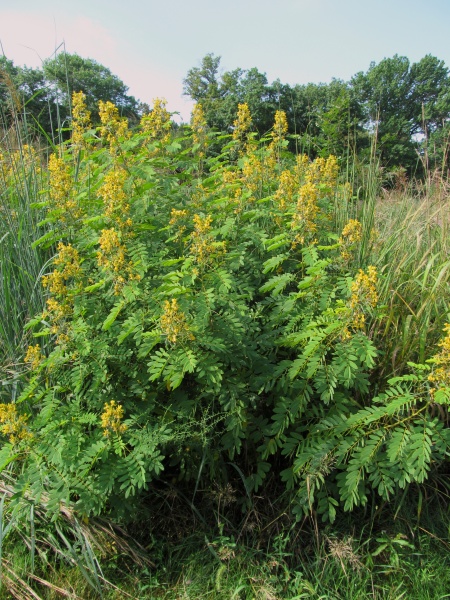
Plant Names

Senna hebecarpa
Wild Senna
Casse à fruits velus
Synonyms
American senna
wild senna
casse sauvage
Plant Characteristics
Bloom Colour: Yellow
Bloom Period: Jul - Aug
Max Height: 5.0 feet
Max Width: 2.5 feet (spreads by rhizome)
Light Condition:
 More than 6 hours of direct sun a day
 More than 2 or 3 hours but less than 6 hours of direct sun a day
Soil conditions:
More than 2 or 3 hours but less than 6 hours of direct sun a day
Soil conditions:
 Tolerates medium soil condition
More than 6 hours of direct sun a day
More than 2 or 3 hours but less than 6 hours of direct sun a day
Tolerates medium soil condition
Lifespan:
Perennial
plants that will come back year after year
Gardener Experience:
 Does not spread uncontrollably
 Spreads by rhizome
 Easy to germinate
 Self-seeding
Does not spread uncontrollably
Spreads by rhizome
Easy to germinate
Self-seeding
Landscape Uses:
 Suitable for rain gardens
 Suitable for container garden
Suitable for rain gardens
Suitable for container garden
Ecological Benefits:
 Supports birds
 Fixes nitrogen in the soil
Supports birds
Fixes nitrogen in the soil
Tolerates:
 Deer resistant
 Rabbit resistant
 Tolerates limestone conditions
 Tolerates transplantation
Deer resistant
Rabbit resistant
Tolerates limestone conditions
Tolerates transplantation
Special Features and Considerations:
 This plant is endangered
This plant is endangered
Seed and plant distribution status
No seeds available for this plant.
We currently accept seeds for this plant
Fun Facts
Wild Senna belongs to the pea family. As a legume, it will fix nitrogen in the soil through nodules on its roots, and can be chopped and dropped as a fertilizer. It has very attractive foliage and light yellow to orange flowers with seed pods that turn dark brown in the fall and are a favourite of wild turkeys. It has upright, branching stems and attractive compound leaves made up of many oval leaflets. In mid to late summer, it produces showy clusters of bright yellow, five-petalled flowers, followed by long, dark seed pods. It is an excellent choice for a native border, meadow or the back of a perennial bed. It forms an upright clump and is generally well behaved. It tolerates a range of soil conditions but performs best with reliable moisture. Give it adequate space because mature plants can become quite large and bushy.
Plant Location
Distribution according to VASCAN
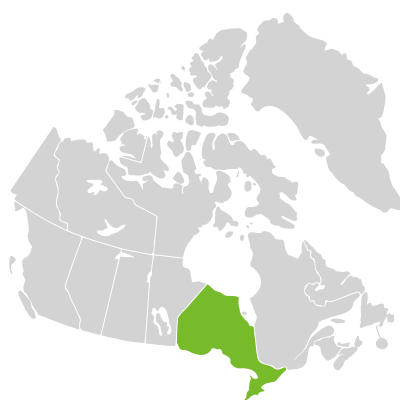
Ephemeral
Native
Introduced
Excluded
Extirpated
Doubtful
Absent
 Canadensis

Thrives in Ecozones
- Mixed Wood Plains
Ecological Benefits
Butterflies Supported by Senna hebecarpa
No butterfly data available for this plant.
Specialized Bees Supported by Senna hebecarpa
No bee data available for this plant.
Complementary Plants
- Agalinis tenuifolia
Slender-leaved False Foxglove
Gérardie à feuilles ténues - Astragalus canadensis
Canada Milk-vetch
Astragale du Canada - Bouteloua curtipendula
Side-oats Grama
Grand boutelou - Verbena simplex
Narrow-leaved Vervain
Verveine simple - Zizia aurea
Golden Alexanders
Zizia doré
Substitute For Non-Native Plants
- Oenothera (Non-Native Primrose)
- Oenothera biennis (Evening Primrose Cultivars)
- Oenothera fructicosa (Sundrops Cultivars)
- Helianthus (Non-Native Sunflower)
- NA (Black Eyed Susan's Cultivars)
- Rudbeckia Triloba (Brown Eyed Susan's)
- NA (Non-native False Sunflower)
Sowing Information
Download Seed Envelope Labels (PDF)
- Sowing depth: Sow just below surface
- Sow anytime
- Stratification duration: 10 days
- Self-seeding
- Notes: Needs scarification if started in the fridge.
Harvesting and Seed Sharing
- Harvest start month: September
- Harvesting indicator:
- Pods are brown, seeds are dark, and crisp, and little stem connecting the pod to the main stem is brown (not green)
- Harvesting:
- Open the pod, remove seeds
- Seed viability test:
- No test needed before donating
- Packaging measure: A dozen (12) seeds (eyeball)
- Seed storage:
- Air dry in paper bag or open container, for a few days until crisp
- Shake seeds to move them once in a while to prevent molding
- Cultivar: No, you can donate without knowing the source as there are only straight species
- No harvesting video available at this time.
Toxicity Notes
The leaves, seeds and pods contain compounds that can have a strong laxative effect and should not be eaten.