Notice: We do not accept seeds that were given before 2025 as they were in fact Blue Vervain (Verbena hastata).
Plant Names

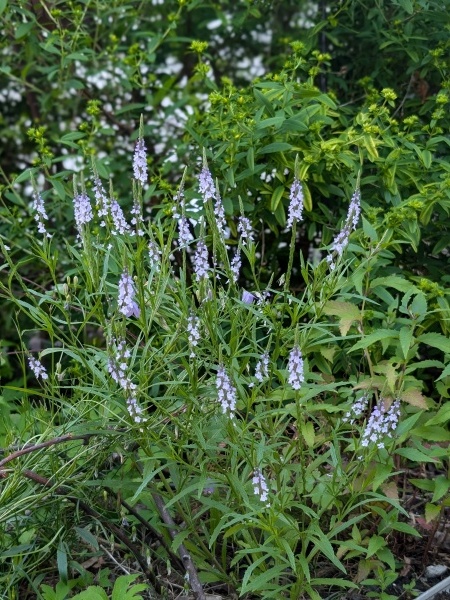
Verbena simplex
Narrow-leaved Vervain
Verveine simple
Synonyms
simple vervain
Plant Characteristics
Bloom Colour: White
Bloom Period: Jun - Aug
Max Height: 2.0 feet
Max Width: 2.0 feet (spreads by rhizome)
Light Condition:
 More than 6 hours of direct sun a day
Soil conditions:
 Tolerates dry soil condition
More than 6 hours of direct sun a day
Tolerates dry soil condition
Lifespan:
Perennial
plants that will come back year after year
Gardener Experience:
 Spreads by rhizome
 Easy to germinate
 Self-seeding
Spreads by rhizome
Easy to germinate
Self-seeding
Landscape Uses:
 Suitable for rock gardens
 Suitable for Right of Way gardens
 Suitable for container garden
 Suitable for school gardens
 Tolerates boulevard garden conditions
Suitable for rock gardens
Suitable for Right of Way gardens
Suitable for container garden
Suitable for school gardens
Tolerates boulevard garden conditions
Ecological Benefits:
 Supports pollinators
 Butterfly host
Supports pollinators
Butterfly host
Tolerates:
 Tolerates limestone conditions
 Tolerates sandy conditions
 Tolerates transplantation
Tolerates limestone conditions
Tolerates sandy conditions
Tolerates transplantation
Special Features and Considerations:
 This plant causes skin rashes
Seed and plant distribution status
Seeds in stock
Available at table Full Sun
Available at table Full Sun
We currently accept seeds for this plant
Fun Facts
Narrow-leaved Vervain forms tidy clumps of narrow, grass-like blue-green leaves. In late spring and early summer, it produces small, vivid blue to violet flowers with yellow centres. Despite its grass-like appearance, it is actually a member of the iris family (Iridaceae). It naturally grows in meadows, open woodlands, clearings, moist prairies, and grassy areas. It prefers average to moist, well-drained soil. It is an excellent choice for the front of a native border, meadow, or naturalized lawn. It forms neat clumps and is generally well behaved. Avoid planting it in areas that remain soggy year-round. It can go somewhat dormant during periods of summer heat or drought and return when conditions improve.
Plant Location
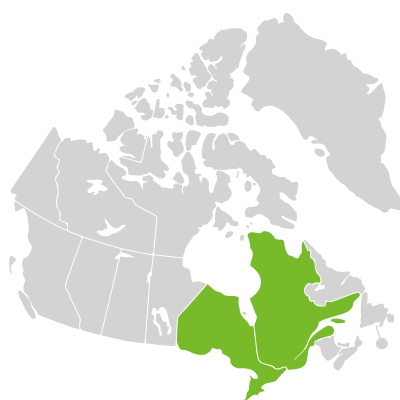
Native to Ottawa region: Yes
Distribution according to VASCAN
Ephemeral
Native
Introduced
Excluded
Extirpated
Doubtful
Absent
 Canadensis

Thrives in Ecozones
- Boreal Shield
- Mixed Wood Plains
Ecological Benefits
Butterflies Supported by Verbena simplex
-
Crambodes talidiformis
Verbena -
Endothenia hebesana
Verbena Bud
Specialized Bees Supported by Verbena simplex
No bee data available for this plant.
Complementary Plants
- Agalinis tenuifolia
Slender-leaved False Foxglove
Gérardie à feuilles ténues - Astragalus canadensis
Canada Milk-vetch
Astragale du Canada - Bouteloua curtipendula
Side-oats Grama
Grand boutelou - Senna hebecarpa
Wild Senna
Casse à fruits velus - Zizia aurea
Golden Alexanders
Zizia doré
Substitute For Non-Native Plants
- Sorbaria sorbifolia (False spirea)
- Aruncus dioicus (Goat's Beard)
- Lamium (Dead nettle)
- Astilbe (Astilbe)
- Lavandula (Lavender)
- Hesperis matronalis (Dame Rocket)
- Liatris (Blazing Star Cultivar)
Sowing Information
Download Seed Envelope Labels (PDF)
- Sowing depth: Surface sow
- Sow by March
- Stratification duration: 30 days
- Self-seeding
Harvesting and Seed Sharing
- Harvest start month: August
- Harvesting indicator:
- Pods are brown, seeds are dark, and crisp, and little stem connecting the pod to the main stem is brown (not green)
- Harvesting:
- Shake seed head in paper bag
- Seed viability test:
- No test needed before donating
- Packaging measure: 1 rounded 1/8 teaspoon
- Seed storage:
- Air dry in paper bag or open container, for a few days until crisp
- Shake seeds to move them once in a while to prevent molding
- Cultivar: No, you can donate without knowing the source as there are only straight species
- Harvesting notes: Please note that in 2025, we partly distributed Blue Vervain (Verbena hastata) instead of Narrow-Leaved Vervain (Verbena simplex). Please check your plants before donating. Thanks!
- Harvesting video: Watch here
Toxicity Notes
Inadequate information on toxicity found.