 Known to be toxic - The plant contains irritating alkaloids and should not be eaten. The yellow-orange sap can irritate skin and eyes. Keep away from children and pets that may chew plants.
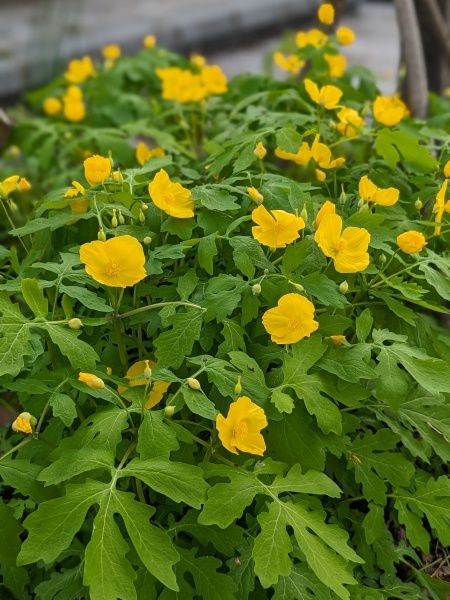
Source: Donna Bos
Plant Names

Stylophorum diphyllum
Wood Poppy
Stylophore à deux feuilles
Synonyms
celandine-poppy
mock poppy
yellow poppy
Plant Characteristics
Bloom Colour: Yellow
Bloom Period: Apr - May
Max Height: 1.0 feet
Max Width: 1.0 feet (spreads by rhizome)
Light Condition:
 Less than 2 or 3 hours of direct sun a day
Soil conditions:
Less than 2 or 3 hours of direct sun a day
Soil conditions:
 Tolerates medium soil condition
Less than 2 or 3 hours of direct sun a day
Tolerates medium soil condition
Lifespan:
Perennial
plants that will come back year after year
Gardener Experience:
 Suitable for beginner gardeners
 Does not spread uncontrollably
 Spreads by rhizome
 Easy to germinate
 Self-seeding
Suitable for beginner gardeners
Does not spread uncontrollably
Spreads by rhizome
Easy to germinate
Self-seeding
Landscape Uses:
 Suitable for container garden
 Suitable for woodland gardens
Suitable for container garden
Suitable for woodland gardens
Ecological Benefits:
 Bee host
Bee host
Tolerates:
 Deer resistant
 Rabbit resistant
 Tolerates limestone conditions
 Tolerates transplantation
Deer resistant
Rabbit resistant
Tolerates limestone conditions
Tolerates transplantation
Special Features and Considerations:
 This plant is endangered
This plant is endangered
Seed and plant distribution status
No seeds available for this plant.
We currently accept seeds for this plant
Fun Facts
Wood Poppy has bright yellow, poppy-like flowers appearing in spring. It has attractive blue-green foliage and can continue flowering intermittently into summer when conditions are favourable. It grows naturally in rich, deciduous forests and moist woodland slopes. Allow it to spread naturally where space permits. It goes dormant during dry conditions or later in summer. It benefits from leaf mulch and rich woodland soil. Disturb established plants as little as possible.
Plant Location
Distribution according to VASCAN
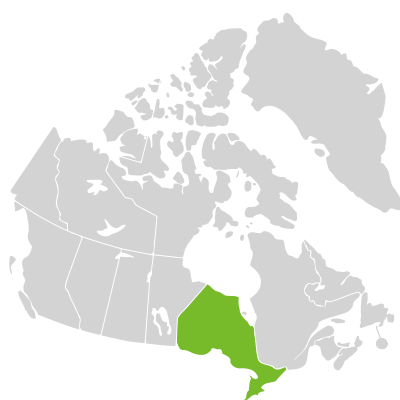
Ephemeral
Native
Introduced
Excluded
Extirpated
Doubtful
Absent
 Canadensis

Thrives in Ecozones
- Mixed Wood Plains
Ecological Benefits
Butterflies Supported by Stylophorum diphyllum
No butterfly data available for this plant.
Specialized Bees Supported by Stylophorum diphyllum
No bee data available for this plant.
Complementary Plants
- Aquilegia canadensis
Red Columbine
Ancolie du Canada - Asarum canadense
Canada Wild Ginger
Asaret du Canada - Hepatica acutiloba
Sharp-lobed Hepatica
Hépatique à lobes aigus - Hepatica americana
Round-lobed Hepatica
Hépatique d’Amérique - Phlox divaricata
Wild Blue Phlox
Phlox divariqué
Substitute For Non-Native Plants
- Oenothera (Non-Native Primrose)
- Oenothera biennis (Evening Primrose Cultivars)
- Oenothera fructicosa (Sundrops Cultivars)
- Helianthus (Non-Native Sunflower)
- NA (Black Eyed Susan's Cultivars)
- Rudbeckia Triloba (Brown Eyed Susan's)
- Echinacea (Coneflowers)
- NA (Coreopsis cultivars)
- NA (Non-native False Sunflower)
Sowing Information
Download Seed Envelope Labels (PDF)
- Sowing depth: Sow just below surface
- Sow anytime
- Stratification duration: 0 days
- Self-seeding
- Notes: Double dormancy. Sow promptly. Can be kept in fridge up to 2 months.
Harvesting and Seed Sharing
- Harvest start month: June
- Harvesting indicator:
- Pods are open
- Harvesting:
- Open the pod, remove seeds
- Seed viability test:
- No test needed before donating
- Packaging measure: 1 rounded 1/8 teaspoon
- Seed storage:
- Keep moist and cool, in a ziploc bag, in the fridge, with the seeds in soil, paper towel or coffee filter, until donation
- Cultivar: No, you can donate without knowing the source as there are only straight species
- Remove non-seed material
- Harvesting video: Watch here
Toxicity Notes
The plant contains irritating alkaloids and should not be eaten. The yellow-orange sap can irritate skin and eyes. Keep away from children and pets that may chew plants.