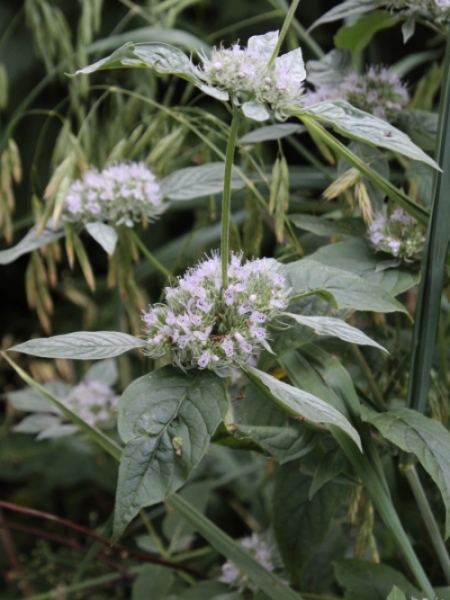
Source: Sundaura Alford-Purvis
Pycnanthemum verticillatum var. pilosum
Pycnanthemum verticillatum var. pilosum
Plant Names

Pycnanthemum verticillatum var. pilosum
Hairy Mountain-mint
Pycnanthème poilu
Plant Characteristics
Bloom Colour: White
Bloom Period: Jul - Aug
Max Height: 3.0 feet
Max Width: 2.0 feet (spreads by rhizome)
Light Condition:
 More than 6 hours of direct sun a day
 More than 2 or 3 hours but less than 6 hours of direct sun a day
Soil conditions:
More than 2 or 3 hours but less than 6 hours of direct sun a day
Soil conditions:
 Tolerates dry soil condition
 Tolerates medium soil condition
More than 6 hours of direct sun a day
More than 2 or 3 hours but less than 6 hours of direct sun a day
Tolerates dry soil condition
Tolerates medium soil condition
Lifespan:
Perennial
plants that will come back year after year
Gardener Experience:
 Spreads by rhizome
Spreads by rhizome
Landscape Uses:
No landscape information available.
Ecological Benefits:
 Supports birds
Supports birds
Tolerates:
 Tolerates drought conditions
 Deer resistant
Tolerates drought conditions
Deer resistant
Special Features and Considerations:
 This plant is endangered
This plant is endangered
Seed and plant distribution status
No seeds available for this plant.
We currently accept seeds for this plant
Fun Facts
Hairy Mountain-mint is similar to whorled mountain mint but has slightly hairier foliage and stems. It performs well in sunny meadows, prairie gardens, and open woodlands with average to moist soils. It forms expanding colonies and is drought tolerant after establishment. It is an excellent pollinator plant.
Plant Location
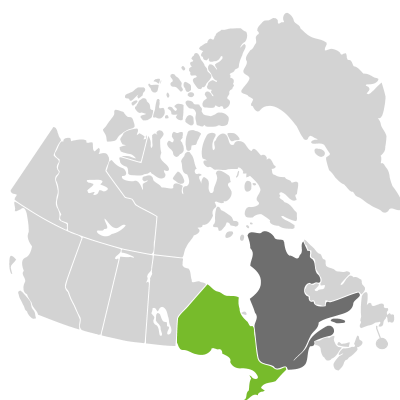
Distribution according to VASCAN
Ephemeral
Native
Introduced
Excluded
Extirpated
Doubtful
Absent
 Canadensis
Thrives in Ecozones
- Mixed Wood Plains
Ecological Benefits
Butterflies Supported by Pycnanthemum verticillatum var. pilosum
No butterfly data available for this plant.
Specialized Bees Supported by Pycnanthemum verticillatum var. pilosum
No bee data available for this plant.
Complementary Plants
- Anaphalis margaritacea
Pearly Everlasting
Immortelle blanche - Asclepias incarnata
Swamp Milkweed
Asclépiade incarnate - Asclepias syriaca
Common Milkweed
Asclépiade commune - Asclepias tuberosa
Butterfly Milkweed
Asclépiade tubéreuse - Asclepias verticillata
Whorled Milkweed
Asclépiade verticillée - Coreopsis lanceolata
Lance-leaved Coreopsis
Coréopsis lancéolé - Hypericum ascyron subsp. pyramidatum
American Great St. John’s-wort
Millepertuis pyramidal - Hypericum fraseri
Fraser's St. John's-wort
Millepertuis de Fraser - Hypericum kalmianum
Kalm's St. John's-wort
Millepertuis de Kalm - Hypericum majus
Large St. John's-wort
Millepertuis majeur - Hypericum prolificum
Shrubby St. John's-wort
Millepertuis prolifère - Prunella vulgaris var. lanceolata
Lance-leaved Self-heal
Brunelle commune - Pycnanthemum incanum
Hoary Mountain-mint
Pycnanthème gris - Pycnanthemum tenuifolium
Slender Mountain-mint
Pycnanthème à feuilles étroites - Pycnanthemum verticillatum
Whorled Mountain-mint
Pycnanthème verticillé - Pycnanthemum virginianum
Virginia Mountain-mint
Pycnanthème de Virginie
Substitute For Non-Native Plants
- Hydrangea (Hydrangea)
Sowing Information
Download Seed Envelope Labels (PDF)
- Sowing depth: Surface sow
- Sow anytime
- Stratification conditions: Can be sown in late spring in warm soil
- Stratification duration: 0 days
Harvesting and Seed Sharing
- Harvest start month: September
- Harvesting indicator:
- Pods are brown and slightly open
- Harvesting:
- Cut top edge then shake seeds off in bag or container with rock or equivalent
- Seed viability test:
- No test needed before donating
- Packaging measure: Half of 1/32 teaspoon
- Seed storage:
- None
- Cultivar: No, you can donate without knowing the source as there are only straight species
- Remove non-seed material
- No harvesting video available at this time.