 Known to be toxic - Berries are not considered highly poisonous but may cause stomach upset if eaten in quantity. Avoid consumption by children and pets.
Plant Names

Maianthemum racemosum
Large False-solomon's Seal
Smilacine à grappes
Plant Characteristics
Bloom Colour: White
Bloom Period: May - Jun
Max Height: 3.0 feet
Max Width: 2.0 feet (spreads by rhizome)
Light Condition:
 More than 2 or 3 hours but less than 6 hours of direct sun a day
 Less than 2 or 3 hours of direct sun a day
Soil conditions:
Less than 2 or 3 hours of direct sun a day
Soil conditions:
 Tolerates medium soil condition
More than 2 or 3 hours but less than 6 hours of direct sun a day
Less than 2 or 3 hours of direct sun a day
Tolerates medium soil condition
Lifespan:
Perennial
plants that will come back year after year
Gardener Experience:
 Spreads by rhizome
Spreads by rhizome
Landscape Uses:
 Suitable for woodland gardens
Suitable for woodland gardens
Ecological Benefits:
 Supports birds
Supports birds
Tolerates:
 Tolerates juglone conditions
Tolerates juglone conditions
Special Features and Considerations:
Seed and plant distribution status
No seeds available for this plant.
We currently accept seeds for this plant
Fun Facts
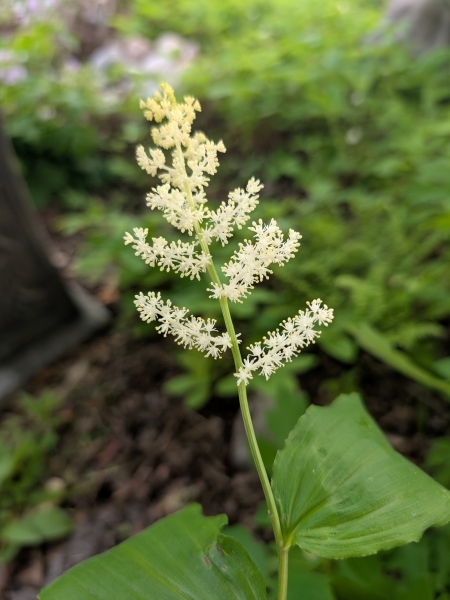
Large False Solomon’s Seal has arching stems lined with alternating leaves and topped with a plume-like cluster of small white flowers in late spring. After flowering, the plant produces clusters of berries that change from green to red as they mature. It grows naturally in rich deciduous forests and woodland edges. It prefers moist, organic-rich soil and is a reliable, long-lived woodland plant. It requires patience while establishing. It benefits from leaf mulch and woodland conditions. It can be divided in spring or fall once established.
Plant Location
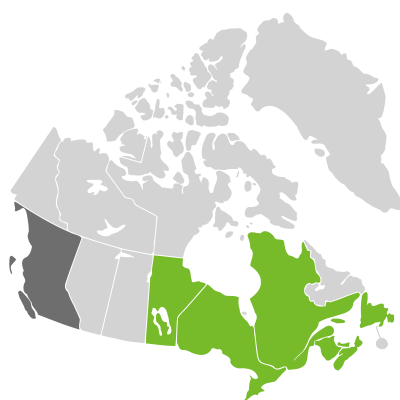
Native to Ottawa region: Yes
Distribution according to VASCAN
Ephemeral
Native
Introduced
Excluded
Extirpated
Doubtful
Absent
 Canadensis
Thrives in Ecozones
- Atlantic Maritime
- Boreal Plains
- Montane Cordillera
- Prairies
- Boreal Shield
- Pacific Maritime
- Mixed Wood Plains
Ecological Benefits
Butterflies Supported by Maianthemum racemosum
No butterfly data available for this plant.
Specialized Bees Supported by Maianthemum racemosum
No bee data available for this plant.
Complementary Plants
- Actaea pachypoda
White Baneberry
Actée à gros pédicelles - Actaea racemosa
Black Snakeroot
Cimicaire à grappes - Actaea rubra
Red Baneberry
Actée rouge - Clintonia borealis
Yellow Clintonia
Clintonie boréale
Substitute For Non-Native Plants
- Lonicera).1 (Non-Native Honeysuckle)
- Astilbe (Astilbe)
- Berberis (Barberry)
Sowing Information
Download Seed Envelope Labels (PDF)
- Sowing depth: Sow just below surface
- Sow anytime
- Stratification conditions: Keep moist in fridge
- Stratification duration: 2 years
- Double dormancy required
Harvesting and Seed Sharing
- Harvest start month: September
- Harvesting indicator:
- Berries are ripen and easily fall off or have fallen off
- Harvesting:
- Put berries through strainer to separate seeds, then rinse with water
- Seed viability test:
- No test needed before donating
- Packaging measure: 1 rounded 1/8 teaspoon
- Seed storage:
- Keep moist and cool, in a ziploc bag, in the fridge, with the seeds in soil, paper towel or coffee filter, until donation
- Cultivar: No, you can donate without knowing the source as there are only straight species
- No harvesting video available at this time.
Toxicity Notes
Berries are not considered highly poisonous but may cause stomach upset if eaten in quantity. Avoid consumption by children and pets.