 Connu comme étant toxique - Toxic to mammals if ingested.
Plant Names

Asarum canadense
Canada Wild Ginger
Asaret du Canada
Synonyms
wild ginger
asaret gingembre
gingembre sauvage
snicroûte
Plant Characteristics
Couleur de floraison: Rouge
Bloom Period: Apr - May
Hauteur max: 0,5 feet
Max Width: 1,0 feet (spreads by rhizome)
Light Condition:
 Less than 2 or 3 hours of direct sun a day
Soil conditions:
Less than 2 or 3 hours of direct sun a day
Soil conditions:
 Tolerates medium soil condition
Less than 2 or 3 hours of direct sun a day
Tolerates medium soil condition
Lifespan:
Vivace
des plantes qui reviennent année après année
(Spring Ephemeral)
Gardener Experience:
 Ne se propage pas de manière incontrôlable
 Spreads by rhizome
Ne se propage pas de manière incontrôlable
Spreads by rhizome
Landscape Uses:
 Suitable for Right of Way gardens
 Suitable for container garden
 Suitable for woodland gardens
 Tolerates boulevard garden conditions
Suitable for Right of Way gardens
Suitable for container garden
Suitable for woodland gardens
Tolerates boulevard garden conditions
Ecological Benefits:
No ecological benefits information available.
Tolerates:
 Deer resistant
 Rabbit resistant
 Tolerates limestone conditions
 Tolerates sandy conditions
 Tolerates juglone conditions
 Tolerates transplantation
Deer resistant
Rabbit resistant
Tolerates limestone conditions
Tolerates sandy conditions
Tolerates juglone conditions
Tolerates transplantation
Special Features and Considerations:
Seed and plant distribution status
No seeds available for this plant.
Nous acceptions les semences de cette plante
Faits intéressants
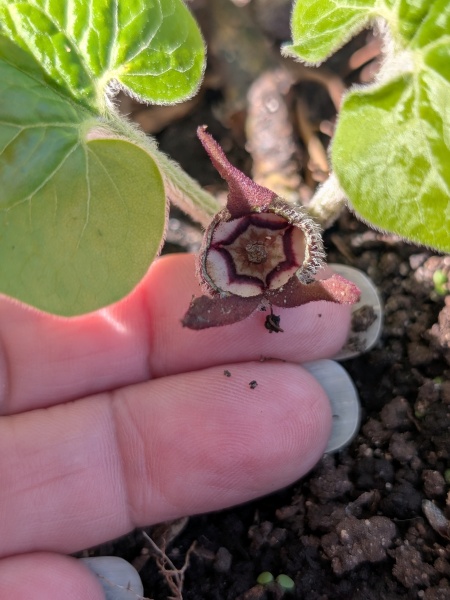
Canada Wild Ginger, is a low-growing native perennial commonly found in deciduous forests. It grows best in moist, rich, well-drained soil and spreads slowly by underground rhizomes, forming an attractive groundcover in woodland gardens. In spring, it produces a small, reddish-brown flower hidden beneath its heart-shaped leaves. While not showy, the plant supports certain specialist insects.
Plant Location
Native to Ottawa region: Oui
Distribution according to VASCAN
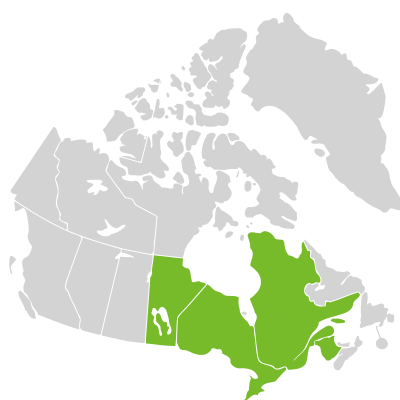
Ephemeral
Native
Introduced
Excluded
Extirpated
Doubtful
Absent
 Canadensis

Thrives in Ecozones
- Plaines boréales
- Bouclier boréal
- Plaines à forêts mixtes
Ecological Benefits
Butterflies Supported by Asarum canadense
No butterfly data available for this plant.
Specialized Bees Supported by Asarum canadense
No bee data available for this plant.
Complementary Plants
- Aquilegia canadensis
Red Columbine
Ancolie du Canada - Hepatica acutiloba
Sharp-lobed Hepatica
Hépatique à lobes aigus - Hepatica americana
Round-lobed Hepatica
Hépatique d’Amérique - Phlox divaricata
Wild Blue Phlox
Phlox divariqué - Stylophorum diphyllum
Wood Poppy
Stylophore à deux feuilles
Substitute For Non-Native Plants
- Ajuga reptans (Bugleweed)
- Convallaria majalis (Lily of the Valley)
- Pachysandra terminalis (Japanese Pachysandra)
- Funkia (Hosta)
- Vinca major and Vinca minor (Periwinkle)
Sowing Information
Download Seed Envelope Labels (PDF)
- Sowing depth: Couvrir très légèrement
- Sow anytime
- Stratification duration: 0 days
- Notes: Double dormancy. Sow promptly. Can be kept in fridge up to 2 months.
Harvesting and Seed Sharing
- Harvest start month: June
- Harvesting indicator:
- Pods are slightly open and seeds inside are dark
- Harvesting:
- Ouvrir la gousse, enlever les graines
- Seed viability test:
- Pas de test requis avant le don
- Packaging measure: 1 rounded 1/8 teaspoon
- Seed storage:
- Garder humide et frais, danssac refermable au frigo, avec graines dans de terre, papier essuie-tout, filtre à café ou vermiculite, jusqu'au don
- Cultivar: No, you can donate without knowing the source as there are only straight species
- Remove non-seed material
- No harvesting video available at this time.
Toxicity Notes
Toxic to mammals if ingested.