 Inconnu - Toxic to mammals if ingested.
Notice: Please note that in 2025, some seeds labeled Spotted Joe Pye Weed were in fact White Vervain. Please check your species before donating. Thanks!
Plant Names

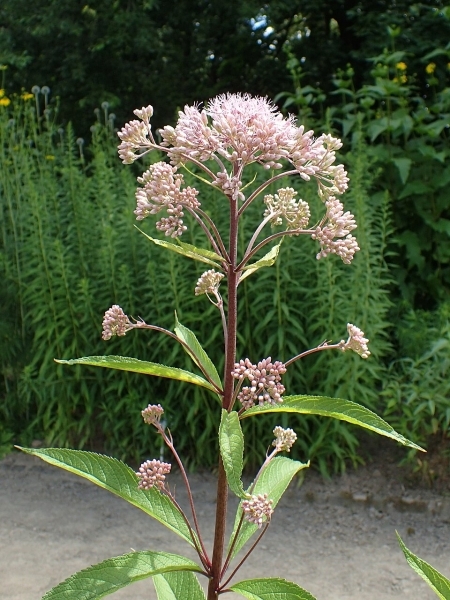
Eutrochium maculatum
Spotted Joe Pye Weed
Eupatoire maculée
Synonyms
eupatoire pourpre
Plant Characteristics
Couleur de floraison: Rose
Bloom Period: Jul - Sep
Hauteur max: 5,0 feet
Max Width: 4,0 feet (spreads by rhizome)
Light Condition:
 Plus de 6 heures d'ensoleillement par jour
 More than 2 or 3 hours but less than 6 hours of direct sun a day
Soil conditions:
More than 2 or 3 hours but less than 6 hours of direct sun a day
Soil conditions:
 Tolerates medium soil condition
Plus de 6 heures d'ensoleillement par jour
More than 2 or 3 hours but less than 6 hours of direct sun a day
Tolerates medium soil condition
Lifespan:
Vivace
des plantes qui reviennent année après année
Gardener Experience:
 Suitable for beginner gardeners
 Spreads by rhizome
 Self-seeding
Suitable for beginner gardeners
Spreads by rhizome
Self-seeding
Landscape Uses:
 Souhaitable dans les jardins de zone humide
 Suitable for rain gardens
 Suitable for shoreline rehabilitation
 Suitable for school gardens
Souhaitable dans les jardins de zone humide
Suitable for rain gardens
Suitable for shoreline rehabilitation
Suitable for school gardens
Ecological Benefits:
 Supports hummingbirds
 Butterfly host
 Keystone species
Supports hummingbirds
Butterfly host
Keystone species
Tolerates:
 Deer resistant
 Rabbit resistant
 Tolerates limestone conditions
 Tolerates sandy conditions
 Tolerates acidic soil conditions
 Tolerates juglone conditions
Deer resistant
Rabbit resistant
Tolerates limestone conditions
Tolerates sandy conditions
Tolerates acidic soil conditions
Tolerates juglone conditions
Special Features and Considerations:
Seed and plant distribution status
Semences disponible
Disponible à la table Mi-soleil, humide
Disponible à la table Mi-soleil, humide
Nous acceptions les semences de cette plante
Faits intéressants
Spotted Joe-Pye Weed has sturdy stems that are often marked with purple or reddish spots, giving the plant its common name. Large, domed clusters of dusty pink to mauve flowers appear from mid to late summer into fall. It is an excellent choice for a wet meadow, pond edge, or the back of a large native border. Its height makes it best suited to the back of a border or a naturalized planting. It generally forms sturdy clumps and is vigorous but not usually aggressive. Keep the soil consistently moist, particularly during establishment. It does not need rich soil. It can survive brief dry periods once established, but it performs best with reliable moisture.
Plant Location
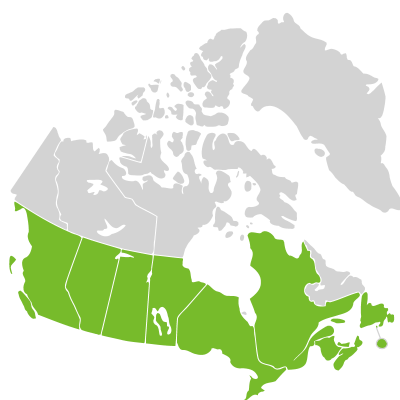
Native to Ottawa region: Oui
Distribution according to VASCAN
Ephemeral
Native
Introduced
Excluded
Extirpated
Doubtful
Absent
 Canadensis

Thrives in Ecozones
- Taïga des plaines
- Maritime de l'Atlantique
- Taïga du Bouclier
- Plaines boréales
- Cordillière montagnarde
- Prairies
- Bouclier boréal
- Maritime du Pacifique
- Plaines à forêts mixtes
Ecological Benefits
Butterflies Supported by Eutrochium maculatum
-
Schinia trifascia
Three lined flower
Specialized Bees Supported by Eutrochium maculatum
No bee data available for this plant.
Complementary Plants
- Agastache nepetoides
Yellow Giant Hyssop
Agastache faux-népéta - Eupatorium perfoliatum
Common Boneset
Eupatoire perfoliée - Lilium canadense
Canada Lily
Lis du Canada - Scirpus atrovirens
Dark-green Bulrush
Scirpe noirâtre - Verbena hastata
Blue Vervain
Verveine hastée
Substitute For Non-Native Plants
- Sorbaria sorbifolia (False spirea)
- Ajuga reptans (Bugleweed)
- Aegopodium podagraria (Goutweed)
- Thalictrum (Non-Native Meadow Rue)
- Symphiotrichum (Non-Native Aster)
Sowing Information
Download Seed Envelope Labels (PDF)
- Sowing depth: Surface sow
- Sow by March
- Stratification duration: 30 days
- Self-seeding
Harvesting and Seed Sharing
- Harvest start month: August
- Harvesting indicator:
- Seeds have become fluffy and can be easily removed by shaking on gently pulling off from stem
- Harvesting:
- Secouer le porte-graines dans un sac de papier
- Seed viability test:
- Pas de test requis avant le don
- Packaging measure: 1 rounded 1/4 teaspoon
- Seed storage:
- Sécher à l'air dans un sac en papier ou contenant ouvert, pour quelques jours jusqu'à sec
- Secouer de temps à autre pour prévenir la moisissure
- Cultivar: Yes, do not donate unless you know source, and there are no known cultivars in your garden or at proximity
- Harvesting video: Watch here
Toxicity Notes
Toxic to mammals if ingested.