 Connu comme étant toxique - Toxic! Fatal to cats. Highly toxic to cats. Even small amounts of pollen, leaves, flowers, or water from a vase can cause fatal kidney failure in cats. Low toxicity to dogs and people.
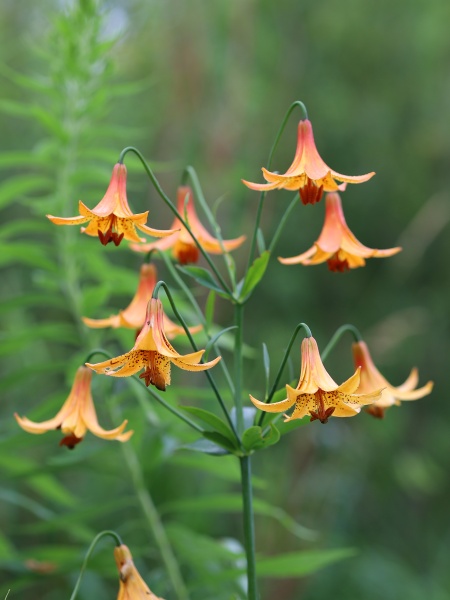
Source: Nichole Ouellette
Plant Names

Lilium canadense
Canada Lily
Lis du Canada
Plant Characteristics
Couleur de floraison: Orange
Bloom Period: Jun - Aug
Hauteur max: 8,0 feet
Max Width: 3,0 feet (spreads by rhizome)
Light Condition:
 Plus de 6 heures d'ensoleillement par jour
 More than 2 or 3 hours but less than 6 hours of direct sun a day
Soil conditions:
More than 2 or 3 hours but less than 6 hours of direct sun a day
Soil conditions:
 Tolerates medium soil condition
Plus de 6 heures d'ensoleillement par jour
More than 2 or 3 hours but less than 6 hours of direct sun a day
Tolerates medium soil condition
Lifespan:
Vivace
des plantes qui reviennent année après année
Gardener Experience:
 Ne se propage pas de manière incontrôlable
 Spreads by rhizome
Ne se propage pas de manière incontrôlable
Spreads by rhizome
Landscape Uses:
 Souhaitable dans les jardins de zone humide
 Suitable for school gardens
Souhaitable dans les jardins de zone humide
Suitable for school gardens
Ecological Benefits:
 Supports hummingbirds
 Butterfly host
Supports hummingbirds
Butterfly host
Tolerates:
 Tolerates juglone conditions
 Tolerates transplantation
Tolerates juglone conditions
Tolerates transplantation
Special Features and Considerations:
 This plant causes skin rashes
This plant causes skin rashes
Seed and plant distribution status
No seeds available for this plant.
Nous acceptions les semences de cette plante
Faits intéressants
Canada lily has graceful nodding yellow to orange flowers spotted with reddish-purple. Its tall stems make it a striking addition to woodland edges and naturalized landscapes. The large flowers attract hummingbirds, bumble bees, and other long-tongued native bees. The bulbs and seeds are occasionally eaten by small mammals.
Canada Lily is slow to establish but long-lived. It does not spread aggressively but may slowly form small colonies. You may want to protect it from deer, rabbits, and especially lily beetles where present. When possible, avoid disturbing established bulbs.
Canada Lily is slow to establish but long-lived. It does not spread aggressively but may slowly form small colonies. You may want to protect it from deer, rabbits, and especially lily beetles where present. When possible, avoid disturbing established bulbs.
Plant Location
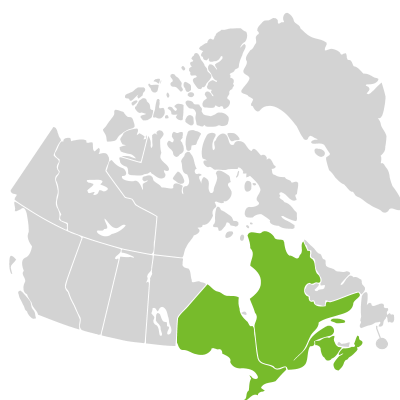
Distribution according to VASCAN
Ephemeral
Native
Introduced
Excluded
Extirpated
Doubtful
Absent
 Canadensis

Thrives in Ecozones
- Maritime de l'Atlantique
- Bouclier boréal
- Plaines à forêts mixtes
Ecological Benefits
Butterflies Supported by Lilium canadense
-
Euxoa messoria
Reaper dart -
Papaipema nebris
Stalk borer - Noctuelle à Taches En Grains
Specialized Bees Supported by Lilium canadense
No bee data available for this plant.
Complementary Plants
- Agastache nepetoides
Yellow Giant Hyssop
Agastache faux-népéta - Eupatorium perfoliatum
Common Boneset
Eupatoire perfoliée - Eutrochium maculatum
Spotted Joe Pye Weed
Eupatoire maculée - Scirpus atrovirens
Dark-green Bulrush
Scirpe noirâtre - Verbena hastata
Blue Vervain
Verveine hastée
Substitute For Non-Native Plants
- Iris pseudacorus (Yellow Iris)
- Iris (Iris Cultivars)
- Hyacinthus (Non-Native Hyacynth)
- Campanula (Non-native Bellflower)
- Petunia (Non-Native Petunias)
- Myosotis sylvatica (Forget-me-not)
- Lamprocapnos spectabilis (Bleeding hearts)
- Phlox subulata (Moss Phlox)
- Acer japonicum (Japanese Maple)
- Acer platanoides (Norway Maple)
- Lamium galeobdolon (Yellow Archangel)
- Buxus sempervirens (Boxwood)
- Forsythieae (Forsythia)
- Cirsium arvense (Canada Thistle)
- Clematis (Non-native Clematis)
- Lonicera).1 (Non-Native Honeysuckle)
- Hedera helix (English Ivy)
- Ipomoea (Morning Glories)
- Glechoma hederacea (Creeping Charlie)
- NA (Coreopsis cultivars)
- Hemerocallis (Daylily)
- Gaillardia (Blanket Flower)
- Elaeagnus angustifolia (Russian Olive)
- Elaeagnus umbellata (Autumn Olive)
- Anethum graveolens (Dill)
- Petroselinum crispum (Parsley)
- Diervilla (Non-Native Honeysuckle)
- Lonicera japonica (Japanese Honesuckle Vine)
- Impatiens glandulifera (Himalayan Balsam)
- Thalictrum (Non-Native Meadow Rue)
- Potentilla (Non-Native Potentilla)
- Leucanthemum (Shasta Daisy)
- Gerbera (Gerbera Daisy)
- NA (Non-native False Sunflower)
- Symphiotrichum (Non-Native Aster)
- Baptisia (False Indigo)
- Cotnius (Smokebush)
- Hibiscus (Non-Native Hibiscus)
- Astilbe (Astilbe)
- Impatiens balsamina (Impatiens Balsamina)
- Pachysandra terminalis).1 (Japanese Pachysandra)
- Berberis (Barberry)
- Canna (Lily)
- Juglans nigra (Black Walnut Cultivar)
- Chamaecyparis (False Cypress)
- Juniperus (Juniper Cultivar)
- Melilotus albus (Sweet White Clover)
- Lavandula (Lavender)
- Hesperis matronalis (Dame Rocket)
- Liatris (Blazing Star Cultivar)
Sowing Information
Download Seed Envelope Labels (PDF)
- Sowing depth: Couvrir très légèrement
- Sow anytime
- Stratification duration: 150 days
- Notes: Warm moist stratify 60d, then cold moist stratify 90d.
Harvesting and Seed Sharing
- Harvest start month: August
- Harvesting indicator:
- Pods are slightly open and seeds inside are dark
- Harvesting:
- Ouvrir la gousse, enlever les graines
- Seed viability test:
- Mettez les graines devant la lumière, si vous pouvez clairement voir que le milieu est opaque, vous pouvez donner
- Si le milieu est transparent, non
- Packaging measure: 1 rounded 1/32 teaspoon
- Seed storage:
- Sécher à l'air dans un sac en papier ou contenant ouvert, pour quelques jours jusqu'à sec
- Secouer de temps à autre pour prévenir la moisissure
- Cultivar: Yes, do not donate unless you know source, and there are no known cultivars in your garden or at proximity
- Remove non-seed material
- No harvesting video available at this time.
Toxicity Notes
Toxic! Fatal to cats. Highly toxic to cats. Even small amounts of pollen, leaves, flowers, or water from a vase can cause fatal kidney failure in cats. Low toxicity to dogs and people.