
 Inconnu - Toxic to mammals if ingested.
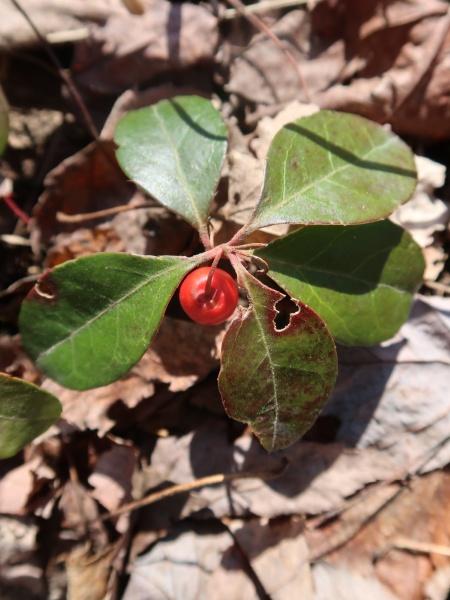
Plant Names

Gaultheria procumbens
Eastern Teaberry
Thé des bois
Synonyms
checkerberry
creeping wintergreen
eastern wintergreen
spring wintergreen
wintergreen
gaulthérie couchée
petit thé
pommes de terre
thé rouge
Plant Characteristics
Couleur de floraison: Blanc
Bloom Period: Jun - Jul
Hauteur max: 0,5 feet
Max Width: 1,0 feet (spreads by rhizome)
Light Condition:
 Less than 2 or 3 hours of direct sun a day
Soil conditions:
Less than 2 or 3 hours of direct sun a day
Soil conditions:
 Tolerates medium soil condition
Less than 2 or 3 hours of direct sun a day
Tolerates medium soil condition
Lifespan:
Vivace
des plantes qui reviennent année après année
Plant is
dioecious
Need a male and female plant to produce seeds
Gardener Experience:
 Ne se propage pas de manière incontrôlable
 Spreads by rhizome
Ne se propage pas de manière incontrôlable
Spreads by rhizome
Landscape Uses:
 Suitable for container garden
 Suitable for woodland gardens
Suitable for container garden
Suitable for woodland gardens
Ecological Benefits:
No ecological benefits information available.
Tolerates:
 Deer resistant
 Rabbit resistant
 Tolerates acidic soil conditions
 Tolerates juglone conditions
Deer resistant
Rabbit resistant
Tolerates acidic soil conditions
Tolerates juglone conditions
Special Features and Considerations:
 This plant is septic tank safe
This plant is septic tank safe
Seed and plant distribution status
No seeds available for this plant.
Nous acceptions les semences de cette plante
Faits intéressants
Eastern Teaberry has glossy leaves, white bell-shaped flowers, and bright red berries that persist through winter. It thrives in acidic, well-drained woodland soil and makes an attractive native groundcover. It is slow-growing but long-lived and is an excellent evergreen groundcover. Please avoid alkaline or heavily amended soils.
Plant Location
Native to Ottawa region: Oui
Distribution according to VASCAN
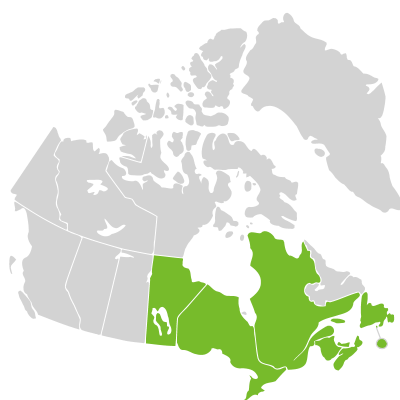
Ephemeral
Native
Introduced
Excluded
Extirpated
Doubtful
Absent
 Canadensis

Thrives in Ecozones
- Maritime de l'Atlantique
- Bouclier boréal
- Plaines à forêts mixtes
Ecological Benefits
Butterflies Supported by Gaultheria procumbens
No butterfly data available for this plant.
Specialized Bees Supported by Gaultheria procumbens
No bee data available for this plant.
Complementary Plants
- Anemone parviflora
Small-flowered Anemone
Anémone à petites fleurs - Erythronium albidum
White Trout Lily
Érythrone blanchâtre - Trillium erectum
Red Trillium
Trille rouge - Trillium grandiflorum
White Trillium
Trille blanc - Viola sororia
Woolly Blue Violet
Violette parente
Substitute For Non-Native Plants
- Ajuga reptans (Bugleweed)
- Convallaria majalis (Lily of the Valley)
- Lysimachia nummularia (Creeping Jenny)
- Iridaceae (Crocus)
- Scilla siberica (Siberian Squill)
- Salvia (Non-Native Sage)
- Vinca major and Vinca minor (Periwinkle)
Sowing Information
Download Seed Envelope Labels (PDF)
- Sowing depth: Surface sow
- Sow by January
- Stratification duration: 90 days
Harvesting and Seed Sharing
- Harvest start month: September
- Harvesting indicator:
- Berries are ripen and easily fall off or have fallen off
- Harvesting:
- Squeeze berries to extract seeds, wash with soapy water, rinse throroughly
- Seed viability test:
- Pas de test requis avant le don
- Packaging measure: A dozen (12) seeds (eyeball)
- Seed storage:
- Sécher à l'air dans un sac en papier ou contenant ouvert, pour quelques jours jusqu'à sec
- Secouer de temps à autre pour prévenir la moisissure
- Cultivar: Yes, do not donate unless you know source, and there are no known cultivars in your garden or at proximity
- No harvesting video available at this time.
Toxicity Notes
Toxic to mammals if ingested.