 Connu comme étant toxique - All parts of white trillium should be considered poisonous if eaten, particularly the roots and berries. Eating the plant can cause gastrointestinal upset and other symptoms.
Plant Names

Trillium grandiflorum
White Trillium
Trille blanc
Synonyms
great white trillium
large-flowered trillium
snow trillium
white wakerobin
trille à grande fleur
trille grandiflore
Plant Characteristics
Couleur de floraison: Blanc
Bloom Period: Apr - Jun
Hauteur max: 1,0 feet
Max Width: 1,2 feet (spreads by rhizome)
Light Condition:
 Less than 2 or 3 hours of direct sun a day
Soil conditions:
Less than 2 or 3 hours of direct sun a day
Soil conditions:
 Tolerates medium soil condition
Less than 2 or 3 hours of direct sun a day
Tolerates medium soil condition
Lifespan:
Vivace
des plantes qui reviennent année après année
(Spring Ephemeral)
Gardener Experience:
 Ne se propage pas de manière incontrôlable
 Spreads by rhizome
Ne se propage pas de manière incontrôlable
Spreads by rhizome
Landscape Uses:
 Suitable for woodland gardens
Suitable for woodland gardens
Ecological Benefits:
No ecological benefits information available.
Tolerates:
 Deer resistant
 Rabbit resistant
 Tolerates limestone conditions
 Tolerates juglone conditions
 Tolerates transplantation
Deer resistant
Rabbit resistant
Tolerates limestone conditions
Tolerates juglone conditions
Tolerates transplantation
Special Features and Considerations:
Seed and plant distribution status
No seeds available for this plant.
Nous acceptions les semences de cette plante
Faits intéressants
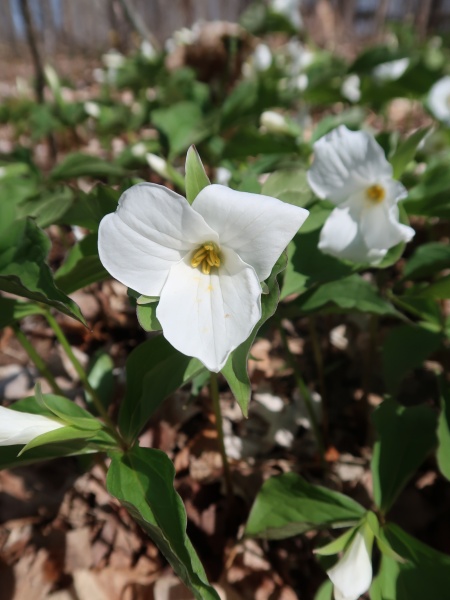
White Trillium forms a single stem topped with three broad, green leaves and one large, three-petalled white flower. The flowers appear in spring, often fading to pink or rose as they age. After flowering, a green berry develops and eventually matures. It is an excellent choice for a native woodland or shade garden. It is very slow to establish, particularly when grown from seed.
Once established, it can form beautiful colonies over many years. Keep soil evenly moist, especially while plants are establishing. A layer of naturally decomposing leaves is beneficial and helps replicate woodland conditions.
White Trilium should not be disturbed; their underground rhizomes can be damaged easily. Do not cut the foliage while it is still green. The leaves need to remain attached after flowering so the plant can replenish its underground food reserves. The plant naturally goes dormant in early to mid-summer. This is normal. Mark its location so that it isn't accidentally dug up after the foliage disappears. Plants grown from seed can take several years to reach flowering size, so patience is essential.
Once established, it can form beautiful colonies over many years. Keep soil evenly moist, especially while plants are establishing. A layer of naturally decomposing leaves is beneficial and helps replicate woodland conditions.
White Trilium should not be disturbed; their underground rhizomes can be damaged easily. Do not cut the foliage while it is still green. The leaves need to remain attached after flowering so the plant can replenish its underground food reserves. The plant naturally goes dormant in early to mid-summer. This is normal. Mark its location so that it isn't accidentally dug up after the foliage disappears. Plants grown from seed can take several years to reach flowering size, so patience is essential.
Plant Location
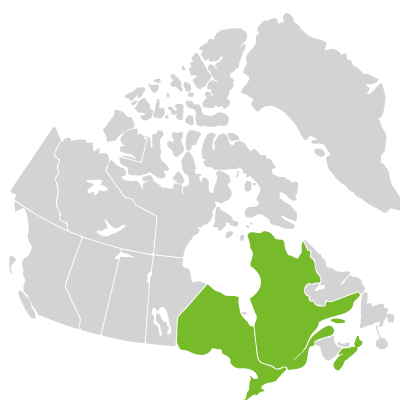
Native to Ottawa region: Oui
Distribution according to VASCAN
Ephemeral
Native
Introduced
Excluded
Extirpated
Doubtful
Absent
 Canadensis

Thrives in Ecozones
- Plaines boréales
- Plaines à forêts mixtes
Ecological Benefits
Butterflies Supported by Trillium grandiflorum
-
Crambodes talidiformis
Verbena -
Euplexia benesimilis
American Angle Shades
Specialized Bees Supported by Trillium grandiflorum
No bee data available for this plant.
Complementary Plants
- Anemone parviflora
Small-flowered Anemone
Anémone à petites fleurs - Erythronium albidum
White Trout Lily
Érythrone blanchâtre - Gaultheria procumbens
Eastern Teaberry
Thé des bois - Trillium erectum
Red Trillium
Trille rouge - Viola sororia
Woolly Blue Violet
Violette parente
Substitute For Non-Native Plants
- Plantago (Non-Native Plantain)
- Lamium (Dead nettle)
- Ajuga reptans (Bugleweed)
- Lysimachia nummularia (Creeping Jenny)
- Iridaceae (Crocus)
- Scilla siberica (Siberian Squill)
- Salvia (Non-Native Sage)
- Hyacinthus (Non-Native Hyacynth)
- Petunia (Non-Native Petunias)
- Myosotis sylvatica (Forget-me-not)
- Phlox subulata (Moss Phlox)
Sowing Information
Download Seed Envelope Labels (PDF)
- Sowing depth: Couvrir très légèrement
- Sow anytime
- Stratification duration: 0 days
- Notes: Double dormancy.
Harvesting and Seed Sharing
- Harvest start month: July
- Harvesting indicator:
- Berries are ripen and easily fall off or have fallen off
- Harvesting:
- Squeeze berries to extract seeds, wash with soapy water, rinse throroughly
- Seed viability test:
- Pas de test requis avant le don
- Packaging measure: Six (6) seeds (eyeball)
- Seed storage:
- Garder humide et frais, danssac refermable au frigo, avec graines dans de terre, papier essuie-tout, filtre à café ou vermiculite, jusqu'au don
- Cultivar: Yes, do not donate unless you know source, and there are no known cultivars in your garden or at proximity
- No harvesting video available at this time.
Toxicity Notes
All parts of white trillium should be considered poisonous if eaten, particularly the roots and berries. Eating the plant can cause gastrointestinal upset and other symptoms.