Plant Names

Erythronium albidum
White Trout Lily
Érythrone blanchâtre
Synonyms
small white fawn lily
white adder's-tongue
white dog's-tooth violet
Plant Characteristics
Bloom Colour: White
Bloom Period: Apr - Apr
Max Height: 1.0 feet
Max Width: 0.5 feet (spreads by rhizome)
Light Condition:
 Less than 2 or 3 hours of direct sun a day
Soil conditions:
Less than 2 or 3 hours of direct sun a day
Soil conditions:
 Tolerates medium soil condition
Less than 2 or 3 hours of direct sun a day
Tolerates medium soil condition
Lifespan:
Perennial
plants that will come back year after year
(Spring Ephemeral)
Gardener Experience:
 Does not spread uncontrollably
 Spreads by rhizome
Does not spread uncontrollably
Spreads by rhizome
Landscape Uses:
 Suitable for container garden
 Suitable for woodland gardens
Suitable for container garden
Suitable for woodland gardens
Ecological Benefits:
 Bee host
Bee host
Tolerates:
 Deer resistant
 Rabbit resistant
 Tolerates juglone conditions
Deer resistant
Rabbit resistant
Tolerates juglone conditions
Special Features and Considerations:
 This plant causes skin rashes
This plant causes skin rashes
Seed and plant distribution status
No seeds available for this plant.
We currently accept seeds for this plant
Fun Facts
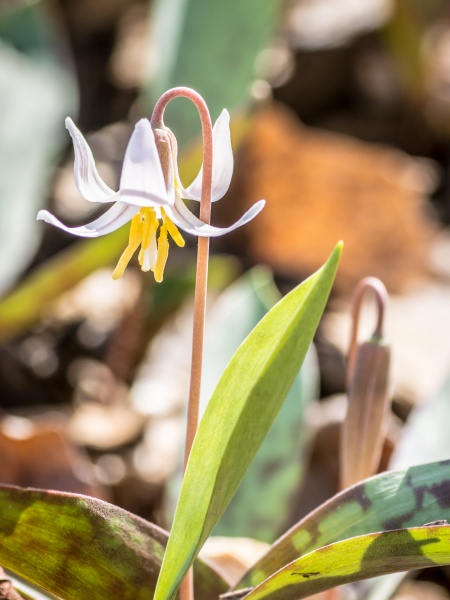
White Trout Lily has mottled green leaves and nodding white flowers marked with yellow at the centre. It emerges early in spring, flowers briefly, and then disappears underground for the remainder of the growing season. It grows naturally in rich deciduous woods and floodplain forests. It prefers partial to full shade and moist, well-drained, humus-rich soil. It is a wonderful choice for a naturalistic woodland garden. It can take several years to establish from seed. It spreads slowly through underground bulbs and offsets. It is best left undisturbed once planted. You can plant it beneath deciduous trees where spring sunlight reaches the ground before the tree canopy fills in. Avoid hot, dry garden locations.
Plant Location
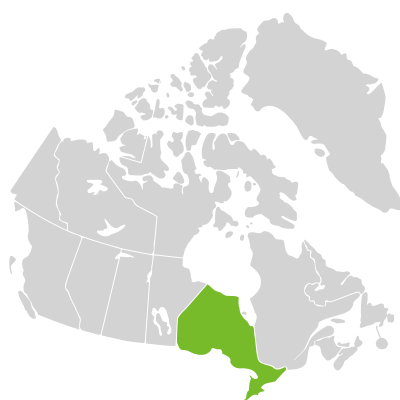
Distribution according to VASCAN
Ephemeral
Native
Introduced
Excluded
Extirpated
Doubtful
Absent
 Canadensis

Thrives in Ecozones
- Boreal Plains
- Mixed Wood Plains
Ecological Benefits
Butterflies Supported by Erythronium albidum
No butterfly data available for this plant.
Specialized Bees Supported by Erythronium albidum
- Andrena erythronii
Complementary Plants
- Anemone parviflora
Small-flowered Anemone
Anémone à petites fleurs - Gaultheria procumbens
Eastern Teaberry
Thé des bois - Trillium erectum
Red Trillium
Trille rouge - Trillium grandiflorum
White Trillium
Trille blanc - Viola sororia
Woolly Blue Violet
Violette parente
Substitute For Non-Native Plants
- Convallaria majalis (Lily of the Valley)
- Lysimachia nummularia (Creeping Jenny)
- Iridaceae (Crocus)
- Scilla siberica (Siberian Squill)
- Tulipa (Tulips)
- Funkia (Hosta)
- Vinca major and Vinca minor (Periwinkle)
Sowing Information
Download Seed Envelope Labels (PDF)
- Sowing depth: Sow just below surface
- Sow anytime
- Stratification duration: 0 days
- Notes: Double dormancy.
Harvesting and Seed Sharing
- Harvest start month: June
- Harvesting indicator:
- Pods are brown and slightly open
- Harvesting:
- Open the pod, remove seeds
- Seed viability test:
- No test needed before donating
- Packaging measure: Six (6) seeds (eyeball)
- Seed storage:
- Keep moist and cool, in a ziploc bag, in the fridge, with the seeds in soil, paper towel or coffee filter, until donation
- Cultivar: Yes, do not donate unless you know source, and there are no known cultivars in your garden or at proximity
- Remove non-seed material
- No harvesting video available at this time.
Toxicity Notes
Not known to be toxic to cats or dogs if ingested. Bulbs and other plant parts should not be eaten. Consumption can cause gastrointestinal upset and may be harmful to pets and livestock.